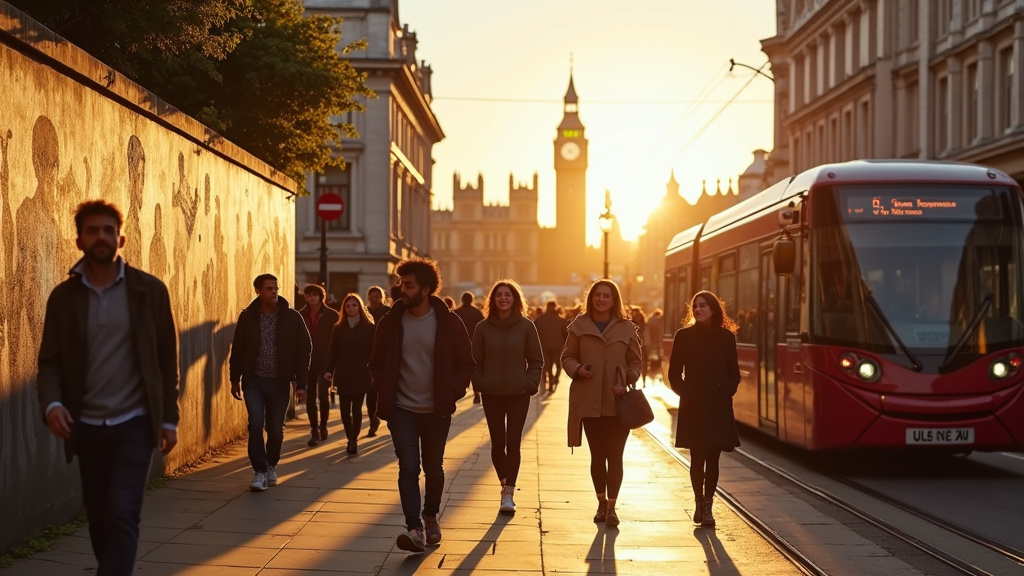
A prevailing narrative paints London as a city in decline, often speaking of rampant crime and urban decay. However, recent data on **London Crime Rates** tells a very different, more positive story, contrasting sharply with this bleak depiction. Understanding current **London Crime Rates** is crucial, as many key indicators show London is thriving.
London Crime Rates Show Significant Declines in Violent Crime
Official figures reveal a notable drop in serious crime. **London Crime Rates**, specifically the homicide rate, have fallen to their lowest point in over a decade. In 2025, the Metropolitan police recorded 97 homicides, a significant decrease from 153 in 2019. The homicide rate is now lower than many other major global cities; for example, it’s significantly less than New York or Los Angeles. Police officials attribute this to a “public health” approach to managing **London Crime Rates**. Furthermore, violent crime resulting in injury also saw a decrease. Knife crime offences have also fallen, and hospital admissions for knife assaults have dropped considerably. These **London crime statistics** counter the idea of an uncontrollable crime wave. Even bike thefts have decreased substantially over the past 15 years, further improving **London Crime Rates**.
Cleaner Air Greets Londoners Amid London Safety Improvements
London’s air quality has seen dramatic improvements, a positive aspect often overlooked when discussing **London Crime Rates**. Since 2016, air pollution levels have fallen significantly. Average nitrogen dioxide (NO2) concentrations dropped by nearly half between 2016 and 2023, a steeper fall than in the rest of England. The expansion of the Ultra Low Emission Zone (ULEZ) is a key driver of this change, contributing to **London safety improvements**. More than 95% of vehicles in London now meet ULEZ standards. Consequently, fewer hours have exceeded legal air pollution limits. In fact, 2023 saw the lowest recorded annual NO2 levels, demonstrating the **London ULEZ impact**. Particulate matter (PM2.5) also met WHO air quality targets at monitoring sites. This means cleaner air for millions of Londoners, with many deprived communities seeing significant benefits. These **London air quality** improvements contribute to an overall better living environment, impacting overall **London Crime Rates** positively.
London Cultural Attractions Remain a Global Draw
London’s vibrant culture continues to attract visitors worldwide, a strong indicator of **London economic growth**. Four out of five travellers cite “culture” as their main reason for visiting. Cultural tourism generates billions for the city’s economy and supports tens of thousands of jobs. Major attractions are seeing visitor numbers rise again. The British Museum, for instance, welcomed 6.5 million visitors in 2024. The Natural History Museum also saw 5.9 million visitors. International tourists are key drivers of this cultural tourism, visiting London’s world-class museums and galleries in large numbers. This cultural richness remains a strong draw for society, contributing to the city’s overall appeal beyond concerns about **London Crime Rates**.
London Population Trends and Economic Growth
London continues to attract new residents and investment, showing positive **London population trends**. The city’s population has grown, reaching nearly 8.8 million residents in 2021. Projections suggest London’s population could hit 10 million by the mid-2030s. This growth is driven by both natural increase and international migration, signaling confidence in London’s future and contributing to **London economic growth**. The city remains a hub for business and innovation. Reports highlight ongoing foreign investment. This ongoing growth paints a picture of a dynamic and attractive capital, far from a city in decline, and often improves **London safety improvements** through community investment, indirectly impacting **London Crime Rates**.
Countering Misinformation About London Crime Rates
The negative narrative surrounding London, particularly concerning **London Crime Rates**, is often amplified by social media, including AI-generated content and biased reporting. Politicians have also contributed to this “lawless London” perception. However, these claims are often exaggerated and do not align with official **London crime statistics**. While issues like phone-snatching persist, they do not define the city’s overall reality or the broader picture of **London Crime Rates**. The trending news often focuses on sensationalism, ignoring the substantial progress being made. **Countering London misinformation** is essential to present an accurate view. London remains a complex, evolving society. Its cultural heart beats strongly. Its environment is improving. Its safety metrics are positive, a testament to ongoing **London safety improvements**. The evidence clearly contradicts the exaggerated decline narrative surrounding **London Crime Rates**.
London’s ongoing success is a testament to its resilience. The city continues to adapt and thrive. Its commitment to improving air quality is evident. Its cultural scene remains world-leading. These facts present a compelling counter-narrative, showing a London that is moving forward. The news from London reflects this positive trend, including the steady improvement in **London Crime Rates**.