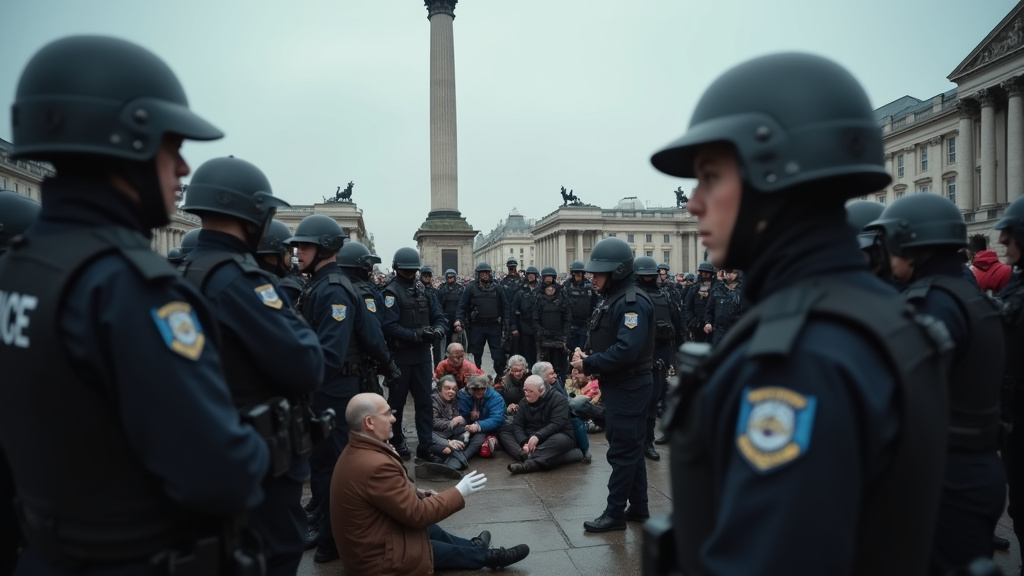
London, UK – October 5, 2025 – London’s Metropolitan Police made nearly 500 arrests on Saturday during a large pro-Palestinian demonstration in Trafalgar Square, a significant policing operation that unfolded amidst heightened national tensions following a deadly terrorist attack on a synagogue in Manchester just days prior. The protest, organized by Defend Our Juries, proceeded despite pleas from Prime Minister Keir Starmer and senior police officials urging organizers to postpone or cancel the event as a mark of respect for the victims and the grieving Jewish community.
Mass Arrests in Trafalgar Square
The demonstration saw approximately 1,000 people gather in central London to protest the UK government’s recent proscription of Palestine Action, a direct-action group that has been classified as a terrorist organization. Police reported a total of 492 arrests, with the vast majority – 488 individuals – detained for expressing support for Palestine Action, an act that has become a criminal offense since the group was banned under anti-terrorism laws in July 2025. The ages of those arrested ranged from 18 to 89, with many of the protesters remaining seated and refusing to move when instructed by officers, leading to them being carried away. Six arrests were also made earlier for unfurling a banner on Westminster Bridge in support of the banned group. The Metropolitan Police stated that 297 individuals remained in custody by Saturday night, with the remainder being bailed.
Context of Fear and Calls for Restraint
The timing of the London protest was particularly sensitive, occurring just two days after a fatal attack on a synagogue in Manchester, which claimed two lives and injured three others. In the wake of this atrocity, Prime Minister Keir Starmer issued a public appeal on social media, urging potential demonstrators to “recognize and respect the grief of British Jews” and emphasizing that it was a “moment of mourning,” not a time to “stoke tension and cause further pain.” Similar sentiments were echoed by Metropolitan Police Commissioner Sir Mark Rowley, who expressed concerns about the diversion of police resources and the potential for the protests to exacerbate community tensions.
Government Response: New Powers to Restrict Protests
In the aftermath of the weekend’s events, the UK government announced significant new measures aimed at strengthening police capabilities to manage and restrict future demonstrations. Home Secretary Shabana Mahmood stated that police forces would be granted enhanced powers to consider the “cumulative impact” of repeated protests on local areas when imposing conditions. This legislative change, to be introduced via amendments to Sections 12 and 14 of the Public Order Act 1986, would allow senior officers to instruct protest organizers to relocate events or alter their timing if a site has experienced prolonged or repeated disorder. Anyone breaching these new conditions would face arrest and prosecution. Mahmood highlighted the government’s commitment to balancing the fundamental right to protest with the need for all citizens, particularly religious communities, to feel safe and free from intimidation.
Protesters and Civil Liberties Groups Push Back
Organizers of the Trafalgar Square demonstration, Defend Our Juries, defended their actions, asserting that “cancelling peaceful protests lets terror win” and that their demonstration was a necessary stand against what they termed the government’s “absurdly authoritarian proscription of Palestine Action.” They also stated that their protests were not intended to be disrespectful to the victims of the Manchester attack but rather to highlight concerns about ongoing events and the restriction of democratic freedoms. Civil liberties organizations, including Amnesty International UK and Liberty, voiced strong criticism of the proposed new police powers. They argued that these measures would undermine fundamental rights, that police already possess extensive powers, and that the move represented a “dangerous step towards authoritarianism” and a “backlash to the ban.”
Palestine Action: A History of Direct Action
Palestine Action, the group in whose support Saturday’s demonstration was held, has a history of direct action since its founding in 2020. Its campaigns have frequently targeted companies supplying Israel’s military, leading to significant property damage at sites like Elbit Systems facilities and RAF Brize Norton. The group’s proscription in July 2025 followed actions such as vandalizing military aircraft, which the government cited as evidence of its involvement in terrorism. However, civil liberties advocates have criticized the proscription as conflating legitimate protest with terrorism, a stance that has led to numerous arrests at subsequent demonstrations.
Broader Societal Concerns
The events of the weekend underscore a period of heightened public division and concern in the UK. The Manchester synagogue attack has amplified fears regarding antisemitism and community safety, while pro-Palestinian protests have continued, drawing criticism for insensitivity and for occasions where chants have been perceived as antisemitic. As the government moves to implement new measures to control protest activity, the debate over balancing security, public order, and the fundamental right to free expression is set to intensify. This news story is currently trending, and many are watching to see how these new laws will shape the landscape of public dissent in the coming months. This is a developing story that continues to capture national attention, with further legal challenges and demonstrations anticipated.