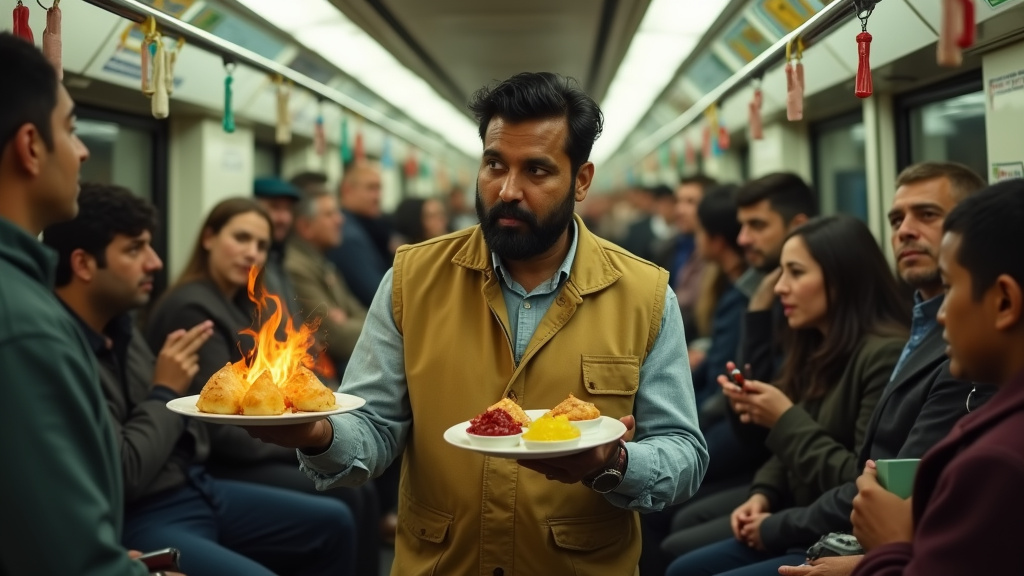
The **Samosa London Stunt** on the Tube has become an overnight sensation, capturing millions of views and igniting a lively debate about viral marketing tactics. This audacious presentation of Indian street food, specifically the famous Ghantawala Bihari Samosa, on the London Underground has certainly put the brand on the map, making it a talking point and a prime example of a memorable samosa viral stunt.
The Ambitious Samosa London Stunt: Ghantawala Bihari Samosa Takes the Tube.
Behind this extraordinary Samosa London Stunt is the owner of Ghantawala Bihari Samosa, a well-regarded Indian street food establishment with two London locations. The viral video depicts him navigating the London Underground with a loaded tray of steaming hot samosas, complete with mint and imli chutneys, proactively offering them to fellow passengers. His bold proclamation, “People here are no longer going to eat croissants. They will eat Bihari’s samosas,” perfectly encapsulates the spirit of this unique Samosa London Stunt. This particular tube food promotion aimed to disrupt established eating habits.
Unpacking the Samosa London Stunt Strategy.
The widely circulated footage strongly suggests meticulous planning for the Samosa London Stunt, with samosas evidently fried fresh before being brought onto the train. Filmed likely at South Harrow Underground Station, the predominantly Indian passenger demographic in the video led many to conclude it was a carefully orchestrated promotional reel, rather than an impromptu sales pitch. Given the general prohibition of vending food on Tube trains, the elaborate nature of this Samosa London Stunt further supports the notion of a deliberate, high-impact marketing campaign.
Public Opinion on the Samosa London Stunt: A Divided Response.
The narrative of the train vendor and his remarkable Samosa London Stunt quickly disseminated across social platforms, accumulating approximately 9.3 million views. The online reactions to this stunt were strikingly polarized. A considerable number of viewers expressed embarrassment, with many commenting on the potential negative implications for the community. Frequent sentiments included, “This made me uncomfortable,” and concerns that the Samosa London Stunt might reflect poorly on Indians. “Please don’t do this for sales,” pleaded one user, while another commented in Hindi, “Naam Kharab Kr Raha” (He is ruining the name), highlighting worries about the business’s methods. The Samosa London Stunt clearly stirred strong emotions, sparking a necessary cultural marketing debate.
Humor and the ‘Reverse Colonization’ Narrative in the Samosa London Stunt Discussion.
Conversely, not all responses to the Samosa London Stunt were negative. A segment of the audience found the stunt highly amusing, with some commending the proprietor’s daring marketing approach. Playful commentary about “reverse colonization” emerged, alongside humorous visions of a future where samosas might supplant croissants. This diverse interpretation of the viral Samosa London Stunt content underscores its effectiveness as a piece of viral food marketing, contributing to the conversation around viral food trends.
A Pattern of Viral Marketing: The Samosa London Stunt and Beyond.
This Samosa London Stunt is not the owner’s first foray into online fame; Ghantawala Bihari Samosa has a documented history of inventive promotions. Earlier in September, the owner garnered significant attention for selling samosas on London streets. These promotions often involved distinctive settings, with one video featuring a foreigner enjoying a samosa near a Tesla. His unwavering confidence and unique style consistently draw attention, forming a cohesive strategy to elevate his brand through memorable moments like the Samosa London Stunt. This demonstrates a clear pattern of effective viral marketing tactics.
Broader Cultural Conversations Sparked by the Samosa London Stunt.
The Samosa London Stunt ignited wider discussions, delving into themes of food, cultural identity, and the dynamics of online performance. The global popularity of Indian cuisine means its presentation frequently becomes a focal point for debate. This incident highlighted the confluence of tradition, humor, and commercial promotion, raising pertinent questions about representation abroad: How should businesses showcase their cultural offerings? The Samosa London Stunt, in particular, undeniably prompted widespread conversation, feeding into the larger cultural marketing debate.
A Defining Samosa London Stunt for Modern Branding.
Regardless of whether it’s perceived as astute branding or an awkward spectacle, the viral video of the Samosa London Stunt undeniably generated substantial buzz for Ghantawala Bihari Samosa. The owner’s bold strategy captured international attention. This news has left a significant mark, illustrating the potent impact social media can have on small businesses. The London Underground served as an unconventional stage for this Samosa London Stunt, a prime instance of contemporary viral food marketing. It continues to be a trending topic, reflecting current social media food trends.