
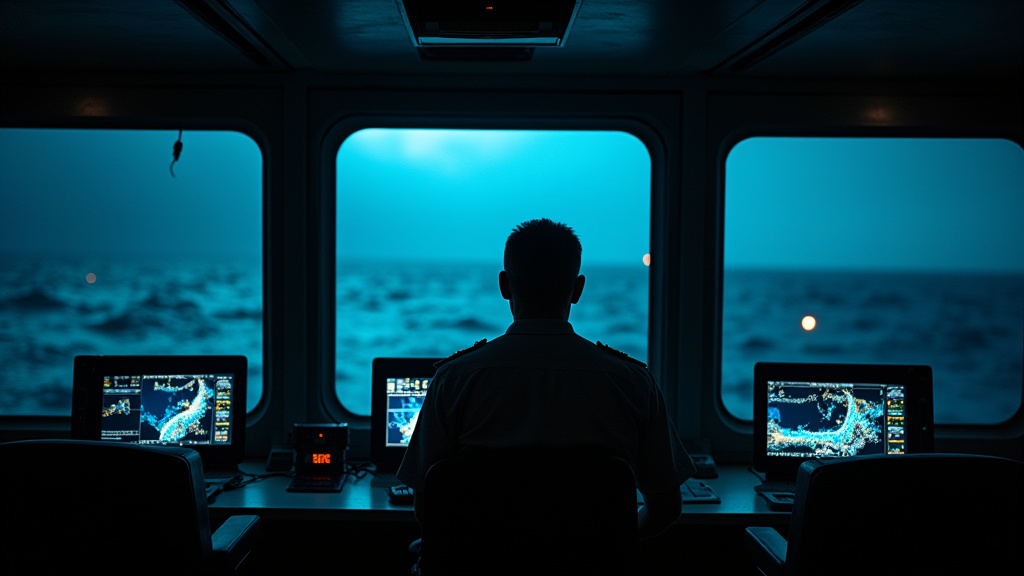
In a decisive display of maritime power, the United Kingdom and Norway successfully concluded a month-long, coordinated military operation to track and deter a group of Russian submarines operating in the North Atlantic. The operation, which involved Royal Navy frigates, maritime patrol aircraft, and specialized Norwegian maritime assets, successfully countered what officials described as “malign activity” by Russian vessels near critical undersea cables and energy pipelines. This high-stakes shadow engagement underscores the intensifying “gray zone” conflict beneath the surface of our oceans, where communication networks and energy grids are increasingly vulnerable to state-sponsored espionage and potential sabotage.
The Shadow Beneath the Waves
The operation primarily targeted a formation consisting of an Akula-class nuclear-powered attack submarine and two specialized vessels linked to Russia’s Main Directorate of Deep Sea Research, commonly known as GUGI (General Directorate of Deep Sea Research). For over a month, these vessels navigated the North Atlantic, drawing the close attention of British and Norwegian intelligence and naval forces. While Moscow has consistently denied any malicious intent regarding its deep-sea fleet, Western defense officials argue that these ships are uniquely designed for intelligence gathering—and, crucially, the sabotage of critical subsea infrastructure.
According to U.K. Defense Secretary John Healey, the Russian attack submarine appeared to act as a diversion, drawing attention while the two specialized research submarines operated in close proximity to underwater infrastructure. This tactic—using one asset to mask the “nefarious” intent of another—highlights the sophisticated nature of modern underwater maneuvering. By maintaining constant surveillance and deploying sonar buoys to effectively “mark” the Russian vessels, the Allied operation made it clear to the Russian command that their presence was not covert, effectively neutralizing the tactical advantage of secrecy.
The GUGI Factor: Understanding the Threat
The involvement of GUGI vessels marks a significant shift in how Western navies view Russian maritime capabilities. Unlike standard combat submarines, GUGI assets are specifically engineered for deep-sea exploration, mapping, and interaction with underwater objects. In the eyes of NATO defense planners, these ships serve a dual purpose: they function as advanced scientific platforms in peacetime and as potential weapons of economic warfare in a conflict scenario.
Mapping cables and pipelines provides the blueprints for future sabotage. Should global tensions escalate, the ability to cut off internet traffic or disrupt energy flow by severing these lines would be a massive strategic advantage. Consequently, the tracking of these ships is not merely a monitoring exercise; it is a vital defensive measure to prevent the “mapping” of the very arteries of the modern global economy. The successful deterrence of these vessels demonstrates that Western navies have upgraded their detection capabilities to keep pace with these highly specialized Russian assets.
Strategic Deterrence and Political Messaging
Beyond the tactical success of the operation, the public disclosure of this mission serves as a potent diplomatic signal. By bringing these events to light, the U.K. and its allies are engaging in a strategy of “calling out” Russian activity, attempting to deter future incursions through transparency. Defense Secretary Healey’s explicit warning—”we see your activity over our cables and our pipelines and you should know that any attempt to damage them will not be tolerated”—is a clear declaration that the “gray zone” is now subject to real-time, public scrutiny.
This move also addresses a growing concern among European leaders: that Russia seeks to exploit global distractions, particularly the conflict in the Middle East, to ramp up aggressive posturing in the North Atlantic. By refusing to let this issue fade into the background, the U.K. is asserting that its commitment to the security of the High North remains a top priority, regardless of other global crises. It sends a message to the Kremlin that its operations, even those conducted in the deep, silent reaches of the Atlantic, are being monitored, recorded, and countered.
The Future of Maritime Security: Evolution of the Conflict
The recent operation is emblematic of a larger, evolving conflict that is likely to define the next decade of naval warfare. As the world becomes increasingly reliant on undersea connectivity, the “physical internet”—the cables that carry 99% of global data traffic—has become a frontline. The integration of uncrewed underwater vehicles, advanced sonar arrays, and AI-driven predictive modeling in naval warfare is changing the game.
This incident also highlights the success of the new cooperation agreements between the U.K. and Norway. The “Lunna House Agreement,” which aims to combine naval fleet operations to hunt threats in the North Atlantic, has moved from a policy framework to a functional reality. The ability of the two nations to pool resources—using British Type 26 frigates alongside Norwegian reconnaissance assets—creates a seamless, and significantly more capable, defensive perimeter. As Russia continues to develop its capabilities for subsea intervention, this integrated approach will be the benchmark for NATO security in the Arctic and North Atlantic regions.
FAQ: People Also Ask
1. What is GUGI and why is it considered a threat?
GUGI is the Russian Main Directorate of Deep Sea Research. It is considered a threat because its specialized deep-sea submarines are designed to survey and interact with underwater infrastructure, which intelligence agencies believe could be sabotaged to disrupt communication cables and energy pipelines.
2. How do allies detect submarines in the open ocean?
Detecting submarines involves a combination of acoustic surveillance, such as sonar buoys dropped from aircraft, hydrophone arrays laid on the seabed, and radar detection of surface vessels that might be acting as decoys. Modern anti-submarine warfare (ASW) integrates data from ships, submarines, and aircraft to track targets.
3. Did the Russian submarines cause any damage?
No. According to British defense officials, there is no evidence that the Russian vessels successfully damaged any undersea infrastructure during this operation. The primary goal of the Allied mission was deterrence and surveillance to prevent such activity.
4. Why is the North Atlantic critical to global security?
The North Atlantic is home to massive networks of fiber-optic communication cables that facilitate global financial transactions and internet traffic. Additionally, it hosts critical energy infrastructure, such as pipelines transporting oil and gas from Norway to the rest of Europe, making it a strategic center of gravity for both energy security and digital communication.