
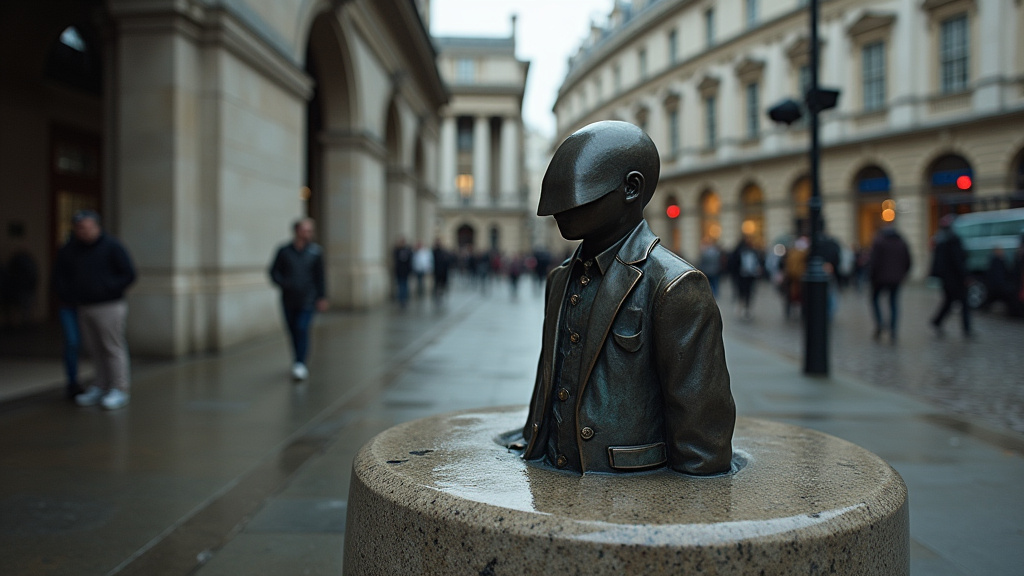
Elusive street artist Banksy has confirmed his authorship of a mysterious new sculpture that appeared overnight in London’s Waterloo Place. The installation, which features a suited figure marching off a plinth while completely obscured by a billowing flag, was verified by the artist on his official Instagram account on Thursday, April 30, 2026. The video footage released by the artist depicts the surreptitious late-night installation, showcasing the technical challenge of placing a heavy sculpture in one of London’s most historic and highly surveilled districts. This latest act of guerrilla art has once again transformed a quiet, monumental corner of Westminster into a focal point for global artistic discourse, highlighting the enduring power of Banksy’s public-facing commentary.
Key Highlights
- Verification Confirmed: Banksy authenticated the sculpture via a social media video that captured the statue being transported and installed under the cover of darkness.
- Symbolic Imagery: The work depicts a suited man walking off a ledge, his vision entirely blocked by a large, flowing flag, interpreted by critics as a critique of blind nationalism and political myopia.
- Historic Context: The statue is situated in Waterloo Place, St James’s, surrounded by monuments to British military and political history, including the Crimean War Memorial.
- Viral Phenomenon: The installation attracted immediate public attention and social media buzz, with onlookers debating its meaning before the artist’s confirmation.
The Anatomy of the Waterloo Place Installation
The arrival of the sculpture in Waterloo Place was not merely an aesthetic addition to London’s urban fabric but a calculated spatial intervention. Waterloo Place, home to significant monuments honoring figures like Florence Nightingale and the Duke of York, is a bastion of traditional, establishment-focused statuary. By placing his own creation—a suited figure stepping into an void—amidst this lineage, Banksy creates an immediate, friction-filled dialogue between the past and the present.
Decoding the Symbolism
The figure is depicted in mid-stride, moving forward with a sense of bureaucratic conviction, yet the flag that covers his face suggests he is unable to see where he is going. In artistic analysis, the flag—often a shorthand for patriotism or state identity—acts as a blinder, effectively rendering the leadership figure leaderless. This creates a powerful, albeit dark, metaphor for political systems that prioritize abstract ideals of nationhood over tangible, real-world consequences. By having the figure step off the plinth, the sculpture forces the viewer to confront the cliff-edge nature of current sociopolitical decision-making.
The Logistics of Guerrilla Art
Banksy’s video confirmation provided a rare glimpse into the logistical heavy lifting required for such an ambitious piece. In an era where central London is heavily monitored by CCTV and private security, the ability to maneuver a heavy sculpture into position unnoticed is a testament to the artist’s operational sophistication. This maneuverability is a signature of Banksy’s career—a mix of high-concept intellectualism and highly physical, localized street execution. The juxtaposition of the work’s heavy, bronze-like appearance against the fleeting, transient nature of the artist’s installation process creates a tension that defines the ‘Banksy experience.’
Secondary Angles: The Evolution of the London Street Art Scene
1. The Institutionalization of Guerrilla Art: This installation raises questions about how traditional city centers treat ‘unauthorized’ monuments. While some works are removed almost immediately by local councils, others, such as this, are initially allowed to stand, potentially shifting the city’s relationship with street art from one of removal to one of temporary exhibition.
2. The Economics of Public Art: The presence of this sculpture creates an immediate boost in foot traffic to the area, illustrating the ‘Banksy Effect’ where artistic intervention acts as a catalyst for cultural tourism, even when the artist remains anonymous.
3. The Technological Shift: Unlike earlier graffiti-based work, the move into heavy, site-specific sculpture suggests an evolution in Banksy’s medium. It challenges the definition of what constitutes a monument in the 21st century, moving from ‘art for the wall’ to ‘art for the space.’
FAQ: People Also Ask
Is the Banksy statue in Waterloo Place still there?
Yes, as of the latest reports, the statue remains in situ in Waterloo Place, though the history of such installations suggests its lifespan in a highly protected historic area like Westminster may be limited.
How did Banksy confirm the artwork?
Banksy confirmed the piece on his official Instagram account, releasing a video that documented the late-night logistics of transporting and erecting the statue in the public square.
What is the primary meaning of the new statue?
While the artist rarely explains his work directly, the consensus among art critics is that the figure—blinded by a flag and walking off a plinth—serves as a critique of blind nationalism, political myopia, and the dangerous trajectories of modern governance.
Why is the location, Waterloo Place, significant?
Waterloo Place is a historically dense area featuring monuments to the military and British establishment. By placing his sculpture here, Banksy creates a stark contrast between traditional, honored figures and his own anonymous, satirical depiction of modern authority.