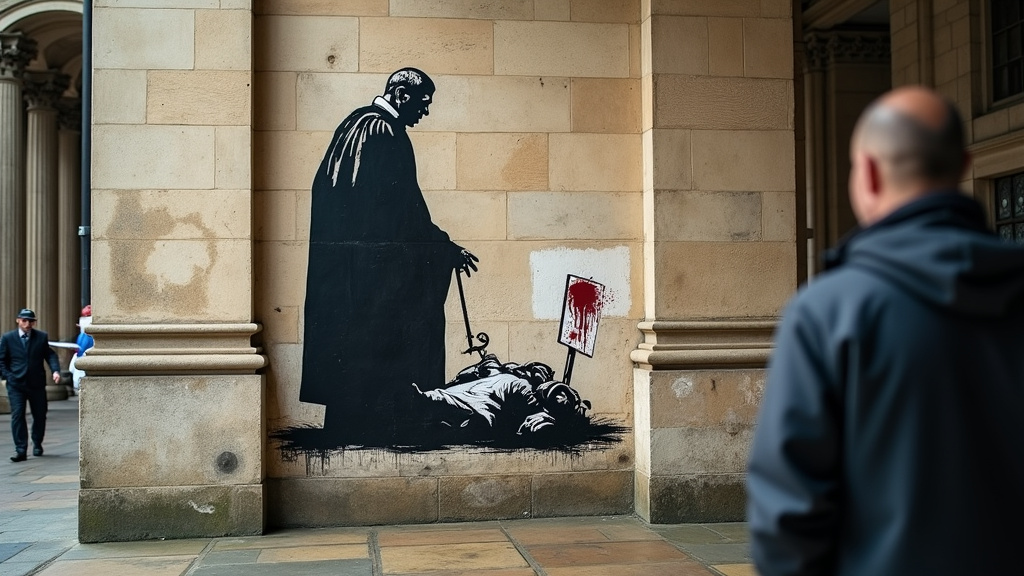
A provocative new mural by the anonymous street artist Banksy, depicting a judge brutally striking a protester with a gavel, appeared on the exterior of London’s iconic Royal Courts of Justice on September 8, 2025. The artwork, which quickly gained global attention and ignited discussions about justice, protest, and censorship, was swiftly covered by authorities and is slated for removal, citing the building’s protected status. Banksy confirmed his authorship of the piece via an Instagram post captioned “Royal Courts Of Justice. London.”
A Stark Depiction of Power and Protest
The striking black-and-white stencil shows a judge, clad in a traditional wig and gown, looming over a fallen protester. The protester lies on the ground, clutching a blood-splattered placard, while the judge raises a gavel in a violent gesture. The artwork’s stark imagery and its placement outside a symbol of the UK’s legal system have led to widespread interpretation as a direct commentary on the state’s approach to dissent and protest in contemporary society.
Context: Palestine Action Ban and Mass Arrests
This powerful artwork emerged just days after nearly 900 demonstrators were arrested in London during a protest challenging the UK government’s ban on the activist group Palestine Action. The group was proscribed as a terrorist organization in July 2025 following incidents where members allegedly damaged military aircraft. The mass arrests, which occurred at a demonstration on September 6, have amplified concerns among human rights groups and activists regarding the potential erosion of civil liberties and the right to peaceful protest in the UK.
Activist Interpretations and Official Response
Campaign groups, such as Defend Our Juries, which organized the protest, have lauded the mural, stating it “powerfully depicts the brutality unleashed” by the government’s ban. They argue that when the law is used to suppress civil liberties, it can inadvertently strengthen dissent. However, authorities responded rapidly to the unauthorized artwork. Within hours of its appearance, security officials covered the mural with black plastic sheeting and erected metal barriers. The Metropolitan Police also received reports of criminal damage, and inquiries are ongoing, raising the possibility that Banksy’s identity could be revealed if charges were pursued.
Scheduled Removal from a Listed Building
HM Courts and Tribunals Service confirmed that the mural would be removed due to the historical significance of the Royal Courts of Justice, a Grade II-listed building. A spokesperson stated that the service is “obliged to maintain its original character.” This decision, coupled with the swift covering of the artwork, has fueled debate about censorship and the institutional discomfort with public critique, especially when directed at the justice system itself.
Banksy’s Legacy of Social and Political Commentary
This latest piece aligns with Banksy’s well-established reputation for using street art as a powerful tool for political activism and social commentary. Throughout his career, the artist has consistently challenged authority, critiqued government policies, and highlighted societal injustices. His works have often tackled themes of war, capitalism, surveillance, and the treatment of marginalized groups, frequently placing his art in politically charged locations to maximize impact and provoke dialogue. His previous works have included pieces addressing the Israeli-Palestinian conflict, migration, and policing, cementing his role as a prominent voice in contemporary culture and a subject of global news.
A Cultural Flashpoint
The appearance and subsequent actions taken regarding the Banksy mural have turned the exterior of the Royal Courts of Justice into a temporary flashpoint for discussions on freedom of expression, the limits of protest, and the role of art in public discourse. While the physical artwork is set to be removed, its message and the ensuing debate continue to resonate widely, reflecting Banksy’s enduring ability to transform urban spaces into canvases for critical social and political commentary, making this a trending topic in London and beyond.