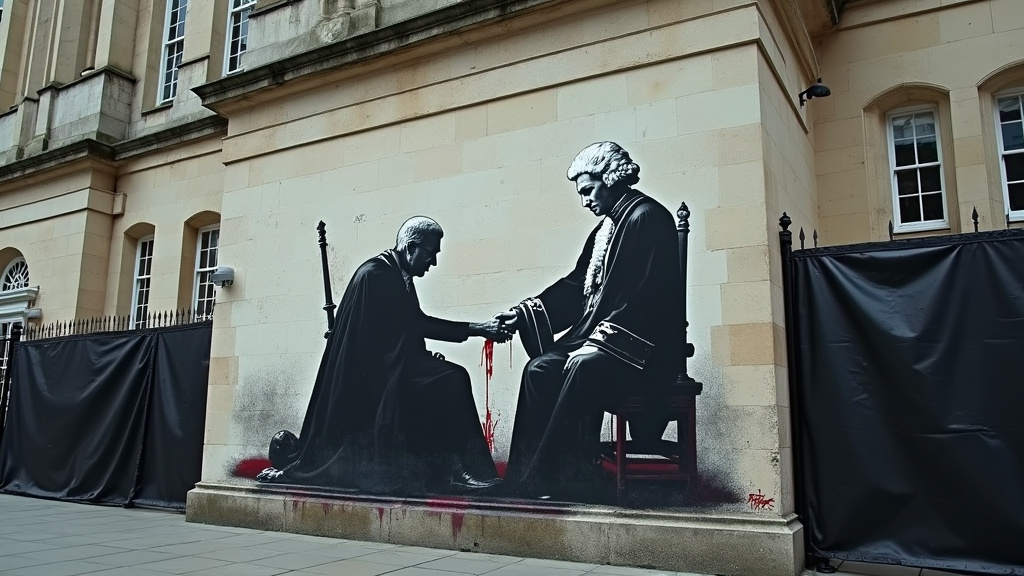
A striking new mural by the enigmatic street artist Banksy, which appeared on the exterior of London’s Royal Courts of Justice, is slated for removal. The artwork, depicting a judge aggressively wielding a gavel against a fallen protester, has been rapidly covered by authorities and is scheduled for dismantling, sparking debate about art, protest, and the preservation of historic landmarks in the capital.
Banksy Claims Controversial Artwork
The latest piece from the world-renowned, anonymous artist Banksy appeared overnight on an external wall of the Queen’s Building at the Royal Courts of Justice in London. Banksy himself confirmed his authorship of the mural via an Instagram post, accompanied by the caption: “Royal Courts Of Justice. London.” The stenciled artwork portrays a judge, complete with wig and gown, poised to strike a protester lying on the ground who clutches a blood-splattered placard.
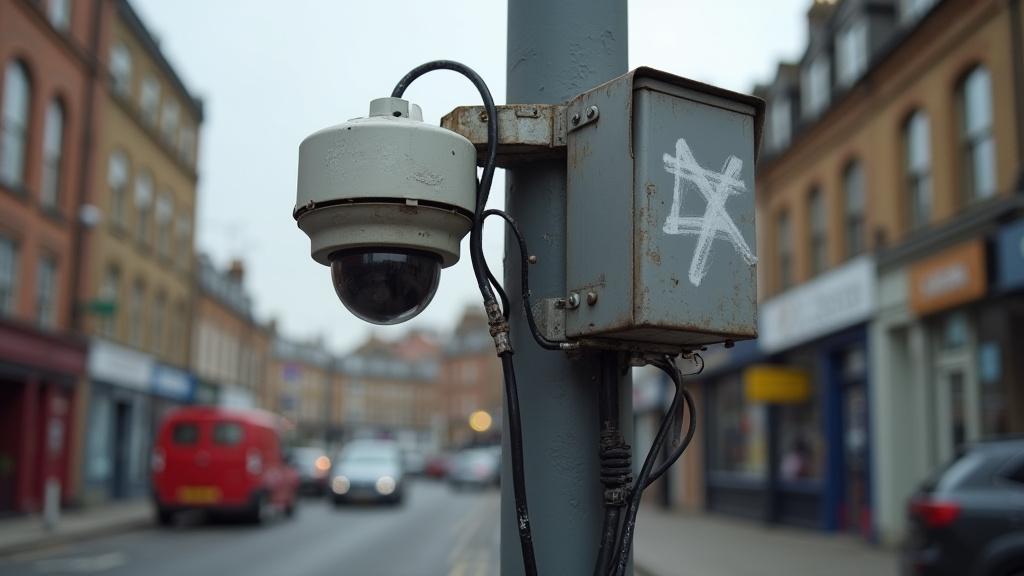
The mural quickly drew attention and was swiftly covered by sheets of black plastic and secured with metal barriers, with security officials and CCTV cameras installed at the site. Its appearance has generated significant interest, becoming a focal point of discussion and a trending topic in London news.
A Commentary on Justice and Protest
Art activists and observers have widely interpreted the mural as a pointed commentary on the UK government’s recent crackdown on protest groups, particularly in light of the ban imposed on the activist organization Palestine Action in July 2025. The timing of the mural’s emergence is particularly resonant, occurring just days after a major demonstration in London on Saturday, September 6, 2025. During this protest, which opposed the ban on Palestine Action, nearly 900 individuals were arrested by the Metropolitan Police. Many of those arrested were detained under anti-terrorism legislation.
Groups such as Defend Our Juries, which organized the recent protest, have lauded the artwork. A spokesperson stated that the mural “powerfully depicts the brutality unleashed” by the government’s ban and commented, “When the law is used as a tool to crush civil liberties, it does not extinguish dissent, it strengthens it.” The artwork also emerges weeks after the Lady Chief Justice expressed concerns over escalating abuse directed at judges.
Listed Building Status Dictates Removal
Authorities have confirmed the mural’s removal is imminent, citing the historical significance of the Royal Courts of Justice. HM Courts and Tribunals Service (HMCTS) stated that as the building is a listed landmark, they are “obliged to maintain its original character.” The National Heritage List for England designates such buildings for their significant historical and architectural importance, providing them with legal protection that necessitates the preservation of their original state.
This decision underscores the tension between public art as a form of political expression and the stringent regulations governing heritage sites. While Banksy’s work often critiques authority and societal norms, its placement on a protected historical building leads to its inevitable removal according to established heritage laws.
Banksy’s Legacy of Political Art
Banksy has built a global reputation for using street art as a medium for potent social and political commentary. His works frequently address issues such as war, capitalism, government policy, and civil liberties, often provoking significant public and media reaction. Previous works have commented on conflicts, environmental issues, and the surveillance state, consistently challenging established narratives and sparking dialogue. The appearance of this mural outside one of the UK’s highest courts continues this tradition, directly engaging with contemporary political and legal controversies.
The swift covering and planned removal of the Banksy mural highlight the complex interplay between artistic freedom, public space, and the preservation of historic architecture. As the artwork is dismantled, the messages it conveyed about justice, dissent, and state power are likely to continue resonating in political and cultural discussions across London and beyond.