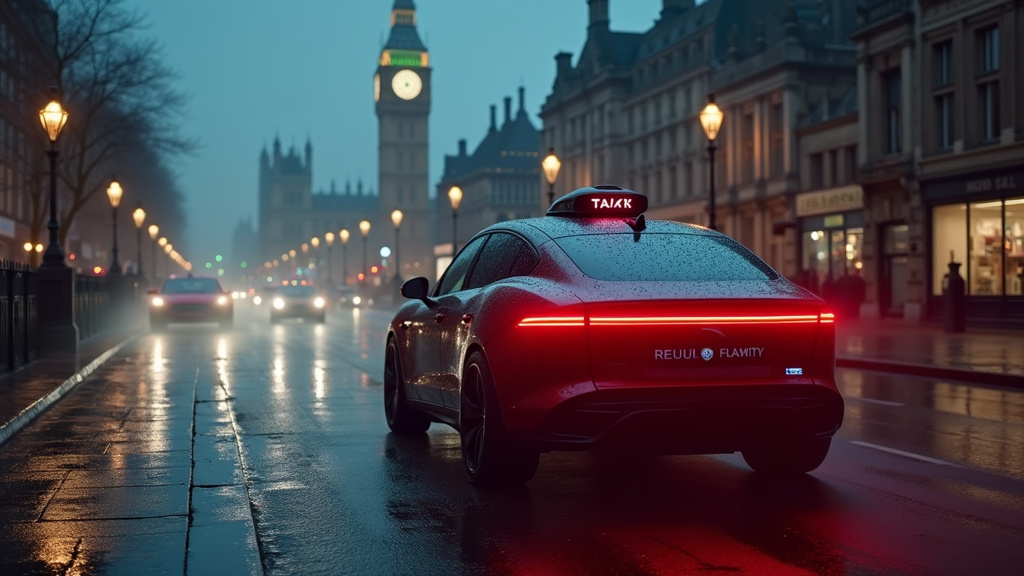
London is on the cusp of a significant transformation in urban mobility, as autonomous taxi services are slated to launch on its roads starting in 2026. This groundbreaking development will see companies like US-based Waymo, a subsidiary of Alphabet, and a collaborative effort between Uber and UK tech firm Wayve, introduce driverless vehicles to the capital.
Key Players Chart a Course for Autonomous Ride-Hailing
Waymo has announced its intention to make London the first European city to host its fully driverless ride-hailing service. The company is already en route to the UK capital, with vehicles set to begin mapping and testing across a 100-square-mile area in the coming weeks. Initially, these vehicles will operate with human safety drivers behind the wheel, a crucial step before fully autonomous passenger services can launch, pending regulatory approval. Waymo will partner with Moove, a global mobility company, to manage fleet operations, including charging and maintenance, leveraging Moove’s existing operational expertise in London.
Simultaneously, Uber, in partnership with UK AI startup Wayve, is also gearing up to launch its own driverless taxi trials in London by spring 2026. This collaboration will integrate Wayve’s advanced Embodied AI platform with Uber’s extensive global mobility network, marking a significant advancement for autonomous vehicle deployment in Europe. This marks Uber’s largest market for such pilot programs on the continent.
Regulatory Framework Accelerates Autonomous Vehicle Adoption
The UK government has signaled its commitment to fast-tracking the development and adoption of self-driving technology. Pilot schemes for small-scale taxi and bus-like services, which can operate without a human safety driver, are scheduled to commence in spring 2026. This acceleration is paving the way for a broader rollout of autonomous vehicles, anticipated to fully take effect when the Automated Vehicles Act becomes law in late 2027. This legislation is designed to establish a robust legal framework for self-driving vehicles, including clarity on liability, requiring that vehicles demonstrate a level of safety at least equivalent to competent human drivers and undergo rigorous safety checks.
Technological Advancements and London’s Unique Challenge
Waymo brings years of experience from operating in several US cities, including San Francisco, Los Angeles, and Phoenix, and has recently expanded testing to Tokyo. Its London fleet will initially consist of electric Jaguar I-PACE vehicles equipped with its proprietary Driver system. Wayve, on the other hand, is developing an AI-first approach, AV2.0, which learns from real-world driving experience, aiming to adapt to complex environments without reliance on highly detailed pre-mapped routes. The challenging nature of London’s streets—characterized by unpredictable traffic, narrow lanes, and historic infrastructure—presents a significant testbed for these advanced autonomous systems.
Economic Promises and Societal Implications
The anticipated arrival of driverless taxis is projected to bring substantial economic benefits to the UK. Government figures suggest the industry could create approximately 38,000 jobs and add £42 billion to the UK economy by 2035. Proponents also highlight the potential for enhanced road safety, as autonomous vehicles aim to reduce human error, which contributes to a significant majority of road collisions. Furthermore, these services could improve transport accessibility, particularly for individuals in underserved areas or those with mobility challenges.
However, this technological leap also raises considerable concerns. Unions like the GMB have voiced anxieties regarding the potential displacement of hundreds of thousands of existing taxi and private hire drivers, whose livelihoods could be under pressure. While the government emphasizes job creation in the new sector, the transition for the existing workforce remains a critical point of discussion.
A New Era for London’s Transport
Despite some skepticism from traditional black cab representatives, who have described the technology as a “fairground ride” for now, the influx of driverless taxis marks a pivotal moment for London’s transport landscape. The city’s unique urban environment will serve as a proving ground, potentially shaping the future of urban mobility not only in the UK but globally. As Waymo and Uber, alongside Wayve, prepare to navigate these complex streets, Londoners may soon experience a fundamental shift in how they travel, ushering in an era of autonomous convenience, provided public trust and safety can be assured.