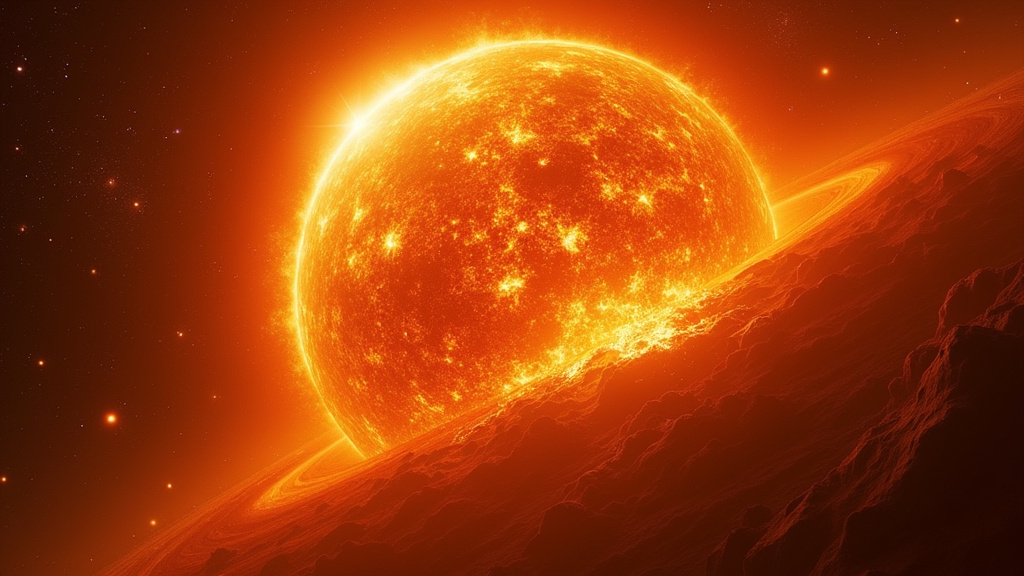
Astronomers have uncovered compelling evidence that Dying Stars are actively consuming the giant planets that orbit them. This dramatic cosmic process, observed through meticulous analysis of TESS data, suggests that the fiery demise of Dying Stars is a common fate for many nearby planetary systems, offering insights into stellar evolution and the eventual exoplanet fate.
The Fate of Planets Around Dying Stars
The groundbreaking research, conducted by a collaborative team from University College London (UCL) and the University of Warwick, reveals a striking scarcity of close-orbiting planets around older, expanded stars. This observation strongly indicates that many of these celestial bodies have been destroyed and absorbed by their evolving host stars. The findings, published in the esteemed Monthly Notices of the Royal Astronomical Society, shed new light on the life cycle of stars and the ultimate destiny of planets within the context of cosmic processes.
When a star like our Sun exhausts its core hydrogen fuel, it begins a transformation into a red giant. This phase involves the star expanding significantly, its outer layers reaching far beyond their original boundaries. Scientists have long theorized that this expansion would inevitably engulf nearby planets, but direct evidence had been elusive until now. The study analyzed nearly half a million star systems, identifying 130 planets and potential planet candidates orbiting these aging stars, including 33 newly detected ones, crucial for understanding the fate of dying stars.
Planetary System Fate: Gravitational Interactions with Dying Stars
Dr. Edward Bryant, lead author of the study and a Warwick Astrophysics Prize Fellow, explained the mechanism behind this cosmic consumption by Dying Stars. “As stars evolve off their main sequence, they can quickly cause planets to spiral into them and be destroyed,” he stated. This process is driven by a powerful gravitational interaction known as tidal interaction. As the star expands, its gravitational pull on a close-orbiting planet intensifies. Similar to how the Moon influences Earth’s tides, a planet’s gravity tugs on its star, causing a gravitational feedback loop that slows the planet’s orbital speed and draws it closer inwards. Eventually, these close-in planets are torn apart or fully swallowed by the star, a dramatic example of star planet consumption and a key aspect of planetary system destruction.
The research highlighted a significant drop in the occurrence rate of giant planets around evolved stars. While younger, main-sequence stars host such planets at a rate of about 0.35%, this figure plummets to a mere 0.11% for stars classified as red giants. This stark difference provides robust evidence for planetary destruction by these Dying Stars.
Implications for Our Solar System and Beyond from Dying Stars
The implications of this discovery extend to our own solar system. Co-author Dr. Vincent Van Eylen noted that in approximately five billion years, our Sun will also expand into a red giant. While Earth might survive the initial expansion, the intense conditions will likely render it uninhabitable. The study’s findings offer a sobering glimpse into the potential planetary system fate, suggesting that stable planetary systems may not be the norm across the universe, especially around Dying Stars.
The research was supported by the UK Science and Technology Facilities Council (STFC), a key funding body for astronomical research in the United Kingdom. Scientists plan to further explore these doomed worlds by measuring their masses, which will help them understand the precise mechanisms driving their spiral into stellar oblivion. This ongoing exploration allows us to enjoy a deeper understanding of celestial dynamics and the profound processes that shape planetary evolution. The fate of red giant planets is a critical area of study when observing dying stars.
This trending news is a significant step forward in exoplanet science, allowing researchers to better interpret the demographics of planetary systems and their resilience against the inevitable march of stellar evolution. As scientists continue to explore the cosmos, discoveries like these help us appreciate the dynamic and often violent nature of the universe and our place within it. This news is a must-read for anyone interested in astronomy and the latest scientific breakthroughs regarding Dying Stars.