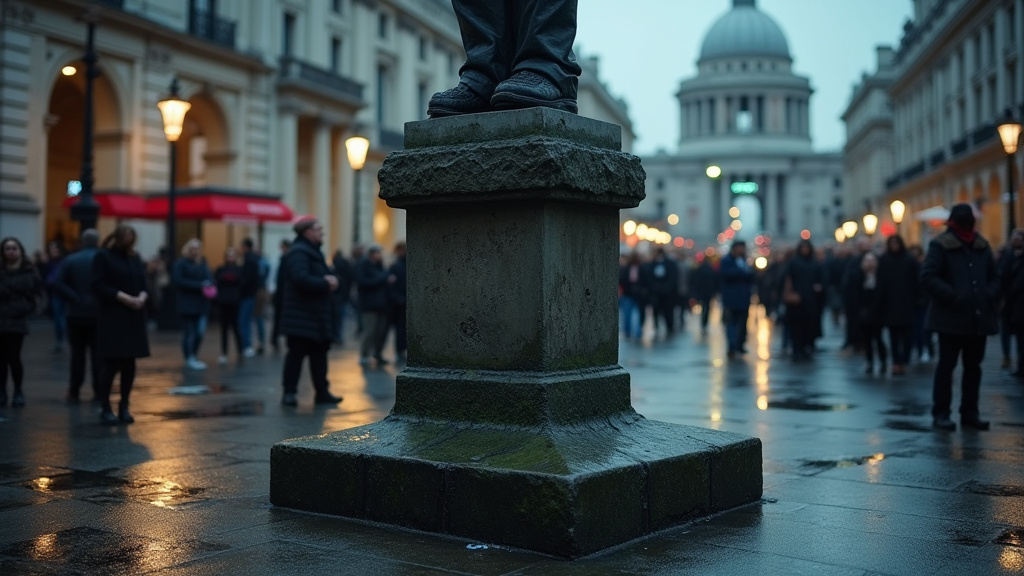
Elusive street artist Banksy has confirmed that a provocative new sculpture appearing in central London is his latest work, ending hours of public speculation. The piece, which depicts a man marching forward off a plinth while his face is completely obscured by a billowing flag, was erected in the dead of night on a traffic island in Waterloo Place, just steps from major landmarks including Buckingham Palace. The artist shared a video on his official Instagram account on Thursday, April 30, 2026, documenting the surreptitious installation process, thereby confirming his authorship and adding another layer of intrigue to his storied career.
Key Highlights
- Guerrilla Installation: The statue was erected overnight on a plinth in Waterloo Place, St. James, without prior public notice.
- Artistic Significance: The sculpture features a suited man stepping off a plinth, his vision blocked by a large, flowing flag, serving as a visceral critique of blind nationalism.
- Official Confirmation: Banksy confirmed the work via a humorous Instagram video that provided a rare behind-the-scenes look at the installation process.
- Contextual Placement: The site is historically significant, positioned near monuments of King Edward VII and Florence Nightingale, creating a sharp contrast between traditional authority and contemporary subversive art.
- Thematic Symbolism: Art critics and observers are already interpreting the work as a commentary on the dangers of uncritical patriotism and the loss of perspective in modern political discourse.
A Monument to Unawareness: The Politics of Waterloo Place
The choice of location for Banksy’s latest intervention is far from accidental. Waterloo Place, a prestigious area in the St. James’s district, is a site defined by historical weight. It is home to various monuments celebrating military and royal figures, including the Crimean War Memorial and the statue of King Edward VII. By placing his “blinded” figure—a man, seemingly in a suit, suggesting a person of authority or governance—directly into this curated landscape of national pride, Banksy has created a jarring, immediate friction. The juxtaposition of a modern, enigmatic sculpture against the backdrop of 19th and 20th-century historical monuments serves as the ultimate visual pun: a figure of the present literally and figuratively marching off the deep end, his vision impaired by the very emblem of the nation he purports to serve.
The Mechanics of the Subversive
Banksy has long been known for his commentary on the art world and political establishments, but this transition into full-scale statuary marks an interesting evolution. Unlike his typical stencil-based graffiti, which often carries a temporary, fragile nature, this sculpture requires physical engineering, logistical planning, and significant effort to transport and erect. The video shared on his Instagram reveals the “dead of night” operation, reminiscent of a covert military maneuver rather than an art installation. This “guerrilla” approach underscores the artist’s desire to bypass institutional permission, effectively forcing the public and the state to engage with his critique on his own terms. It is an act of reclaiming public space for public discourse, even if that discourse is uncomfortable.
Interpretations of the Flag
The symbolism of the flag covering the face is the central anchor of this piece. In political art, the flag is often a double-edged sword—a source of identity and belonging, but also a shroud that hides uncomfortable truths. By having the flag “blind” the subject, Banksy appears to be critiquing the concept of blind nationalism, where the fervor of patriotism prevents the actor from seeing the consequences of their actions—or the cliff edge they are marching toward. It is a powerful, concise visual metaphor that transcends specific national borders, making it applicable to the broader global climate of polarized politics and rising nationalist rhetoric.
Historical Context: Banksy’s Sculptural Works
While the public is accustomed to Banksy’s murals, this is not the artist’s first foray into three-dimensional public art. His 2004 installation “The Drinker” on Shaftesbury Avenue, a satirical subversion of Rodin’s “The Thinker,” remains a seminal moment in his career. The latest Waterloo Place installation shares that same DNA of subversion but arrives at a moment of heightened tension in public discourse. The statue’s location, near the Centre Point Tower and the Royal Courts of Justice—sites of his previous, often fleeting interventions—signals a continued commitment to “bombing” the city center with messages that force passersby to pause, look, and reconsider the symbols of power that surround them.
The Public and Media Reaction
Within hours of its appearance, the statue drew crowds of tourists and locals alike, some of whom suspected it was a Banksy due to the signature scrawled at the base of the plinth. The wait for official confirmation turned the artwork into a temporary pilgrimage site. The media cycle, fast to pick up on the “Banksy watch,” treated the confirmation as a major cultural event. This interaction between the artist, the physical work, and the digital confirmation on Instagram represents a sophisticated feedback loop that defines modern celebrity street art. The work is not just the statue itself; it is the mystery, the speculation, the confirmation, and the ensuing public debate.
FAQ: People Also Ask
Q: Where exactly is the new Banksy statue located?
A: The statue is situated in Waterloo Place, St. James, in central London. It was placed on a traffic island near the statues of King Edward VII and Florence Nightingale.
Q: How do we know it is a genuine Banksy?
A: Banksy officially confirmed his authorship by sharing a video of the installation process on his verified Instagram account on Thursday, April 30, 2026.
Q: Is this the first time Banksy has made a statue?
A: No, Banksy has created sculptural work before. A notable example is ‘The Drinker,’ installed in 2004, which reinterpreted Rodin’s ‘The Thinker.’
Q: What is the meaning behind the man with the flag?
A: While the artist has not provided an official manifesto, the consensus among observers and critics is that the piece critiques blind nationalism, where an obsession with national identity obscures one’s vision of reality and the consequences of their actions.
Q: Will the statue remain in place?
A: Street art installations of this nature are often temporary. Given the location’s historical and high-traffic status, there is significant speculation regarding how long local authorities will permit the sculpture to remain.