London, UK – September 17, 2025 – Thousands of protesters marched through central London today, voicing their strong opposition to the state visit of United States President Donald Trump. The demonstrations unfolded against a backdrop of significant royal pageantry as the President and First Lady Melania Trump received an unprecedented second state welcome in the United Kingdom.
Royal Pomp and Unprecedented Honour
President Trump’s state visit, which began on September 16 and is set to conclude on September 18, has been marked by elaborate ceremonies hosted by King Charles III. The itinerary has focused heavily on Windsor Castle and the Prime Minister’s country estate, Chequers, a strategic decision to keep the President away from the potential disruptions of central London. This marks Trump’s second full state visit, an honour rarely bestowed, particularly on a president serving a second term. Historically, such repeat visits have typically involved less formal engagements, such as tea with the monarch, making this extensive royal reception particularly notable.
The visit has included a formal welcome at Windsor Castle, military ceremonies, a carriage procession, and is set to culminate in a state banquet. The King and President Trump are scheduled for bilateral talks, which are expected to cover trade, tariffs, and international relations, including the ongoing conflict in Ukraine.
Thousands March Against Visit in London
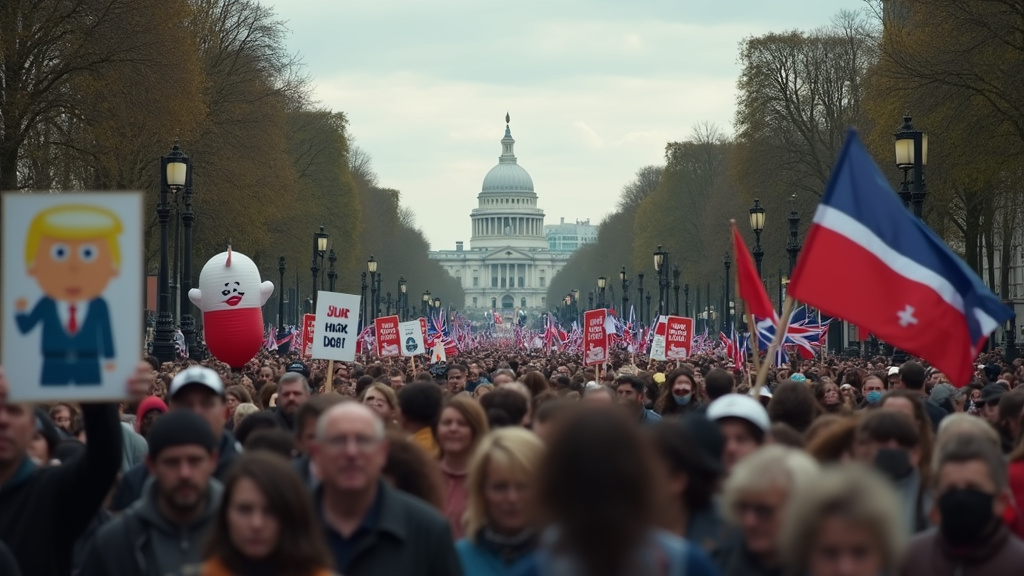
Concurrent with the ceremonial events, a significant protest movement has mobilized in the capital. Organized by the Stop Trump UK coalition, several thousand demonstrators gathered in central London on Wednesday, September 17. The march route saw participants moving down Regent Street towards Parliament, carrying banners with slogans such as “No to the racism, no to Trump” and “No to Trump, no to fascism.” Some carried inflatable caricatures reminiscent of the “Trump baby blimp” that gained notoriety during his first visit in 2019.
Estimates suggest around 3,000 people participated in the main London march. While some reports indicate this turnout was smaller than that seen during Trump’s first state visit in 2019, the presence of thousands underscores a persistent and organized opposition to the US President’s policies and rhetoric. The sheer scale of the protest has made it a focal point of the day’s news.
Diverse Groups Unite in Opposition
The Stop Trump UK coalition has brought together approximately 50 different groups, reflecting a broad base of dissent. Participants included activists from climate, anti-racism, and pro-Palestinian organizations, among others. Socialist Students also announced plans for student walkouts across colleges and universities to protest the visit. The reasons cited for the widespread opposition are varied, encompassing concerns over Trump’s stance on issues like migration, climate change, and his impact on human rights globally. Liberal Democrat leader Sir Ed Davey has also confirmed his boycott of the state banquet, signaling his disapproval.
A small counter-protest supporting Trump was met with boos from the larger demonstration, highlighting the polarized public sentiment surrounding the visit.
Extensive Security Operation
Authorities have implemented robust security measures to manage the visit and potential disruptions. The Metropolitan Police deployed around 1,600 officers in London, bolstered by an additional 500 from other forces. Public Order Act conditions have been applied to the planned demonstrations, and road closures were put in place to facilitate the march. The decision to hold key events at Windsor Castle, some 20 miles west of London, is widely seen as a tactic to limit the impact of large-scale street protests.
Despite the royal welcome and the security cordon, the presence of thousands of protesters in London serves as a powerful counter-narrative to the official proceedings, making this state visit a significant moment for political and social commentary in the UK.