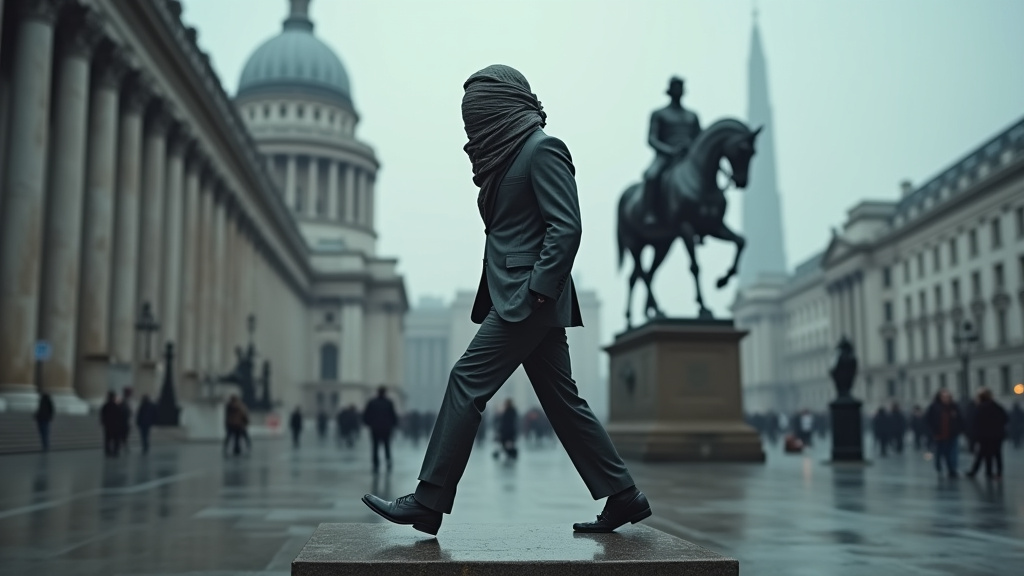
In the early hours of Wednesday morning, the heart of London’s establishment district, Waterloo Place, gained an unexpected new resident. A life-sized, seemingly bronze-finish sculpture of a man in a suit, mid-stride and blinded by a heavy, billowing flag, appeared on a traffic island—only to be confirmed as the latest work by the elusive street artist Banksy by Thursday. The installation, which disrupts the traditional, imperial aesthetics of the St. James’s district, has immediately sparked a national conversation about the nature of patriotism, the role of public monuments, and the evolution of Banksy’s own relationship with the city of London.
Key Highlights
- The Installation: Banksy utilized heavy machinery under the cover of night to place the sculpture in Waterloo Place, confirming the act via his official Instagram account.
- The Subject: The work depicts a man in a business suit striding off the edge of a plinth, his vision completely obstructed by a flag that covers his face.
- Official Reception: Unlike previous unsanctioned installations that were removed by authorities, Westminster City Council has stated it has no plans to remove the work, welcoming it as a “striking addition” to the local art scene.
- Artistic Intent: Observers and critics are widely interpreting the piece as a scathing satire on “blind patriotism” and the dangers of extreme nationalism.
The Anatomy of a Subversive Masterpiece
The arrival of the “flag-blinded man” in Waterloo Place represents a significant escalation in Banksy’s public performance art. Historically, Banksy’s works have often relied on two-dimensional stencils applied to walls—a medium that, while provocative, is inherently flat and easily removed by cleaning crews or weather. This new installation, however, is a three-dimensional, weighty sculptural intervention. The choice of location is not merely convenient; it is a calculated challenge to the historical narrative of the surrounding area.
Waterloo Place is defined by its colonial and imperial architecture. It is populated by statues of historical figures, including King Edward VII, Florence Nightingale, and various military commanders associated with the Crimean War. By introducing a figure that is visibly “blinded” by the very symbols—the national flag—that usually represent these institutions, Banksy creates a stark visual dissonance. The man’s stride, which carries him dangerously close to the edge of the plinth, suggests a path taken with blind conviction, ignoring the void ahead. It is a potent, sculptural warning about the trajectory of nationalist fervor in the modern geopolitical climate.
The Logistics of Rebellion
Banksy’s Instagram confirmation provided a glimpse into the “gamesmanship” required to pull off such a feat. The video footage reveals the use of a low-loader and crane, maneuvering the heavy structure into the heart of a highly policed, high-security zone near Buckingham Palace and various foreign embassies. The sheer audacity of placing an unauthorized, massive sculpture in one of London’s most protected ceremonial areas highlights the artist’s mastery of logistics. It serves as a reminder that Banksy is not merely a painter, but a master of orchestrating public spectacles that expose the porous nature of security and the fragility of public space.
Evolving Public Perception: From Vandal to Cultural Asset
Perhaps the most striking aspect of this event is not the art itself, but the reaction of the Westminster City Council. In years past, Banksy’s “unauthorized” works were almost universally slated for immediate removal, scrubbed clean by council workers who viewed them as vandalism. However, the council’s statement regarding this new piece—calling it a “striking addition to the city’s vibrant public art scene” and confirming it will remain—signifies a massive cultural pivot.
Banksy has effectively transitioned from an outlaw to a recognized cultural asset. This shift reflects a broader societal change where the “vandalism” of yesterday is now curated into the “cultural heritage” of today. The city now recognizes that the presence of a Banksy work acts as a tourism magnet, drawing crowds and generating international press coverage. This commodification of dissent is a secondary layer to the artist’s work: is the art still revolutionary if the establishment embraces it so readily? Or is the establishment’s embrace the final, cynical punchline of the joke?
Symbolism and the Modern Bureaucrat
The figure in the sculpture is not a soldier or a commoner; he is dressed in a suit. This is a critical detail. By cladding the subject in business attire, Banksy links the concept of blind patriotism not to the populace, but to the architects of policy. It implies that those in positions of power, blinded by their own flags and institutional allegiances, are the ones most prone to walking off the proverbial edge.
This imagery resonates deeply with contemporary concerns regarding isolationist policies and the erosion of critical discourse in governance. The flag, traditionally a symbol of unity or national pride, here becomes a shroud—a literal barrier to seeing the truth of one’s surroundings. It forces the viewer to confront a uncomfortable question: who are we blindly following, and where is that lack of vision leading us?
The Digital Gallery and the Mythos of Identity
While the physical statue occupies a small, defined space in Waterloo Place, the work exists primarily in the digital realm. Banksy’s reliance on Instagram to confirm the piece acts as the final authentication, turning a physical object into a viral moment. The “Banksy effect” is now instantaneous. Once the signature is confirmed digitally, the physical object becomes a pilgrimage site.
This digital-first approach ensures that the work is seen by millions globally, regardless of whether they ever step foot in St. James’s. It also sustains the mythos of the artist. Despite ongoing investigations and various reports attempting to identify the man behind the moniker—most notably the ongoing scrutiny surrounding Robin Gunningham—the artist remains an enigma. This ambiguity is crucial; it allows the art to be judged on its own merit rather than the biography of the creator. By remaining anonymous, Banksy ensures that the focus remains firmly on the flag-blinded man, and the dangerous, heedless march that the statue represents.
FAQ: People Also Ask
1. Why was the statue placed in Waterloo Place?
The location is highly symbolic. Waterloo Place is home to several monuments of British imperial history and military figures. By placing a satirical work criticizing “blind patriotism” in the middle of this area, Banksy creates a direct, ironic dialogue with the traditional statues surrounding it.
2. Will the statue be removed?
Unlikely. A spokesperson for the Westminster City Council has stated that they welcome the sculpture as a “striking addition” to the city’s art scene and have no plans to remove it, noting that they have even taken steps to protect it.
3. Is this officially confirmed as a Banksy?
Yes. Shortly after the sculpture was spotted and began drawing crowds, Banksy posted a video on his official Instagram account detailing the nighttime installation process, thereby confirming his authorship.
4. What does the artwork represent?
Critics and analysts widely interpret the statue as a commentary on “blind patriotism.” The suit-clad figure, representing authority or the status quo, is so obscured by the national flag he carries that he cannot see he is walking off a ledge, suggesting the dangers of nationalism that prevents one from seeing reality.