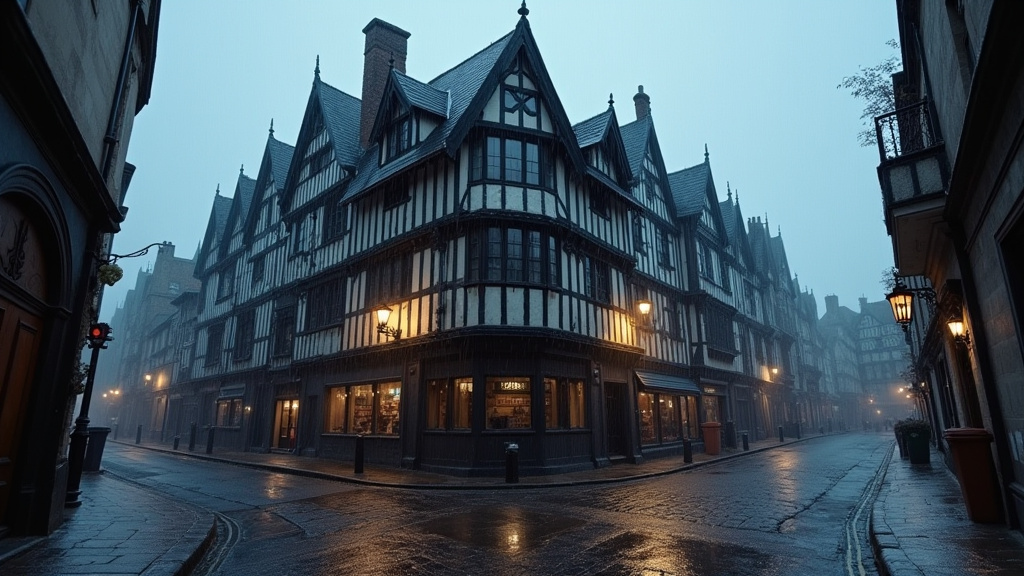
For centuries, the London life of William Shakespeare has been shrouded in a fog of ambiguity, with scholars and tourists alike settling for a vague plaque that placed his only purchased city home merely “near” an undisclosed site. That long-standing historical mystery has finally been dismantled. A groundbreaking discovery within the London Archives has revealed an original 1668 property plan, pinpointing the exact coordinates of the playwright’s Blackfriars residence. Led by Professor Lucy Munro of King’s College London, this finding does more than just update a plaque; it challenges the long-held narrative regarding Shakespeare’s final years and his relationship with the capital city.
The Archival Breakthrough
The discovery occurred almost by chance, a common yet thrilling occurrence in the world of archival research. While examining documents for a broader project, Professor Munro uncovered a detailed 1668 plan of the Blackfriars precinct. The document, drafted shortly after the Great Fire of London in 1666, provided the missing link that historians had sought for generations. By cross-referencing this plan with existing historical descriptions of the property Shakespeare purchased in 1613, the team was able to verify the site with unprecedented precision. The plan delineates an L-shaped structure, carved from the former medieval Dominican friary, providing a clear visual record of where the Bard once walked, worked, and arguably composed his final masterpieces.
Decoding the Blackfriars Mystery
For decades, the standard historical record held that Shakespeare purchased lodgings in the Blackfriars Gatehouse, but the lack of a precise map forced researchers to settle for an approximation. The ambiguity led to a commemorative plaque on St. Andrew’s Hill reading “near this site,” a phrasing that proved to be historically inaccurate. The newly discovered map reveals that the gatehouse structure—which functioned as a prominent dwelling—was not just adjacent to the area but sat on a specific footprint that would have placed Shakespeare in the heart of the thriving Blackfriars district. While the building itself was consumed by the Great Fire of 1666, the discovery provides a tangible connection to the playwright’s physical presence in London during the twilight of his career.
Challenging the Retirement Narrative
The implications of this find extend far beyond geography; they touch upon the very nature of Shakespeare’s biography. The traditional academic view has long been that Shakespeare, having achieved wealth and reputation, essentially retired to Stratford-upon-Avon in 1613, effectively abandoning the London theatre scene. This discovery suggests a more complex reality. Owning a substantial property in the prestigious Blackfriars district—near his workplace, the Blackfriars Theatre—implies that Shakespeare may have maintained a much more active and entrenched presence in the city than previously acknowledged. This L-shaped dwelling, which researchers believe was large enough to be subdivided into two properties by 1645, was not merely an investment; it was a home base for the most productive dramatist in history.
A Legacy Reimagined
What this discovery gives to literature lovers and historians is a refreshed lens through which to view Shakespeare’s late-life output. If he was spending more time in this London home than the “swift retirement” theory allows, it is highly plausible that his final collaborative works were penned within these very walls. The discovery is a reminder that history is not static; it is constantly being rewritten by the persistence of scholars and the silent, patient testimony of archival documents. As the world celebrates this new clarity, the plaque on St. Andrew’s Hill will likely be the first to change, finally marking the spot with the certainty that history demands.
FAQ: People Also Ask
Q: Why was the location of Shakespeare’s London home a mystery for so long?
A: The property was destroyed in the Great Fire of London in 1666, and detailed city plans from that era were either lost or had not been closely linked to specific property deeds until now. Historians relied on vague references rather than precise cartography.
Q: Did Shakespeare live in this house permanently?
A: While he purchased the house in 1613, historical evidence suggests he may have used it as a London base while living in Stratford-upon-Avon. The size of the property indicates it may have been split into two dwellings, possibly serving as both a home and a source of income.
Q: How does this discovery change our view of Shakespeare’s retirement?
A: It challenges the assumption that he left London immediately in 1613. The fact that he held a significant property in the city suggests he remained professionally and personally connected to London longer than previously thought.
Q: What happened to the house eventually?
A: The house remained in the family until 1665, when it was sold by Shakespeare’s granddaughter, Elizabeth Hall Nash Barnard. It was subsequently destroyed in the Great Fire of London in 1666.