The V&A East Museum officially opened to the public today in Stratford, London, signifying a transformative moment for the UK’s cultural landscape. Situated at the heart of the East Bank development in Queen Elizabeth Olympic Park, this new institution is far more than a satellite branch of its South Kensington predecessor; it represents a radical departure from traditional museum curatorial philosophy. Under the directorship of Dr. Gus Casely-Hayford, the museum has been built on a foundation of radical inclusivity, aiming to shatter the barriers that have historically kept local communities at arm’s length from national cultural assets.
The Architecture of Inclusion
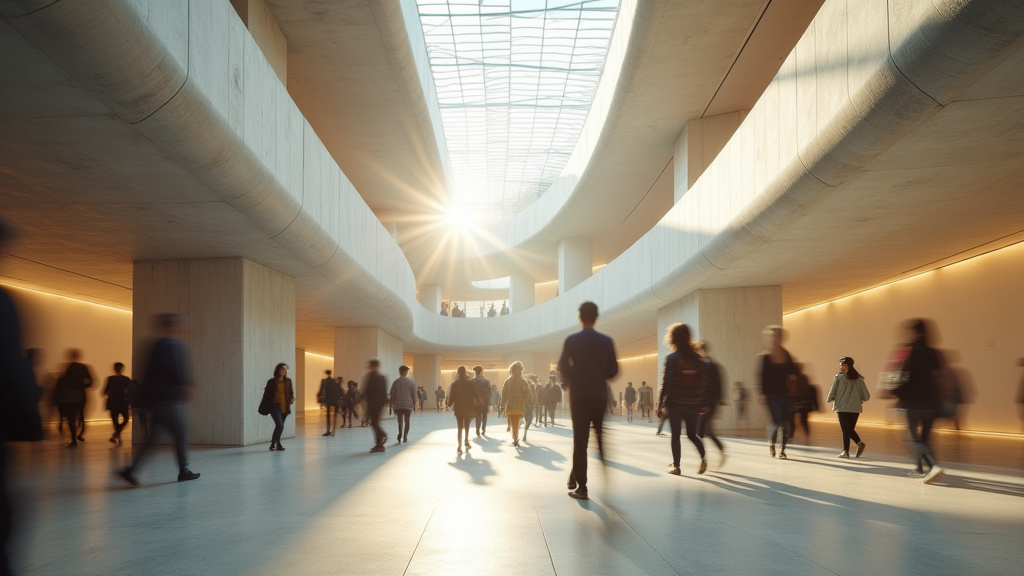
Designed by the award-winning Irish architectural practice O’Donnell + Tuomey, the museum’s building itself serves as a manifesto for its mission. The structure is not an imposing, static monument to the past, but rather a dynamic, folded sculptural form. The architects drew profound inspiration from the legacy of Spanish couturier Cristóbal Balenciaga—specifically, his innovative use of volume and the ‘space between’ the garment and the body. This concept, intertwined with the Japanese philosophy of ‘Ma’ (the empty space that defines the whole), resulted in a building that prioritizes public flow and openness. The exterior, composed of uniquely shaped precast concrete panels, creates a welcoming interface with Waterfront Square, featuring integrated benches and seating that invite passersby to rest and interact with the building, blurring the line between the institution and the public realm.
Why We Make: A Shift in Curation
Central to the V&A East’s identity is its inaugural permanent exhibition, ‘Why We Make.’ Unlike traditional collections that are organized by rigid historical periods, regions, or rigid disciplines, ‘Why We Make’ adopts a thematic, human-centric approach. Spanning two floors, the exhibition features over 500 objects from the V&A’s extensive archives, ranging from ancient artifacts to contemporary digital fashion. The curation was a deeply collaborative process, developed alongside the V&A East Youth Collective, local designers, and community groups. By involving residents of the surrounding East London boroughs—Newham, Hackney, Tower Hamlets, and Waltham Forest—in the very design of the gallery layouts and storytelling, the museum ensures that the narratives displayed resonate with the lives and histories of the people who actually live there.
The East Bank Ecosystem
The opening of V&A East is a cornerstone of the broader East Bank development, arguably the most ambitious cultural regeneration project in the UK since the 1851 Great Exhibition. This ‘cultural quarter’ is designed to foster a dense, collaborative ecosystem of knowledge and creativity. The museum does not sit in isolation; it sits in a powerful cluster with institutions such as the London College of Fashion (UAL), Sadler’s Wells East, UCL East, and the forthcoming BBC Music Studios. This concentration of expertise and creative talent is intended to leverage the Olympic legacy, transforming a space once defined by global sport into one defined by global innovation, performance, and design.
A New Social Contract for Museums
The V&A East is positioning itself as a ‘public work with civic purpose.’ In an era where cultural institutions are frequently criticized for their elitism or detachment, the V&A East is attempting to rewrite the social contract between the museum and the visitor. The emphasis on ‘belonging’ is not merely marketing rhetoric; it is embedded in the physical layout, which promotes fluid movement through ‘interstitial’ zones that encourage social interaction rather than silent contemplation. By integrating the museum into the daily thoroughfares of Stratford and using local community feedback to shape its collection strategies, the V&A East is striving to prove that a major national institution can be both intellectually rigorous and genuinely communal.
The Future of Cultural Regeneration
As the city of London continues to grapple with the complexities of gentrification, the V&A East’s success will be measured by its ability to remain truly open to the local working-class communities that have long been the backbone of East London. The project faces the dual challenge of acting as a global draw for tourists—showcasing the weight and significance of the V&A brand—while simultaneously serving as a ‘living room’ for local residents. The decision to make the museum’s permanent galleries free to enter is a critical component of this strategy, ensuring that the threshold for participation remains low. If the V&A East manages to maintain this delicate balance, it could provide a replicable blueprint for urban regeneration projects worldwide, proving that high culture and local community identity are not mutually exclusive, but can actually reinforce one another.
FAQ: People Also Ask
Where is V&A East Museum located?
V&A East is located at Waterfront Square within the Queen Elizabeth Olympic Park in Stratford, East London. It is a key anchor of the new East Bank cultural quarter.
Is admission free?
Yes, the V&A East Museum’s permanent collection galleries, including ‘Why We Make,’ are free to the public, consistent with the institution’s commitment to accessibility and civic engagement.
How does V&A East differ from the South Kensington V&A?
While the South Kensington location is famous for its vast, encyclopedic collections organized by traditional historical and disciplinary categories, V&A East is designed around thematic storytelling and co-creation with local communities. It focuses on the power of making and creativity as a contemporary, living force rather than a purely historical record.
What can I see at the museum right now?
The museum’s centerpiece is its permanent exhibition, ‘Why We Make,’ which features over 500 objects spanning 5,000 years of creativity. Additionally, the museum will host rotating temporary exhibitions, with ‘The Music Is Black: A British Story’ serving as a major inaugural highlight.