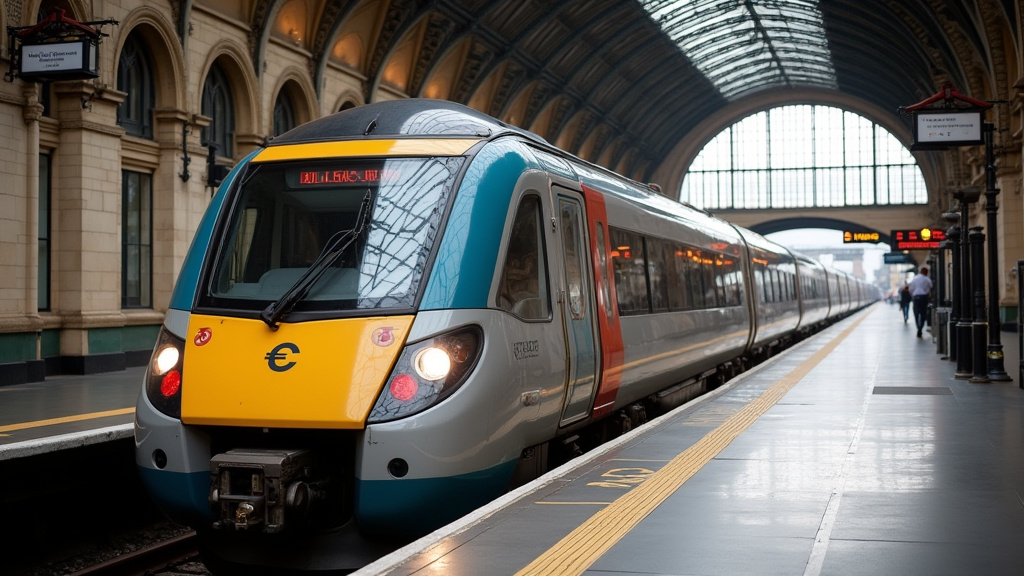
The UK’s railway landscape has officially shifted again as Chiltern Railways transitions into public ownership, marking a decisive step in the Labour government’s ongoing strategy to nationalise key rail services. This move, executed under the framework of the Department for Transport (DfT), signals the end of the traditional private franchise model for this critical route, effectively bringing the operation under state control to align with the government’s broader rail reform agenda. The transition represents a fundamental change in how the service—connecting London Marylebone with the West Midlands—will be managed, funded, and held accountable in the years to come.
Key Highlights
- State Oversight: Chiltern Railways is now operated under public ownership, with the government assuming direct responsibility for the service’s performance and financial management.
- Strategic Reform: This move is a central component of the Labour Party’s ‘Rail Reform Bill,’ which aims to consolidate disparate operators into a unified system under Great British Railways (GBR).
- Continuity Promise: Officials have emphasized that for the immediate future, passenger-facing operations, including ticket pricing and timetables, will remain stable to prevent service disruption.
- Franchise Era Ends: The transition marks another significant contraction of the privatised franchise system that has governed UK rail since the 1990s.
A New Era for the Marylebone Line
The transition of Chiltern Railways is not merely a bureaucratic shift; it is a manifestation of a profound change in the philosophy of public transport in the United Kingdom. For decades, the rail network has operated under a patchwork of private franchises, a model that critics long argued prioritised shareholder dividends over operational excellence and passenger comfort. By bringing Chiltern into the public fold, the government is signalling its intention to treat rail infrastructure as a public utility rather than a profit-driven commercial enterprise.
The Mechanism of Transition
To understand the legal mechanics, one must look at how the government utilizes the ‘Operator of Last Resort’ (OLR) framework. When a franchise contract reaches its natural conclusion or is terminated due to performance failures, the DfT steps in. In this instance, the transition is part of a planned phase-out of legacy contracts. The government has established a ‘Passenger Services Trust’ to oversee these operations, ensuring that the staff, rolling stock, and maintenance contracts are transferred seamlessly without impacting the day-to-day commute.
Critics of the previous model point to the complexity of the franchise system, which often led to conflicting incentives and fragmented investment. Under the new public ownership structure, the DfT can, in theory, synchronize the Chiltern line more effectively with other national services, creating a more integrated network. The goal is to move away from the competitive bidding wars of the past and toward a ‘Great British Railways’ structure where cooperation between lines replaces competition.
Policy Objectives and Economic Reality
The Labour government’s decision to accelerate nationalisation is rooted in its manifesto commitments to reduce rail fragmentation. The economic argument is twofold: first, by eliminating franchise fees and management profit margins, the government hopes to reduce long-term taxpayer subsidies; second, central control allows for tighter budgetary oversight. However, this is not without its risks. Taking on these responsibilities means the state also assumes the financial risk of operational deficits. Should passenger numbers fail to recover to pre-pandemic levels, the burden falls directly onto the Treasury rather than a private operating company.
Furthermore, the integration process involves significant technical hurdles. Harmonizing IT systems, payroll, human resources, and safety protocols for a large rail operator requires meticulous planning. The Department for Transport has tasked a team of industry experts with ensuring that this transition does not compromise safety or performance metrics—areas where public trust is particularly fragile given the historical challenges of state-managed rail entities.
Passenger Impact: Short-term vs. Long-term
For the daily commuter, the immediate impact is likely to be negligible—and that is by design. The government is acutely aware that any service degradation during the transition period would undermine the entire reform narrative. Ticket prices, as currently regulated by the government, will remain largely unchanged in the short term. However, the long-term potential for ‘simpler ticketing’ and ‘integrated multi-modal transport’—where a single ticket might cover a train, bus, and tram journey—is the touted benefit of this state-led model.
Future-Proofing the Network
Looking ahead, the success of the Chiltern nationalisation will serve as a bellwether for the rest of the network. If the government can demonstrate that it can run this specific route more efficiently, with higher punctuality and cleaner stations, it will bolster the argument for the rapid nationalisation of the remaining private contracts. If, conversely, the service struggles under the weight of administrative bureaucracy, it may embolden critics who believe that public management is inherently less efficient than private enterprise. The coming eighteen months will be critical, as the government continues to phase out other franchises across the country, building towards a monolithic, state-directed network that is expected to rival the structures seen in countries like France, Germany, and Switzerland.
FAQ: People Also Ask
1. Does the nationalisation of Chiltern Railways mean ticket prices will go down immediately?
No. The transition to public ownership does not automatically trigger a price reduction. Ticket pricing remains a government-regulated policy, and while the aim is to create a more integrated and efficient system, immediate fare cuts are not a part of the current operational transition plan.
2. Will there be changes to the train timetables or routes?
Not in the immediate future. The government’s priority is ‘continuity of service.’ While long-term rail planning will eventually involve timetable restructuring as part of the Great British Railways roll-out, commuters should expect current schedules to remain in place for the foreseeable future.
3. Is this part of a wider trend in the UK rail network?
Yes. This is a deliberate, systematic policy by the current Labour government. They are committed to phasing out the private franchise model across the entire UK rail network as existing contracts expire, moving toward a unified nationalised service under the Great British Railways brand.
4. Who is now responsible for the day-to-day running of Chiltern Railways?
The operations are now managed under the authority of the Department for Transport (DfT), utilizing the government’s rail operational framework. The specific management teams are tasked with maintaining current safety, service, and infrastructure standards on behalf of the public.