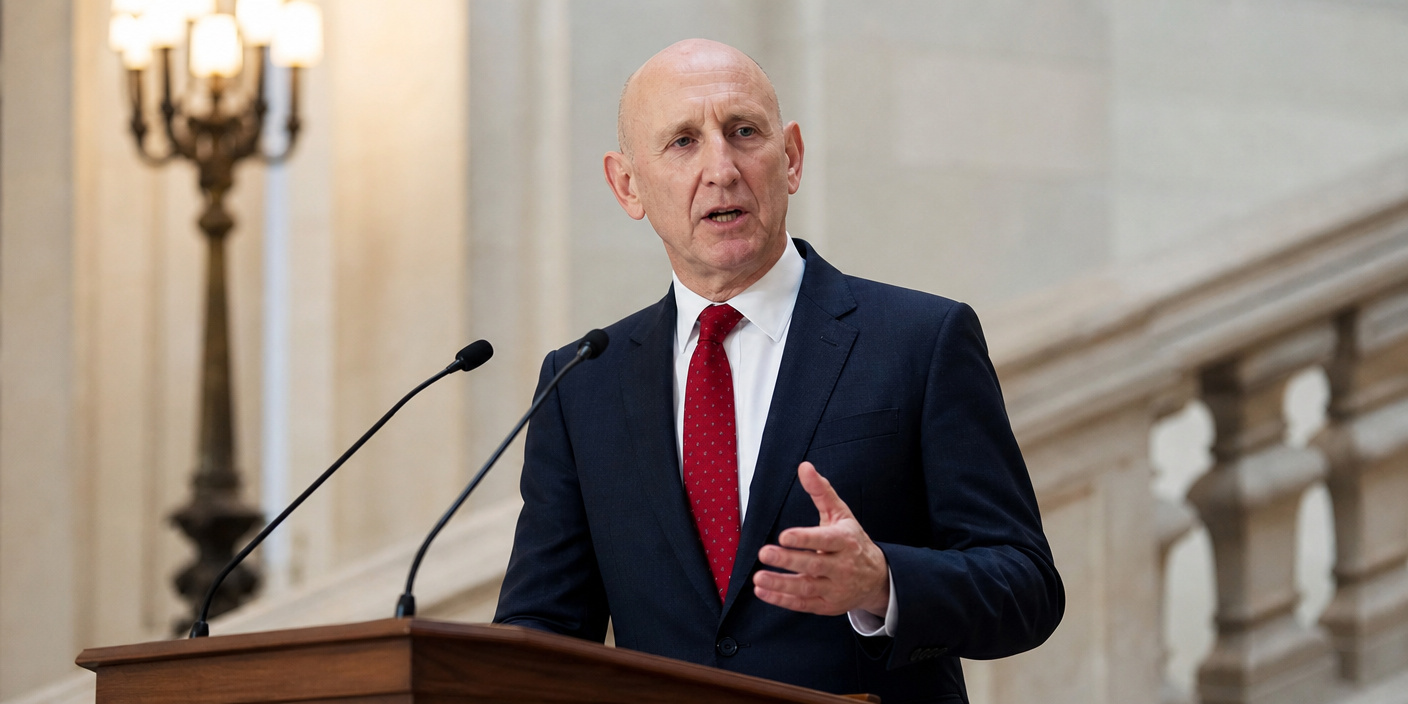
In his first major speech as Chancellor, John Healey has laid out a starkly ambitious agenda for the UK economy, signaling an urgent pivot toward what he termed ‘Great Britain Growth Britain.’ Facing a challenging landscape of persistent inflation and stagnating productivity, Healey utilized his platform to issue a direct pledge to businesses: the government intends to draw a line under the spiraling costs that have crippled the private sector. While the rhetoric was heavy on ambition, the substance remains tied to a delicate balancing act, particularly as businesses wait for the pivotal October Budget to see if these promises will be met with tax relief or further fiscal consolidation.
Key Highlights
- Strategic Pivot: Chancellor John Healey has formally launched the ‘Great Britain Growth Britain’ initiative, prioritizing structural economic growth over short-term fiscal contraction.
- The Three-Pronged Approach: The government will focus its immediate interventions on three critical cost drivers: energy bill volatility, burdensome regulatory requirements, and the rising cost of labor.
- Budget Ambiguity: Despite the pro-growth sentiment, Healey offered no concrete details on potential tax hikes, keeping investors and business leaders on high alert ahead of the October Budget.
- Economic Realignment: The strategy represents a fundamental shift in the Treasury’s approach to the private sector, aiming to foster an environment conducive to long-term investment.
The Strategy: Drawing the Line on Growth
Chancellor John Healey’s maiden speech was not merely a series of policy announcements; it was a calibrated effort to reassure a nervous business community. For months, UK firms—ranging from small and medium-sized enterprises (SMEs) to FTSE 100 giants—have grappled with a ‘polycrisis’ of economic pressures. By explicitly pledging to ‘draw a line’ under rising costs, Healey has set a high-stakes benchmark for his own administration. The core of this strategy rests on the recognition that without a competitive cost environment, the UK will struggle to attract the foreign direct investment (FDI) necessary to power a broader economic recovery.
The Energy Burden
The most immediate pressure point identified in the Chancellor’s speech was the volatility of energy bills. While the UK wholesale energy market has stabilized compared to the shocks of 2022, businesses continue to operate under a cloud of uncertainty. Healey’s plan appears to pivot toward long-term price security rather than just short-term subsidies. By pushing for a greater emphasis on domestic energy security and grid modernization, the Treasury aims to insulate British manufacturing from global commodity market shocks. This approach is widely viewed by economic analysts as a shift from reactionary support to strategic resilience.
The Regulatory Shackles
Regulatory burden remains a perennial complaint from the UK’s Confederation of British Industry (CBI) and other trade bodies. Healey acknowledged that the current layering of post-Brexit compliance, combined with existing labor laws, has stifled innovation and expansion. The Chancellor signaled a desire to streamline planning permissions and review ‘gold-plated’ regulations that do not add value to the national economy. The effectiveness of this move will depend heavily on the Treasury’s ability to navigate the complex inter-departmental bureaucracy required to actually implement deregulation.
The Labor Market Challenge
Perhaps the most complex aspect of the pledge is the promise to address labor costs. With wage inflation having been a necessary, yet painful, driver of cost-of-living adjustments, businesses are currently caught in a wage-price spiral. Healey’s speech hinted at a partnership model—focusing on skills training and vocational investment to boost productivity—thereby allowing businesses to absorb higher labor costs through increased output per worker rather than simple price increases. It is a long-term economic gamble that risks short-term friction with unions and industry advocates alike.
The October Budget: A Silent Storm
While the rhetoric regarding ‘Great Britain Growth Britain’ was optimistic, the shadow of the October Budget looms large. The Chancellor’s deliberate silence on tax hikes—specifically regarding potential changes to capital gains or business rates—has created a ‘wait-and-see’ environment. This ambiguity is the primary risk factor for Healey. If the upcoming budget prioritizes immediate revenue generation over long-term growth incentives, the market sentiment could turn negative rapidly. Business leaders are seeking a clear, stable fiscal roadmap, and the Chancellor has bought himself time with this speech, but he has also raised expectations that must be met in the autumn.
FAQ: People Also Ask
1. What does the ‘Great Britain Growth Britain’ slogan mean?
It represents the Treasury’s new narrative focus on transitioning from austerity-driven management to a proactive, growth-oriented fiscal policy, aimed at increasing national productivity and GDP.
2. How will the government address energy costs?
While the full plan is in development, the Chancellor emphasized energy independence and grid modernization, suggesting a move away from temporary handouts toward structural market security.
3. Will there be tax hikes in the October Budget?
Healey remained intentionally vague. While he promised to lower the cost of doing business, he did not rule out potential tax adjustments, which remains the primary concern for investors.
4. Which sectors will benefit most from this policy?
Manufacturing, energy, and infrastructure sectors are the primary targets, as they are most sensitive to the specific regulatory and energy cost pressures identified by the Treasury.