
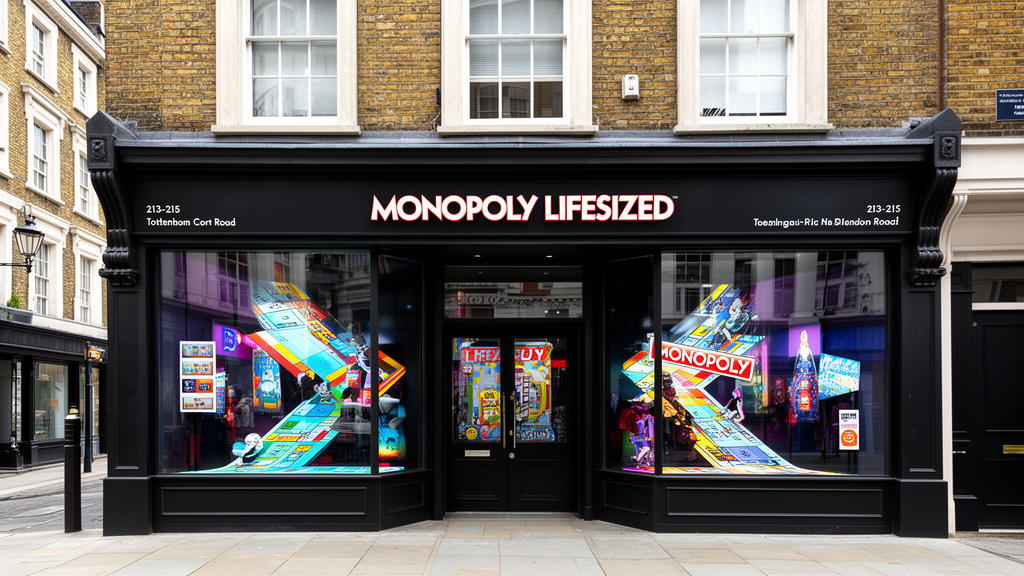
London’s entertainment landscape is bracing for a significant shift as the immersive phenomenon Monopoly Lifesized prepares to close its doors permanently on January 3, 2027. The attraction, located on the bustling Tottenham Court Road, has been a fixture of the city’s “retailtainment” sector for five years, blending the iconic board game with high-stakes physical interaction. While the news of Monopoly Lifesized closing has surprised many regular visitors, the decision reflects a broader, calculated cycle within the immersive venue market, where temporary residencies are becoming as strategically important as long-term retail establishments.
Key Highlights
- Closure Date: Monopoly Lifesized will cease all operations on January 3, 2027.
- Location Context: The venue occupies a prime spot at 213-215 Tottenham Court Road, London.
- The Run: This closure concludes a successful five-year tenure that brought the Hasbro-licensed board game to life for thousands of participants.
- Strategic Shift: The move highlights the evolving business model of Gamepath Entertainment in the post-pandemic immersive market.
The Strategic Sunset of Monopoly Lifesized: Why the Game is Ending
The closure of Monopoly Lifesized is not merely a sign of decline, but rather a reflection of the sophisticated lifecycle management now required in the immersive entertainment industry. Since its opening, the attraction has been a flagship for Gamepath Entertainment, the company responsible for delivering the experience under license from Hasbro. By bringing the board game into a 4D, physical, and digital hybrid space, the venue provided a case study in how to successfully monetize intellectual property through physical proximity.
The Evolution of Immersive Entertainment
When the attraction first opened, it was at the vanguard of the ‘eatertainment’ and immersive movement. The industry saw a boom in venues that required physical presence, transforming empty retail spaces into high-density experience centers. However, as the market matures, operators are becoming more selective. The five-year lifecycle—an often-cited benchmark in real estate and entertainment licensing—allows operators to recoup significant capital expenditure while keeping the brand relevant. By closing on January 3, 2027, the organizers are effectively managing the depreciation of the physical infrastructure and the potential fatigue of the customer base, ensuring that the brand maintains a premium reputation rather than becoming stale.
Analyzing the Gamepath Entertainment Model
Gamepath Entertainment’s approach to this location has been highly disciplined. By integrating the mechanics of Monopoly—property trading, jail time, and utilities—into a physical, full-scale environment, they tapped into a multi-generational audience. The economics of such a venture are complex; they rely on high-volume throughput and secondary spending (food, beverage, and merchandise). After five years, the data regarding customer acquisition costs and repeat visitation rates has likely reached a point where the marginal return on maintaining this specific site is no longer the most efficient use of resources. This is a common strategy in the tech-enabled hospitality sector: hit the market hard, maximize the ROI, and exit before the maintenance costs of complex mechanical and digital systems outweigh the revenue growth.
Tottenham Court Road: A Changing Urban Canvas
Beyond the business metrics, the venue has occupied a critical node on Tottenham Court Road, a street that has undergone significant transformation over the last half-decade. As London’s urban planning prioritizes mixed-use developments, the 213-215 site finds itself in a highly competitive real estate market. The closure provides a blank canvas for the next iteration of the building’s utility. Whether this results in a new, modernized entertainment concept or a pivot toward more traditional commercial use remains to be seen, but the departure of such a high-profile anchor tenant will certainly trigger a pivot in the local foot traffic patterns.
The Future of Branded Real-World Experiences
What does the closure signal for the future? We are likely witnessing a transition toward “pop-up plus” models—experiences that are designed from the outset to move, evolve, or shutter on a defined schedule. The industry is moving away from permanent brick-and-mortar installations of fleeting content and toward highly curated, time-bound residencies. This allows companies like Hasbro to keep their IP fresh. As Monopoly Lifesized wraps up, the industry will look closely at what replaces it. Is there a appetite for a new, higher-tech experience, or is the market signaling a return to more traditional forms of social entertainment? For now, the closure stands as a milestone: a five-year testament to the power of taking a classic tabletop experience and inflating it into a real-world, high-stakes, city-center spectacle.
FAQ: People Also Ask
Q: Is Monopoly Lifesized closing permanently?
A: Yes, the venue will permanently close its doors on January 3, 2027, following a successful five-year run in London.
Q: Why is the attraction closing after five years?
A: While an official reason regarding the specific lease has not been disclosed, industry analysts point to the standard lifecycle of immersive retailtainment venues, where five years typically marks the end of an initial strategic investment period for high-overhead, tech-enabled experiences.
Q: What will happen to the Monopoly Lifesized location on Tottenham Court Road?
A: Details regarding the future use of the space at 213-215 Tottenham Court Road have not yet been announced. The prime location will likely attract significant interest from commercial real estate developers or other entertainment operators.