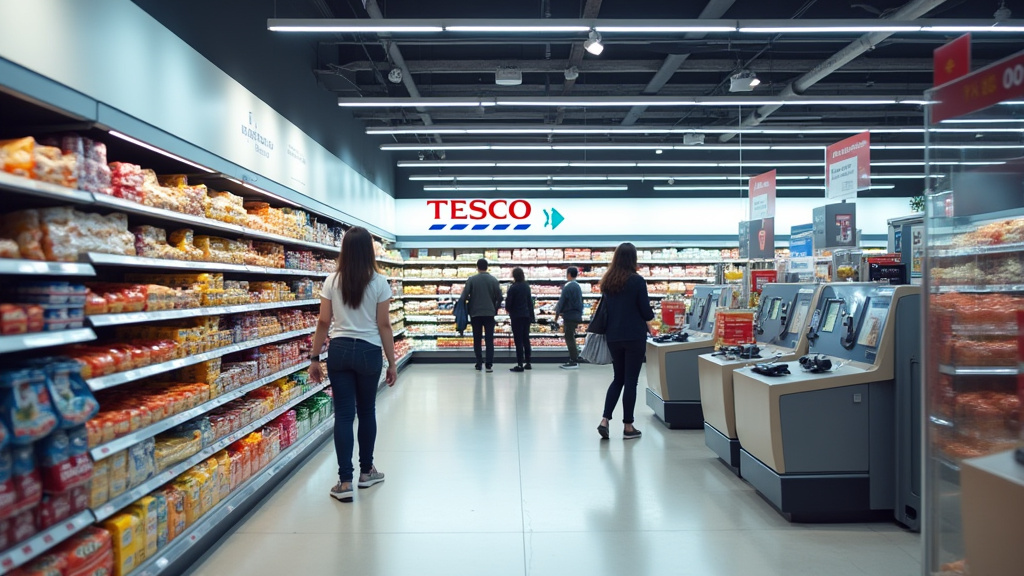
Tesco has unveiled a formidable financial performance for the first half of the 2026/27 fiscal year, characterized by robust sales growth and a significant uptick in digital engagement. As the UK’s leading retailer navigates a complex economic landscape, its latest interim results demonstrate operational resilience and a sharp focus on consumer value, underscored by record-breaking customer satisfaction scores and consistent profitability.
Key Highlights
- Group sales (excluding VAT and fuel) grew by 2.0% year-on-year.
- Adjusted operating profit reached an impressive £1,783 million.
- Online channel dominance continues with an 8% increase in digital sales.
- Achieved record-high customer satisfaction scores across all store formats.
Navigating Market Volatility: Tesco’s Strategic Pivot to Digital Dominance
The retail sector in 2026 remains a battlefield of efficiency, cost-management, and technological integration. Tesco PLC’s latest interim report provides a masterclass in balancing these conflicting demands. With an adjusted operating profit of £1,783 million, the company has proven that its scale is a major asset, allowing it to absorb inflationary pressures while maintaining aggressive pricing strategies that keep the competition, particularly the discounters, at bay.
The Financial Foundation: Resilience in Numbers
At the core of the 2026/27 results is the 2.0% growth in group sales (excluding VAT and fuel). In an economy where consumer spending has been heavily scrutinized, a 2% top-line expansion represents significant volume protection. It indicates that Tesco’s ‘Clubcard Prices’ strategy—a central pillar of their loyalty mechanics—continues to resonate with the cost-conscious British shopper. By anchoring prices for loyalty members, Tesco has successfully maintained high footfall and basket sizes even when broader economic indicators suggested a contraction.
The £1,783 million adjusted operating profit is perhaps the most closely watched metric by analysts on the FTSE 100. This figure highlights the efficiency of the group’s supply chain. By leveraging AI-driven demand forecasting, Tesco has successfully reduced spoilage and inventory holding costs, directly contributing to the bottom line without needing to pass on excessive price hikes to the end consumer.
Digital Transformation: The 8% Shift
The standout statistic in this report is the 8% increase in online sales. This growth is not merely a post-pandemic trend; it is a fundamental shift in how the average household interacts with their primary grocer. Tesco has invested heavily in its ‘Whoosh’ rapid delivery service and has optimized its online user interface (UI) to reduce friction in the checkout process. This digital acceleration proves that the physical store is increasingly becoming a hybrid fulfillment hub rather than just a retail space.
Integrating the online experience with the physical store network has allowed Tesco to extract more value from every square foot of its real estate. The increase in online sales demonstrates a successful capture of the ‘convenience economy,’ where time-poor consumers prioritize delivery speed and reliability over the experience of in-store browsing.
Consumer Loyalty and Satisfaction Metrics
Perhaps the most intangible yet vital result reported for 2026/27 is the record customer satisfaction score. In an era where brand switching is at an all-time high, Tesco’s ability to retain loyalty is a strategic moat. These satisfaction scores are driven by a combination of consistent stock availability, a high-quality private-label offering, and an improved in-store experience that focuses on cleanliness and staff helpfulness. This sentiment data is a leading indicator of future revenue; satisfied customers are not only more likely to shop again but also more likely to engage with the full range of Tesco services, including their financial products and mobile offerings.
Secondary Angle: Competitive Dynamics
Tesco remains the market leader in the UK, but the rise of discounters like Aldi and Lidl remains a permanent pressure on the business model. The 2026 results show a divergence from the narrative of ‘losing ground’ to the discounters. By sharpening their own-brand products to mimic the quality and price point of discounter rivals, Tesco has effectively neutralized the primary value proposition of the low-cost chains.
Secondary Angle: Supply Chain Efficiency
A deeper look at the operational costs reveals that the £1,783m profit is also a result of a massive investment in logistics automation. The deployment of autonomous vehicles in local distribution hubs and the increased use of automated picking systems in large-format stores have smoothed out labor fluctuations. This automation is a strategic hedge against rising labor costs in the UK retail market.
Secondary Angle: Future Predictions
Looking toward the second half of 2026/27, the primary challenge for the retailer will be maintaining this momentum in the face of potential supply chain disruptions and continued geopolitical instability. However, with a strong balance sheet and a proven track record of digital and physical integration, Tesco appears well-positioned to maintain its leadership in the FTSE 100 retail space.
FAQ: People Also Ask
1. What does the 2.0% growth figure represent?
It represents the year-on-year growth in group sales, excluding the volatile effects of VAT and fuel prices, providing a ‘like-for-like’ look at the health of the core grocery business.
2. Why is the 8% online sales growth significant?
It indicates that digital grocery shopping is continuing to grow despite the full return to in-person shopping, suggesting that online delivery has become a permanent, integral part of the grocery model.
3. How does Tesco justify such high operating profits?
Through a combination of massive scale, supply chain automation, and the effective use of loyalty data to optimize pricing and inventory, allowing the company to maintain margins without alienating price-sensitive customers.
4. What are the key factors driving customer satisfaction?
Retail analysts point to improved in-store availability, the success of the loyalty program (Clubcard), and the seamless integration of digital ordering with physical store pickup as the primary drivers of this record-high sentiment.