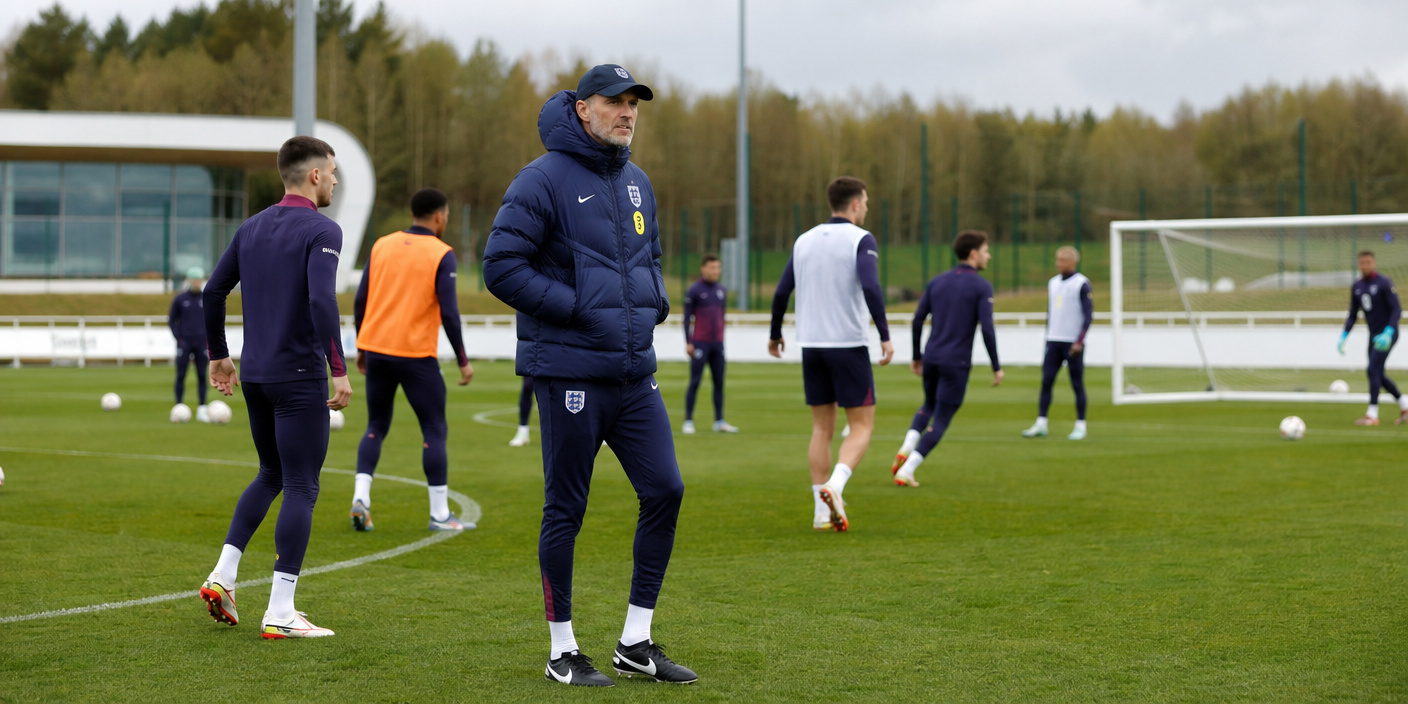
Thomas Tuchel has provided a sobering update regarding England’s defensive preparations for Tuesday’s UEFA Nations League encounter against the Czech Republic, confirming that defenders Ezri Konsa and Nico O’Reilly are currently nursing “minor issues.” The pair, who have been integral to Tuchel’s training plans during this international window, were notable absences from Monday’s tactical session, casting immediate doubt over their availability for the upcoming fixture. With the Nations League group stage reaching a critical juncture, the England manager faces a selection dilemma that could necessitate a tactical reshuffle at the back.
The Training Ground Setback
The confirmation from Thomas Tuchel comes at a delicate time. England is currently fine-tuning its defensive structure, a hallmark of Tuchel’s early tenure, and the loss of two key defensive personnel—even if described as “minor issues”—disrupts the fluidity of the squad’s preparation. The duo missed the entirety of the Monday session at St. George’s Park, an essential period where the coaching staff typically embeds the final tactical instructions before a matchday.
While “minor issues” is often football parlance for precautionary management, the timing is less than ideal. In international football, where the time between matches is compressed, such absences can quickly escalate from precautionary rests into match-day omissions. Tuchel, known for his meticulous approach to player fitness, is unlikely to risk aggravating long-term issues for short-term gains, particularly given the squad depth currently at his disposal. However, the absence of Konsa, whose versatility across the defensive line has been a key asset, and O’Reilly, who has been pushing for greater involvement, limits the manager’s ability to rotate his squad effectively against a disciplined Czech side.
Tactical Implications and Defensive Stability
The absence of specific players is not merely about personnel; it fundamentally changes the tactical blueprint. Ezri Konsa has established himself as a reliable, ball-playing defender capable of operating in a back three or a back four. His comfort on the ball is vital for Tuchel’s system, which demands patient build-up play from the defensive third.
If Konsa is sidelined, Tuchel must decide whether to promote a more traditional defensive profile or lean into a younger, more dynamic alternative. The Czech Republic’s tactical identity typically relies on a compact defensive shape coupled with rapid transitions, meaning England’s defenders must be both technically proficient and physically prepared to handle counter-attacks. Without the specific profiles of Konsa and O’Reilly, Tuchel may be forced to alter his defensive line’s height and pressing triggers. This match serves as a barometer for England’s defensive resilience; the ability to maintain a clean sheet despite personnel changes is often what separates tournament contenders from the pack.
The Tuchel Era: Integrating Youth and Depth
This injury news highlights the broader challenge Thomas Tuchel faces in his first full cycle: balancing the integration of emerging talents like Nico O’Reilly with the need for consistent results. The Nations League provides the perfect laboratory for this experimentation. O’Reilly’s development has been a bright spot in the squad’s recent trajectory, and his absence from the training pitch is a missed opportunity for the coaching staff to continue refining his positioning within a senior-level structure.
Tuchel’s management philosophy has always prioritized tactical rigidity and positional intelligence. By missing training, players often miss the granular details—the specific instructions on how to handle the Czech Republic’s attacking transitions or the precise movements required to break down their low block. While the senior players may adapt quickly, for younger talents, these training sessions are the difference between looking assured or looking overwhelmed on the international stage. The staff will now have to rely on video analysis and individual meetings to ensure any potential replacements are fully briefed on the tactical requirements of the match.
Secondary Angle 1: Nations League Group Context
The result on Tuesday is not just about points; it is about momentum. The Nations League is increasingly viewed as a competitive dress rehearsal for the upcoming World Cup qualifiers. England currently finds themselves in a position where they cannot afford complacency. Dropping points at home, particularly while managing fitness concerns, could hand the initiative to their group rivals. The psychological pressure of maintaining an unbeaten record under a new manager cannot be understated. Every player missing from the starting XI is a variable that complicates the equation, requiring the remaining squad members to step up and perform beyond their usual capacity.
Secondary Angle 2: The Physicality of the International Schedule
The strain on elite players is a perpetual conversation in the modern game, and this incident brings the topic into sharp relief. With the club season already demanding, these international breaks are becoming increasingly physical. Tuchel’s immediate reaction—classifying these as ‘minor’—is an attempt to manage expectations and avoid fueling media speculation, but it also reflects the reality of a manager protecting his assets. The modern footballer is essentially an elite performance machine, and the margin for error in managing their load is razor-thin. This episode underscores the importance of the medical staff in modern football; they are now arguably as important as the assistant coaches.
Secondary Angle 3: Long-term Squad Architecture
Finally, this situation tests the squad’s ‘next-man-up’ mentality. If England is to succeed in major tournaments, they cannot rely on a fixed starting eleven. They need a deep pool of players who can slot into the system seamlessly. The absence of Konsa and O’Reilly allows the coaching staff to see how the squad responds to adversity. Can the team maintain its defensive shape? Can the backup defenders execute the specific tactical patterns Tuchel demands? These questions are answered not in the training session, but under the lights of a competitive match. This is the crucible in which a winning team is forged: the ability to overcome individual absences and execute the collective mission regardless of who takes the field.
FAQ: People Also Ask
Q: Are Ezri Konsa and Nico O’Reilly definitely out for the match?
A: Thomas Tuchel stopped short of ruling them out, describing their issues as “minor.” The final decision will likely be made after a late fitness test on match day morning to determine if they can participate without risking further injury.
Q: How does this impact England’s defensive formation?
A: If both are unavailable, Tuchel may have to revert to a more experienced central defensive pairing or shuffle positional roles. The primary concern is maintaining the ball-playing efficiency that Konsa typically provides at the back.
Q: Has Tuchel given an update on any other injuries?
A: Aside from the specific mention of Konsa and O’Reilly, the squad otherwise appears to be tracking towards full fitness, though the manager is monitoring several players for fatigue following a demanding domestic club schedule.
Q: Where is the match being played?
A: The UEFA Nations League fixture is hosted by England, with the team utilizing St. George’s Park for their final preparations leading up to the clash.