
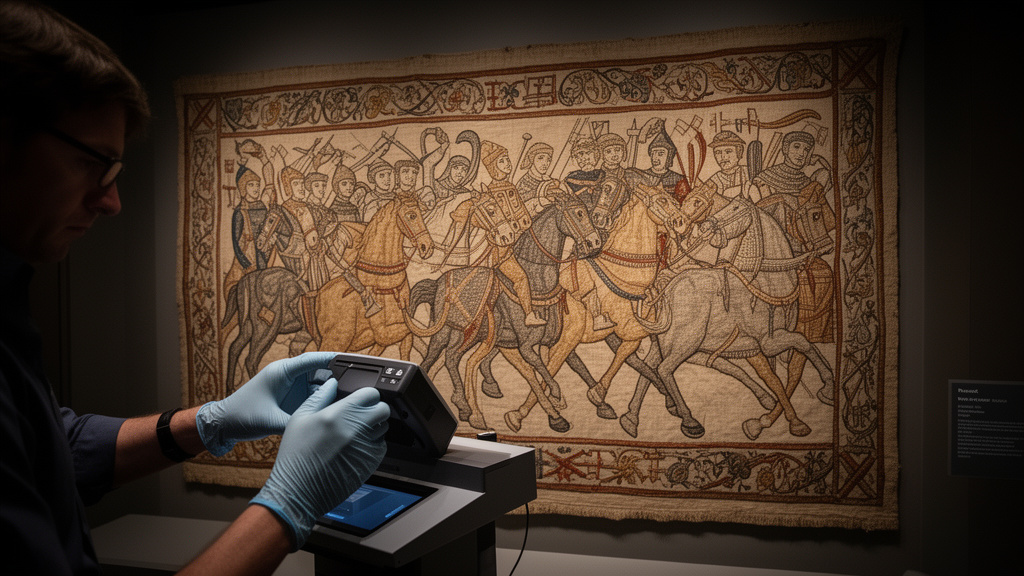
The Bayeux Tapestry, a monumental 70-meter embroidery depicting the pivotal events of the 1066 Norman Conquest, has emerged as the focal point of a significant cultural conversation in London. As scholars from Northeastern University and other institutions provide renewed context to this artifact, modern audiences are gaining a deeper understanding of the intricate visual narrative that details the transition of power from the Anglo-Saxon King Harold Godwinson to William the Conqueror. This ongoing academic exploration highlights not just the history of the conquest, but the lasting cultural significance of what remains one of the most sophisticated examples of medieval storytelling in existence.
Key Highlights
- Unmatched Scale: The tapestry spans approximately 70 meters (230 feet) in length, functioning as a continuous narrative frieze of the 11th-century political and military conflict.
- Scholarly Reinterpretation: Researchers from Northeastern University are leading efforts to contextualize the tapestry’s iconography, using digital humanities to bridge the gap between medieval craft and contemporary historical understanding.
- The 1066 Legacy: The work chronicles the Battle of Hastings, a turning point in English history, serving as a primary source for the tactical, social, and cultural realities of the Middle Ages.
- Global Cultural Impact: Beyond its age, the tapestry serves as a case study for propaganda, visual communication, and the evolution of political power dynamics that still resonate with 21st-century viewers.
Unweaving the Norman Conquest: A New Scholarly Perspective
The Bayeux Tapestry has long been regarded as a masterpiece of Romanesque art, but recent analysis by Northeastern scholars is transforming how we interpret its 70-meter length. While historians have studied the embroidery for centuries, the modern academic lens—often involving advanced digital humanities—is uncovering layers of nuance previously overlooked. By treating the tapestry as a form of “pre-cinematic” storytelling, researchers are now mapping the sequence of events with greater precision, analyzing how the medieval artisans manipulated time and space to favor the Norman perspective of the conquest.
The Art of 11th-Century Narrative
Unlike traditional written records, which were often filtered through the biases of court historians, the Bayeux Tapestry functions as a visual record. It utilizes a combination of crewelwork and couching stitches, primarily using wool yarn on a linen background. The Northeastern research cohort has emphasized that the narrative flow—beginning with Edward the Confessor’s decision to send Harold to Normandy and culminating in the tragic defeat at Hastings—serves as an early form of serialized visual journalism. The scholars argue that the tapestry was not merely decorative but was designed to legitimize William’s claim to the English throne, functioning as a powerful piece of state-sponsored propaganda.
Mapping the Tactical Detail
One of the most compelling aspects of the ongoing research is the focus on the military tactics depicted across the 70-meter length. The scholars are cross-referencing the embroidered cavalry charges, the construction of motte-and-bailey castles, and the use of the famous Saxon shield wall with archaeological evidence. This analysis provides a more granular view of the Battle of Hastings. By aligning the physical evidence found at the battlefield sites with the depictions on the fabric, historians are finding that the artisans possessed a surprisingly acute understanding of military logistics, including the logistical challenges of transporting horses across the English Channel and the specific nature of early Norman siege warfare.
A Modern Connection to Medieval Media
Why does this 11th-century artifact continue to captivate London and the broader international public? The answer lies in its accessibility. In an era saturated with digital media, the Bayeux Tapestry’s linear storytelling feels surprisingly familiar. Researchers note that the “panels” of the tapestry mirror the structure of modern graphic novels or storyboards. The Northeastern team suggests that the tapestry’s ability to communicate complex political shifts—without the need for extensive literacy—makes it a universal touchstone. As it captures the imagination of London, it serves as a reminder that the human need to document, memorialize, and debate historical turning points is a constant throughout the ages.
The Logistics of the 70-Meter Masterpiece
Displaying a textile of such scale and fragility presents immense challenges. The tapestry is essentially an organic document; it is susceptible to light, humidity, and temperature fluctuations. The conservation efforts surrounding the piece are as complex as the research itself. Experts are currently utilizing non-invasive scanning technologies, partly influenced by the research methodologies seen in Northeastern’s digital humanities initiatives, to create high-resolution replicas. This ensures that while the original artifact is preserved in climate-controlled conditions, the narrative can be shared, studied, and exhibited without compromising the structural integrity of the 900-year-old linen.
FAQ: People Also Ask
Q: How long is the actual Bayeux Tapestry and what does it measure?
A: The Bayeux Tapestry is approximately 70 meters (230 feet) long and 50 centimeters (20 inches) wide. It is comprised of several linen panels sewn together to create a singular, continuous narrative.
Q: Does the tapestry accurately depict the events of 1066?
A: While it is a primary source from the period, it is important to note that the tapestry was commissioned, likely by Bishop Odo of Bayeux, and therefore reflects a Norman viewpoint. Scholars use it in conjunction with other historical documents to form a balanced understanding of the Battle of Hastings.
Q: Why are Northeastern scholars involved in the study of this artifact?
A: Northeastern University’s researchers, particularly within the fields of digital humanities and information design, are applying modern analytical techniques to visualize and parse the tapestry’s data-heavy narrative. Their work helps to digitize the story, making it more accessible to modern students and the public while offering new insights into how medieval visual culture operated as a communication tool.