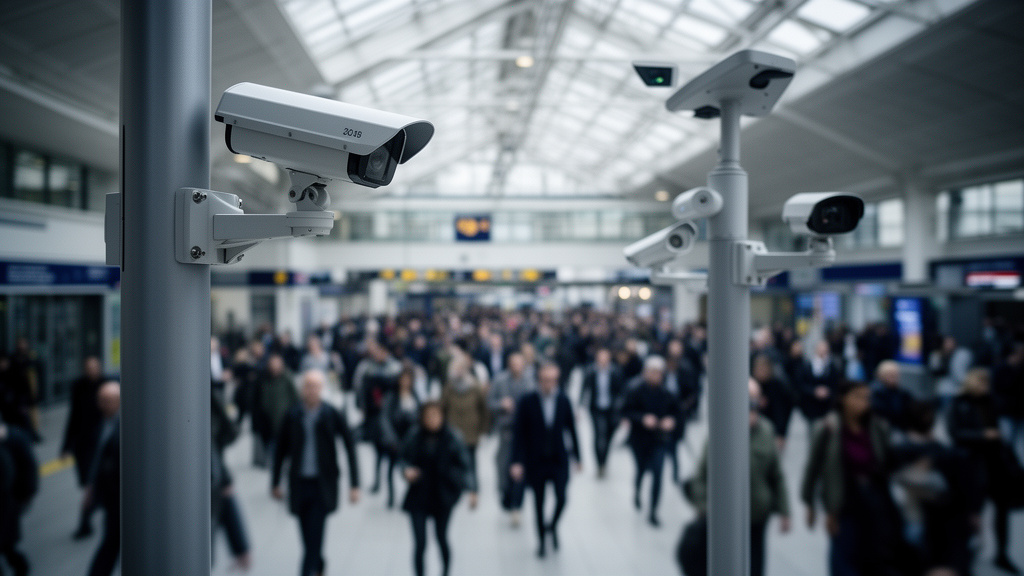
A pilot of live facial recognition (LFR) technology deployed across London’s transport network has faltered, casting a significant shadow over the Metropolitan Police’s (MPS) evolving surveillance strategies. The deployment, intended to identify individuals wanted for serious offenses, resulted in a confirmed false positive identification that led to no arrests, yet effectively compromised the privacy of an innocent commuter. This incident has reignited an urgent, multifaceted debate regarding the accuracy, transparency, and civil liberty implications of deploying biometric policing tools in high-traffic public spaces.
Key Highlights
- Algorithmic Failure: A confirmed false positive identification occurred during the recent London LFR trial, causing unnecessary disruption and raising questions about system reliability.
- Zero Arrest Efficacy: The event resulted in no arrests, highlighting the high cost and low operational efficiency of relying on automated biometric matching in public environments.
- Civil Liberties Scrutiny: Privacy watchdogs, including Big Brother Watch and Liberty, are demanding a moratorium on the technology, citing the potential for discriminatory outcomes and the erosion of public anonymity.
- Policy Tension: While the Metropolitan Police maintain that LFR is a vital tool for combating violent crime, this latest error underscores the significant technical and ethical hurdles that remain before widespread adoption is feasible.
The Surveillance Crossroads: Evaluating London’s Biometric Misstep
The Metropolitan Police Service has long championed the use of Live Facial Recognition as a force multiplier—a technological solution designed to scan the faces of thousands of commuters and cross-reference them against a pre-existing ‘watchlist’ in real-time. The promise is efficiency: finding dangerous offenders in the crowd without manual intervention. However, the recent incident in a London transport station serves as a stark reminder of the gap between the promise of precision and the reality of algorithmic fallibility.
At the core of the issue is the ‘false positive’—a scenario where the AI engine incorrectly matches a member of the public to a profile within the police database. When such an error occurs, it is not merely a technical glitch; it is an interaction that carries real-world consequences, ranging from public embarrassment and inconvenience to the potential for escalated police intervention.
The Mechanics of Algorithmic Error
To understand why this failure occurred, one must look at how LFR systems function. These systems utilize deep neural networks trained on vast datasets of human features. They measure ‘nodal points’—the distance between eyes, the shape of the jawline, and the structure of the nose—to create a mathematical ‘faceprint.’ This print is then compared against a watchlist, which typically includes images of individuals wanted for outstanding warrants, violent offenses, or serious crimes.
However, these systems are not infallible. Variables such as lighting conditions in busy transport stations, camera angles, crowd density, and occlusions (such as hats, glasses, or movement) can significantly skew the accuracy of the matching process. When the system returns a ‘match,’ it is essentially providing a probability score. In this instance, that probability was incorrectly weighted, identifying an innocent individual as a target. This failure exposes the inherent tension between the ambition of ‘perfect’ security and the chaotic, unpredictable nature of human movement in urban centers.
Regulatory and Legal Implications
The deployment of this technology occurs within a complex legal framework. In the UK, police use of LFR is governed by a combination of the Data Protection Act 2018, the Human Rights Act 1998, and the ongoing interpretation of common law police powers. Critics argue that the current legal structure is insufficiently robust to handle the nuances of AI-driven surveillance.
Legal challenges have frequently centered on the ‘necessity and proportionality’ of these trials. If a system is prone to false positives, does its potential benefit—catching a wanted offender—outweigh the rights of the innocent citizens who are scanned, stored, and falsely flagged without their consent?
The Impact on Public Trust
Beyond the legal and technical arguments, there is the sociological impact. The introduction of pervasive biometric surveillance can alter the social fabric of a city. The ‘chilling effect,’ where citizens alter their behavior, dress, or willingness to engage in public assembly due to the knowledge that they are being tracked, is a primary concern for civil liberty organizations. When a false positive occurs, it reinforces the narrative that these systems are ‘guilty until proven innocent,’ shifting the burden of verification onto the citizen rather than the state.
Future Trajectory of UK Biometrics
The Metropolitan Police have signaled that they intend to refine their approach, potentially integrating more sophisticated sensors and improving the quality of the watchlist data. Yet, as the technology advances, so too does the call for legislative oversight. Many policy experts argue that a dedicated statutory framework, rather than relying on existing policing guidelines, is necessary to regulate the use of LFR. This would include mandates for regular independent audits, public transparency reports, and clear protocols for addressing algorithmic bias and error rates.
As London moves forward with future iterations of these trials, the threshold for public acceptance will likely be tied to the system’s ability to demonstrate consistent, verified accuracy. Until then, the spectre of the false positive will remain a potent argument for those who fear that the efficiency of technology may come at the expense of fundamental democratic freedoms.
FAQ: People Also Ask
1. What exactly constitutes a ‘false positive’ in facial recognition?
A false positive occurs when the facial recognition algorithm incorrectly flags an individual as being a ‘match’ for someone on the police watchlist. The system determines there is a high probability that the person is the target, even though it is actually a different person, leading to erroneous intervention.
2. Is there a way to prevent these errors?
While no algorithm is 100% accurate, the Metropolitan Police attempt to mitigate errors by ‘tuning’ the matching threshold. However, this is a trade-off: a tighter threshold might reduce false positives but increase ‘false negatives’ (missing actual suspects), while a looser threshold captures more suspects but increases the frequency of false positives.
3. Do police have the right to scan my face in public?
This remains a subject of intense legal debate. While the police operate under general powers to prevent and detect crime, courts have previously ruled that the use of LFR must be ‘in accordance with the law,’ which implies a need for clearer, more specific legislation rather than broad reliance on current policing discretion.
4. What happens to my data if I am scanned?
According to police policy, data of individuals who are not a match should be deleted almost immediately. However, privacy advocates argue that the initial processing itself—the scanning and comparison—is an intrusion that requires strict independent oversight to ensure data is not being retained or repurposed improperly.