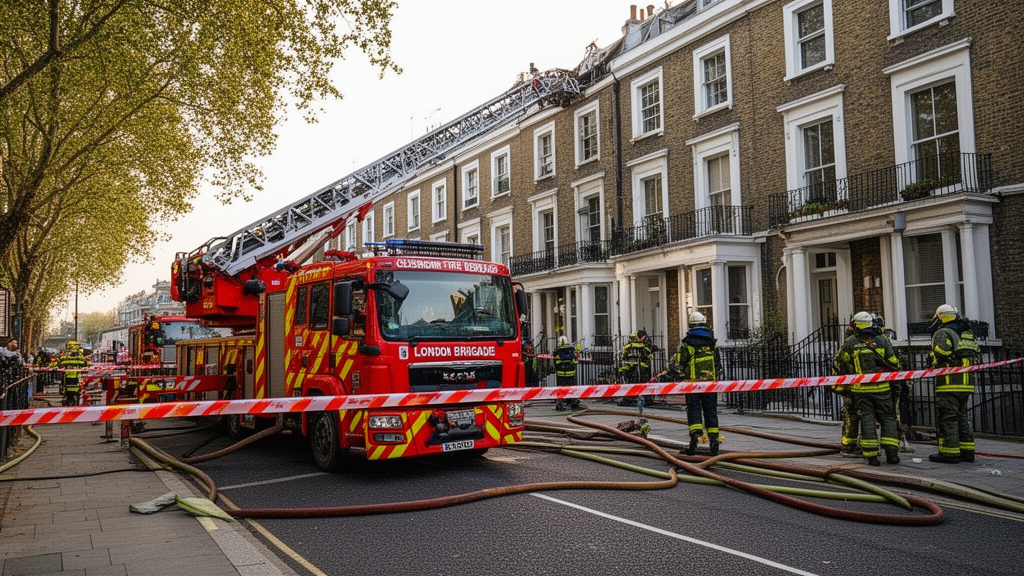
A high-stakes emergency unfolded this Saturday morning as multiple fire crews rushed to combat a significant building fire on Westbourne Park Road in Notting Hill, prompting a major emergency response across the district. The incident, which saw seven London Fire Brigade (LFB) units descend upon the scene, caused immediate disruption to local traffic and raised concerns regarding public safety in the densely populated neighborhood.
Key Highlights
- Rapid Mobilization: Seven London Fire Brigade units were dispatched to the Westbourne Park Road incident, indicating a serious structural fire rating.
- Strategic Cordon: Authorities established an immediate exclusion zone to facilitate firefighting efforts and protect local residents.
- Operational Focus: The primary objective of the LFB is to prevent fire spread to adjacent, historically significant properties.
- Traffic Impact: Significant delays are expected in the Notting Hill area; commuters are advised to avoid the vicinity.
The Anatomy of the Notting Hill Emergency Response
The activation of seven fire appliances suggests that the London Fire Brigade assessed this incident as a high-priority structural fire. Fighting fires in areas like Notting Hill presents unique, complex challenges for emergency responders. The architecture, characterized by dense, late-Victorian terrace housing, creates a high risk of rapid lateral fire spread through common wall cavities and interconnected roof spaces.
Tactical Fire Suppression in Urban Environments
When the first responders arrived on Westbourne Park Road, their initial priority was establishing an outer cordon to clear the streets for heavy apparatus. The deployment of seven units typically includes not only standard fire engines but also specialized aerial appliances, such as the 32-meter turntable ladder, which allows firefighters to tackle blazes from above—a critical necessity in older neighborhoods where narrow street access can obstruct ground-level equipment.
In urban fire suppression, the ‘command and control’ structure is vital. On-scene commanders must balance the need for aggressive interior firefighting with the structural integrity of buildings that may have compromised floors or stairwells. The LFB’s strategy involves using high-pressure water jets and thermal imaging cameras to identify hotspots behind walls or ceiling voids before they ignite, a procedure that requires extreme precision in a multi-story residential building.
The Logistics of Historical Preservation and Safety
Notting Hill is renowned for its architectural heritage, which often conflicts with modern fire safety requirements. Many properties in the Westbourne Park Road area retain original features that lack modern fire-stopping materials—the fire-resistant barriers that prevent smoke and flames from migrating between apartments. During an active fire, the primary goal of the LFB is to contain the ‘fire load.’ If the fire originates in a single unit, the structural gaps inherent in older building designs mean that firefighters must work simultaneously in the affected unit and the surrounding homes to strip back plaster and ensure no sparks have traveled through the ceiling joists.
Analyzing the Economic and Social Impact
Beyond the immediate danger, an event of this magnitude disrupts the delicate economic ecosystem of Notting Hill. Westbourne Park Road serves as a critical artery, and its closure impacts local businesses, delivery routes, and public transit. Historically, incidents like this lead to temporary displacements. The local council, in coordination with the London Fire Brigade, often triggers emergency protocols to provide shelter and support for affected residents. The economic impact is twofold: the immediate cost of fire suppression resources and the secondary, long-term costs associated with building repairs, potential business interruption, and insurance premiums for the area.
Future Predictions: Building Safety Legislation
The Notting Hill fire serves as a stark reminder of the ongoing debate surrounding building regulations in London. While new builds are subject to strict fire safety codes, the city’s vast stock of older, converted properties remains a focal point for safety regulators. Experts argue that there is a critical need for retrofitting existing structures with advanced sprinkler systems and improved fire-stopping technology. As climate patterns shift, with longer, drier summer periods, the risk of fire incidents in aging urban centers is predicted to rise, necessitating a robust evolution in how the city manages structural fire risk.
FAQ: People Also Ask
Q: Was anyone injured in the Notting Hill fire?
A: Emergency services have not yet released an official statement regarding casualties or injuries. The primary focus remains the containment of the fire and the search-and-rescue operation within the affected building.
Q: Why were there seven fire units sent to this location?
A: The LFB determines the number of units based on the severity of the incident. A response of seven units indicates a multi-pump assignment, which is standard for fires that are deemed ‘well-developed’ or posing a significant risk of spreading to adjacent properties.
Q: When will Westbourne Park Road reopen?
A: Road closures are expected to remain in place while fire investigators and structural engineers assess the site. Residents are advised to monitor the London Fire Brigade’s official social media channels for real-time traffic updates.
Q: What caused the fire?
A: The cause of the fire is currently unknown. Fire investigators will conduct a thorough scene examination once the site is declared safe, which usually occurs after the ‘dampening down’ phase is complete.