
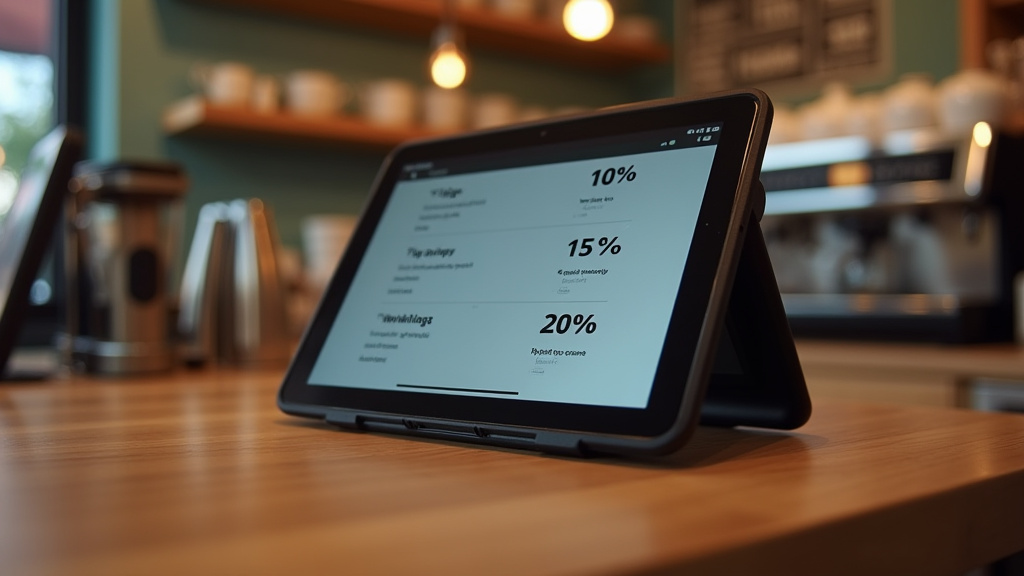
The simple act of buying a morning flat white or a pint in London has become a battlefield of social awkwardness. As customers encounter point-of-sale (POS) terminals rotated toward them with pre-set gratuity prompts—often starting at 10%, 15%, or 20%—a wave of resentment is building across the United Kingdom. This phenomenon, dubbed ‘tip creep,’ represents a fundamental collision between the US-style transactional tipping model and the established British hospitality tradition, where service is largely considered a cost of doing business rather than a consumer obligation.
Key Highlights
- The Technology Shift: The proliferation of digital card readers and integrated POS systems has turned every retail transaction into a potential request for a gratuity, often bypassing the historical ‘discretionary’ nature of tipping.
- Wage Disparities: Unlike in the United States, where sub-minimum wage laws for tipped staff necessitate heavy gratuities, UK hospitality workers are protected by the National Living Wage (currently £11.44 per hour as of April 2024).
- Consumer Backlash: Recent market studies indicate that over 60% of British consumers feel uncomfortable or ‘guilt-tripped’ by automated tipping prompts in non-service settings, such as self-service kiosks or counter-service cafes.
- Hospitality Sector Anxiety: UK Hospitality, the leading trade body, faces a delicate balancing act: supporting staff earnings amid the cost-of-living crisis while avoiding an aggressive tipping culture that alienates the core customer base.
The Americanization of the British Tab: A Cultural Clash
The fundamental friction driving the ‘tip creep’ controversy lies in the disparate economic foundations of the UK and US hospitality sectors. In the United States, the Fair Labor Standards Act allows for a ‘tipped minimum wage’ that is significantly lower than the standard minimum wage, shifting the burden of staff compensation directly onto the consumer. In contrast, the UK operates under a legislative framework that ensures staff receive a base National Living Wage. Consequently, when a customer in a London coffee shop is prompted to leave a 20% tip for a transaction that took thirty seconds, the request is often perceived not as a reward for exceptional service, but as a systematic attempt to offload business operational costs onto the patron.
The Digital Architect of Discontent
The rise of ‘tip creep’ is inextricably linked to the ubiquity of integrated payment technology. Companies such as SumUp, iZettle, and Toast have revolutionized small business accounting, but their default software settings often include automated tipping prompts as a ‘feature’ rather than an afterthought. Business owners, struggling with inflation, supply chain costs, and the need to retain staff during a post-pandemic labor shortage, have frequently enabled these features without fully anticipating the customer-facing impact. The ‘tablet-facing-the-customer’ interaction creates a high-pressure psychological moment; the customer must manually select ‘No Tip’ or ‘Other Amount’ under the gaze of the staff member, fundamentally altering the social contract of a transaction.
Economic Pressures: Staff vs. System
It is vital to distinguish between the ‘tip creep’ observed at the counter and the traditional service charge applied in full-service restaurants. Many UK establishments now apply an optional (or sometimes mandatory) 12.5% service charge to the final bill. This practice has become a standard mechanism to ensure wage stability for front-of-house and back-of-house staff, particularly as rising rent and energy prices squeeze thin profit margins in the hospitality industry. However, when this is combined with automated prompts for additional tipping, the consumer perception shifts from ‘supporting staff’ to ‘being taxed twice.’ The economic reality is that the hospitality sector is navigating its most challenging period in a generation, and while business owners seek to boost retention through increased potential earnings, they risk institutionalizing a model that is deeply unpopular with the British public.
Consumer Psychology and the ‘Guilt-Trip’ Economy
Behavioral economists suggest that the digital prompt introduces ‘decision fatigue’ and ‘social friction.’ Historically, cash tipping was a deliberate, voluntary act of appreciation. The new POS systems replace this with an explicit interface interaction. Data suggests that while ‘opt-out’ rates remain high, a significant minority of consumers—pressured by the physical presence of the terminal—are ‘compliance tipping.’ This behavior is fueling a growing sense of frustration, leading to social media discourse where patrons identify establishments not by their quality of food or drink, but by their ‘aggressiveness’ regarding digital gratuities. This environment creates a reputation risk for independent businesses that may simply be using off-the-shelf software, inadvertently importing American cultural friction into the local high street.
Future Predictions: Will the Bubble Burst?
The trajectory of UK tipping culture appears to be reaching an inflection point. Industry analysts predict a pushback where consumers gravitate toward establishments that maintain a ‘no-prompt’ or ‘no-tip’ policy, viewing it as a badge of honest, upfront pricing. Conversely, larger chains are likely to continue using these systems to subsidize wages as they struggle to fill vacancies. The tension will likely result in a bifurcation of the market: high-end establishments will continue to bake service into the price (or a single, transparent service charge), while the ‘fast-casual’ sector will remain the primary arena for this ongoing digital tipping battle. Ultimately, the survival of the tip prompt in the UK will depend on whether business owners can prove that these tips are transparently distributed to staff rather than simply bolstering operating margins.
FAQ: People Also Ask
Is tipping mandatory in the UK?
No, tipping is strictly voluntary in the UK. Unlike in the US, service staff are paid a mandatory minimum wage. While tips are appreciated for exceptional service, they are not expected to subsidize a worker’s basic salary.
What is the difference between a service charge and a tip?
A ‘service charge’ is a pre-added percentage (typically 12.5%) often found on bills in London restaurants. It is usually discretionary, meaning you can ask for it to be removed, but it is intended to standardize gratuity. ‘Tip creep’ refers to the automated, often aggressive prompts on card machines for additional gratuity.
Why are card machines asking for tips now?
Most modern Point-of-Sale (POS) systems come with pre-installed software settings that include tipping modules to accommodate international markets, particularly the US. Business owners often enable these settings to provide staff with a route to earn extra income during a difficult economic climate.
How should I handle a tipping prompt at a cafe?
It is perfectly acceptable to select ‘No Tip’ or skip the prompt. In the UK, counter service does not carry the same historical tipping expectation as full-table service. If the prompt makes you uncomfortable, remember that it is a software setting, not a moral judgment by the staff.