As record-breaking temperatures become a seasonal regularity rather than an anomaly, London is grappling with an invisible structural disaster: a sharp rise in home subsidence. Driven by the unique geology of the London Basin, successive heatwaves have caused the capital’s underlying clay soil to dehydrate, shrink, and shift, leading to widespread structural damage in residential properties. According to the latest data from the Association of British Insurers (ABI), this climatic shift has sparked a 15% increase in subsidence claims, with the average repair bill now reaching £20,000. For thousands of Londoners, the dream of homeownership is currently beset by hairline fractures and structural warnings, marking a significant, costly shift in the city’s property landscape.
Key Highlights:
- Escalating Damage: A 15% rise in subsidence claims has been recorded by the Association of British Insurers, directly correlated to recent intense heatwaves.
- Financial Toll: The average insurance claim for subsidence repairs has climbed to £20,000, creating substantial economic pressure on homeowners.
- Geological Vulnerability: The culprit is the ‘London Clay’ soil, which expands and contracts significantly with moisture levels, causing foundations to shift.
- Historical Risk: Older housing stock, particularly Victorian and Edwardian terraces with shallower, original foundations, is bearing the brunt of the instability.
The Climate-Driven Subsidence Crisis
The phenomenon of subsidence—the downward movement of the ground supporting a building—has long been a concern in parts of the UK, but the velocity at which it is currently manifesting in London is unprecedented. Unlike standard wear and tear, subsidence is a fast-moving, destructive process triggered when the soil beneath a building loses volume. In London, this is primarily a story of moisture and clay. The vast majority of the capital sits upon a thick deposit known as the ‘London Clay,’ a geology that is notoriously sensitive to moisture content. When the soil is wet, it swells; when it dries, it shrinks. In the context of extreme, back-to-back heatwaves, the soil loses moisture so rapidly that the foundation of a building is left unsupported, leading to sudden, jagged cracking.
The Mechanics of Clay Soil Shrinkage
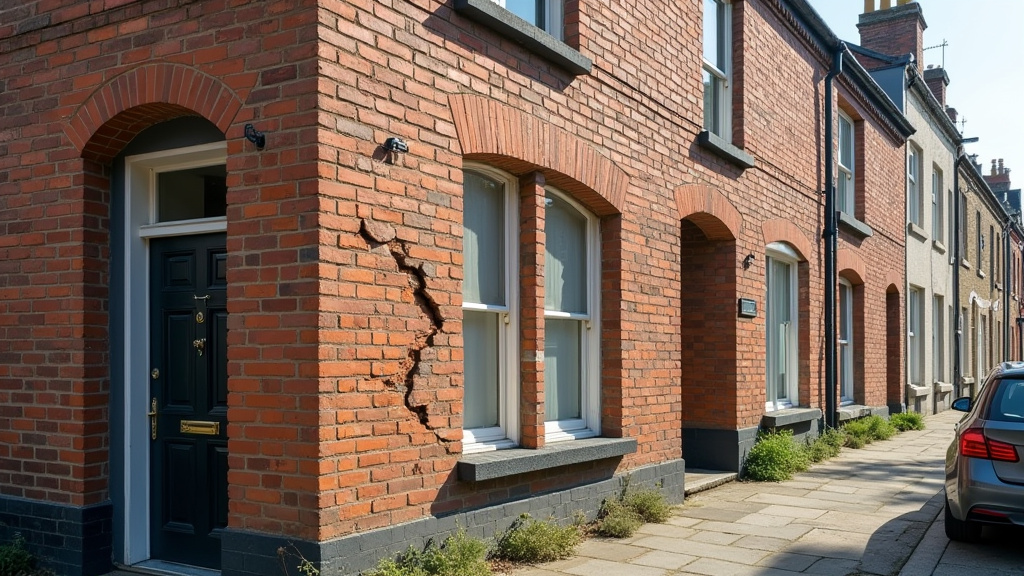
At the microscopic level, London Clay consists of minerals that are highly absorbent. During periods of prolonged drought and intense heat, water is drawn out of the soil by both evaporation and the aggressive root systems of nearby vegetation, such as mature oak or willow trees. As the soil particles lose their water content, they compact. This process is not uniform. The resulting settlement is often differential, meaning one corner of a property may sink while another remains stable, placing immense torque on the structure. This structural tension is the ‘horrendous’ crack homeowners are discovering. These fissures often begin as fine, hairline cracks in brickwork or internal plaster, but if the cycle of soil shrinkage continues unchecked, they can widen into significant structural failures requiring complex, multi-stage remediation efforts.
Older Housing Stock and Architectural Vulnerability
While modern homes are built to modern standards, a significant portion of London’s housing stock dates back to the Victorian and Edwardian eras. These buildings were constructed during an age where drainage and foundation engineering were markedly different. Most notably, these houses often have relatively shallow foundations—frequently less than a meter deep. In the 19th century, this was deemed sufficient, as the water table was more stable and the climate less prone to extreme, prolonged heat. Today, however, these shallow foundations are far more susceptible to the fluctuations of the upper soil layers.
Experts from the Climate Change Committee have repeatedly warned that the UK’s aging housing infrastructure is not prepared for the volatility of a changing climate. For the thousands of residents in the city’s iconic terraced streets, this means the very foundation that has held their home for over a century is being challenged by 21st-century environmental conditions. The result is a surge in professional survey requests and a spike in emergency insurance interventions as homeowners notice sudden structural shifts.
The Economic Toll: Insurance and Real Estate
For many homeowners, the discovery of subsidence is followed by an immediate financial shock. The Association of British Insurers (ABI) reports that claims have jumped by 15%, a figure that reflects both the increased frequency of soil-related issues and the rising costs of construction materials and labor. At £20,000 per average claim, the cost is not merely in the repair—which often involves underpinning, a process of extending building foundations deeper into the earth—but also in the long-term impact on property insurability.
Subsidence on a record can complicate the sale of a property, affecting both the valuation and the ability for future buyers to secure insurance. Many insurers are now scrutinizing properties in ‘high-risk’ zones, leading to higher premiums for homeowners located on clay-rich soil. This has created a secondary economic anxiety: the devaluation of older, structurally fragile housing in parts of London that were once considered prime real estate.
Mitigating Future Risks
Is there a way forward? Engineers are now emphasizing ‘structural resilience’ as the new standard for London property maintenance. For homeowners, this means proactive measures. Managing vegetation is a critical first step—monitoring the proximity of large, water-thirsty trees to property foundations is essential. Furthermore, improving drainage around the perimeter of the home to ensure water is directed away (or towards, depending on the season) can help keep soil moisture levels more stable.
However, in cases of severe subsidence, structural intervention is unavoidable. Underpinning remains the gold standard, though it is invasive and expensive. Newer, less-intrusive methods involving resin injection—where a polymer resin is injected into the soil to fill voids and bind soil particles together—are becoming increasingly popular for stabilizing smaller, localized cases of movement. As London continues to heat up, the engineering sector is bracing for a sustained period of high demand for these stabilization services, shifting the focus from aesthetic home improvement to essential structural preservation.
FAQ: People Also Ask
Q: Does every crack in my wall mean I have subsidence?
A: No. Many cracks are caused by ‘thermal movement’ or simple building settlement, which is common in older homes. Subsidence cracks typically run diagonally, are wider at the top than the bottom, and often appear suddenly after a dry spell.
Q: Will my insurance cover the cost of underpinning?
A: Most standard home insurance policies cover subsidence, but the approval process is rigorous. You will likely need a structural engineer’s report to confirm the movement is indeed subsidence before the insurer approves high-cost interventions like underpinning.
Q: How can I tell if my home is at risk of subsidence?
A: If your home is located on clay-heavy soil and has shallow foundations, the risk is higher. Look for signs of ‘stuck’ windows or doors, cracks appearing in brickwork outside, or floors that seem to have become uneven. If you are concerned, consult a chartered building surveyor.