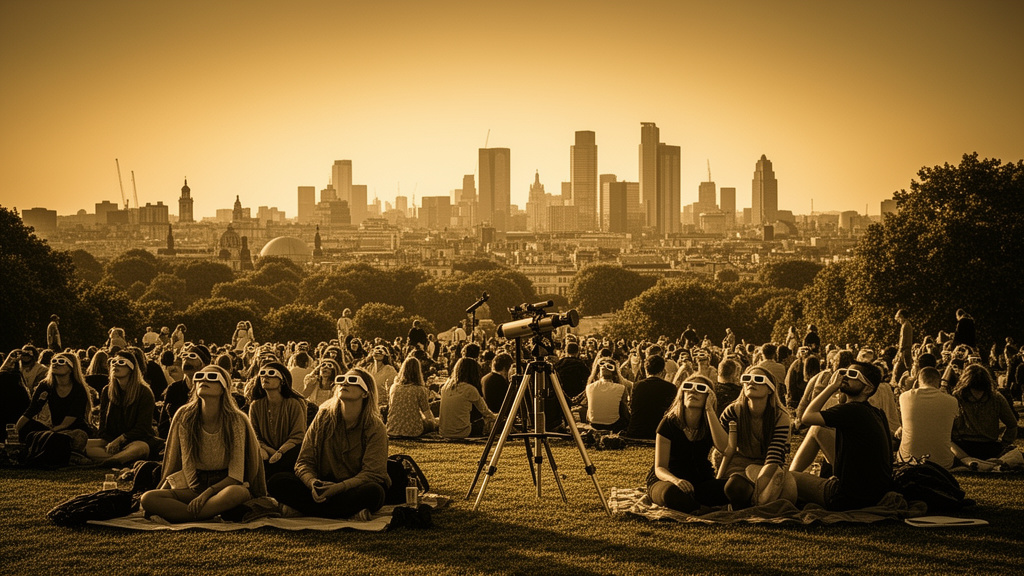
On August 13, 2026, the familiar contours of London’s skyline served as the backdrop for a rare celestial occurrence that saw thousands of residents and visitors ascend to Primrose Hill. The event, a significant solar eclipse, transformed the open parkland into a hub of community anticipation and shared wonder, marking one of the most notable public gatherings in the city’s recent history. As the moon’s shadow began its encroachment, the bustling energy of the capital gave way to a hushed, golden-tinged reverence, drawing amateur astronomers, families, and casual observers alike to the northern slope of the hill.
Key Highlights
- Massive Turnout: Thousands of Londoners congregated on Primrose Hill, creating a rare communal spectacle in the heart of the city.
- Event Date: The eclipse occurred on August 13, 2026, aligning with optimal viewing conditions across London.
- Golden Atmosphere: Observers reported a unique ‘gold-tinged’ luminescence as the eclipse progressed, a phenomenon caused by the specific angle of the sun during the event.
- Strategic Location: Primrose Hill’s elevated position provided unobstructed views of the celestial alignment, cementing its status as the premier urban viewing spot.
A City United Under the Shadow
The phenomenon on August 13, 2026, was more than a mere astronomical alignment; it was a defining cultural moment for London. By mid-morning, the paths leading to the summit of Primrose Hill were crowded with people carrying protective eyewear, telescopes, and picnic blankets. Unlike typical London gatherings, which often center around concerts or festivals, this event was defined by a shared, silent focus on the horizon. The atmosphere was characterized by a distinct “gold-tinged togetherness,” a phrase coined by attendees to describe both the changing quality of the sunlight and the palpable sense of unity that permeated the crowd.
The Optics of the Eclipse
As the partial eclipse reached its peak, the environmental lighting underwent a dramatic shift. Astronomers noted that the light filtered through the canopy of the surrounding trees and the hazy atmosphere of late summer, creating sharp, crescents-shaped shadows on the grass. The “gold-tinged” effect mentioned by so many observers was not an optical illusion, but rather the result of a higher percentage of long-wavelength light reaching the earth as the sun’s more intense, short-wavelength rays were filtered out by the moon’s traversal. This resulted in a warm, sepia-toned hue that seemed to bathe the entire park in an antique, cinematic light, heightening the emotional impact of the experience.
Primrose Hill: The Urban Observatory
Primrose Hill has long been considered one of the most strategic viewing points in the city. Its elevation, though modest, offers a 360-degree vantage that bypasses the dense forest of skyscrapers in the City of London and Canary Wharf, which often obstruct views of the horizon. Urban planners and local historians have noted that the hill serves as a vital ‘green lungs’ space that allows for celestial observation without the light pollution that plagues the street level. On this day, the park became a temporary observatory, with local enthusiast groups and volunteers from the Astronomical Society assisting newcomers with solar filters and advice on safe viewing practices.
The Psychology of Shared Awe
Sociologists often study the “overview effect” and the power of shared experiences to bridge societal divides. The 2026 eclipse at Primrose Hill provided a perfect case study for this phenomenon. In an era dominated by screens and individualized digital experiences, the act of thousands of people looking toward the same point in the sky generated a profound sense of temporal belonging. Participants spoke of a “slowing down” of the city; for those few hours, the frantic pace of the London metropolis was replaced by a collective, meditative stillness.
Future Predictions and Urban Planning
The success of the gathering has prompted discussions among local council members regarding the designation of ‘public sky-gazing zones.’ With urban densification threatening to limit the availability of high-altitude viewing spots, the event at Primrose Hill has highlighted the need to preserve clear sightlines from public parks. Future celestial events are expected to see even larger crowds, and officials are now considering infrastructure improvements, such as tiered seating or permanent educational signage, to accommodate the growing interest in urban astronomy.
FAQ: People Also Ask
Why was the light described as ‘gold-tinged’?
The golden tint is a result of the moon blocking the bluer, shorter wavelengths of light from the sun. As the sun became partially obscured, the light that remained was dominated by the warmer, longer wavelengths, creating a distinct golden-sepia glow across the park.
Was Primrose Hill the only place to see the eclipse?
While the eclipse was visible across the UK, Primrose Hill became the unofficial hub for the event due to its high elevation, clear horizon lines, and central location within London, which made it easily accessible for a large number of people.
How often do solar eclipses like this occur in London?
Significant solar eclipses visible from London are relatively rare. While partial eclipses happen periodically, deep partial or total events are infrequent, making the August 13, 2026, event a landmark occasion for the city.
Were there safety concerns for the crowd?
The event remained peaceful and safe. The Astronomical Society and park authorities had advised the public on the necessity of ISO-certified eclipse glasses, and general compliance was high, with many attendees sharing viewing equipment and knowledge.