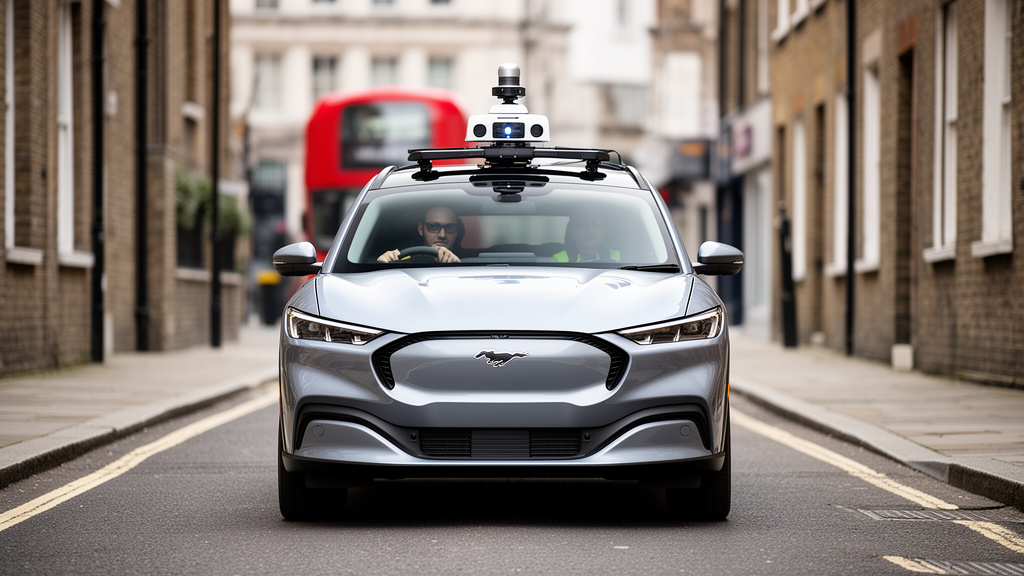
London has officially stepped into a new era of urban mobility as Uber and the UK-based AI startup Wayve have launched the city’s first-ever supervised autonomous ride-hailing service. This milestone marks the first time that public-facing autonomous vehicle (AV) technology has been deployed in the UK, signaling a significant divergence from the AV testing models currently seen in the United States. Passengers using the Uber app in specific zones of London may now be matched with a Wayve-equipped Ford Mustang Mach-E, complete with a professional safety driver behind the wheel.
Key Highlights
- First-of-a-Kind UK Deployment: This collaboration represents the first public access to autonomous ride-hailing technology in the UK, moving beyond closed-course testing.
- The ‘Supervised’ Standard: All rides currently feature a professional safety driver present to monitor the technology and take control, prioritizing safety over full automation.
- AI-First Engineering: Wayve utilizes its proprietary ‘AV2.0’ technology, which relies on deep learning and end-to-end embodied AI rather than traditional, pre-mapped HD navigation.
- Vehicle Platform: The fleet consists of the Ford Mustang Mach-E, a vehicle chosen for its advanced sensor suite and adaptability for Wayve’s autonomous software integration.
Navigating the Complexity of London’s Streets
The introduction of autonomous ride-hailing in London is not merely a technical update; it is a fundamental test of how artificial intelligence can handle one of the world’s most complex driving environments. Unlike the sprawling, grid-like streets of cities such as Phoenix or San Francisco, where many US-based AV trials take place, London presents a challenging urban landscape. Its narrow lanes, unpredictable weather, high density of cyclists, and centuries-old road layouts require a higher level of situational awareness.
The Mechanics of Wayve’s AV2.0
Wayve distinguishes itself from competitors through its ‘AV2.0′ approach. While many autonomous technology companies rely on heavy pre-mapping—essentially teaching the car where it is down to the centimeter using LiDAR-backed high-definition maps—Wayve employs ’embodied AI.’ This technology uses deep learning to enable the vehicle to learn from experience, much like a human driver.
By processing data from a suite of cameras and sensors in real-time, the Wayve system ‘understands’ the world around it rather than simply following a digitized script. This is critical for London’s erratic traffic. If a road is blocked or a new temporary barrier appears, the AI must reason through the situation. This ‘end-to-end’ learning means the system can theoretically generalize across different driving scenarios, making it more robust when encountering conditions it has not explicitly mapped out beforehand.
Uber’s Strategic Pivot in the UK
For Uber, this partnership serves as a vital component of its long-term strategy to diversify its fleet and reduce dependence on human labor in the decades to come. By embedding Wayve’s technology into its global platform, Uber is not just testing a product; it is testing the integration of third-party autonomy into an established, high-volume consumer app.
This is a careful, measured rollout. By limiting the availability of these vehicles, Uber can gather immense amounts of safety data and user feedback without scaling too aggressively. The presence of the safety driver is a non-negotiable requirement of the current regulatory framework, ensuring that the trial remains within strict safety parameters while gathering the necessary data to eventually transition to driverless operations in the coming years.
Regulatory Landscape and Safety
The UK government has been vocal about its desire to become a global leader in the autonomous vehicle race. With the launch of the Automated Vehicles Act, the UK has established a legal framework that creates clear lines of accountability for who is responsible when an autonomous vehicle is in control. This regulatory certainty is exactly what attracted companies like Wayve to remain headquartered in London.
However, the path to full autonomy is not without its hurdles. The public’s trust remains the biggest barrier. The ‘supervised’ nature of these initial rides is designed specifically to mitigate this. It allows riders to experience the sensation of a vehicle navigating itself while providing the reassurance of a human fail-safe. This transitional phase is essential for societal adoption, ensuring that when the tech finally does go driverless, the public will have been acclimated to the presence of these machines on the road.
The Road Ahead: Challenges and Scaling
While the collaboration between Uber and Wayve is a historic achievement, it is only the beginning. Scaling this technology to the point where it can serve millions of Londoners daily requires overcoming significant compute costs, regulatory hurdles, and public skepticism. The current Ford Mustang Mach-E fleet is a proof-of-concept, a testbed for the technology’s viability in the real world.
As the fleet learns from millions of miles of data, the frequency of human intervention is expected to drop. If Wayve can prove that its AI is statistically safer than the average human driver—especially in the chaotic conditions of a London rush hour—it may pave the way for a rapid expansion of the program, setting a new global standard for how AI can integrate into urban infrastructure.
FAQ: People Also Ask
Q: Is the car actually driving itself?
A: Yes and no. The car is being operated by Wayve’s AV2.0 software, which makes steering, braking, and acceleration decisions autonomously. However, a trained human safety driver is present in the driver’s seat at all times to take control immediately if the system encounters a situation it cannot handle, ensuring maximum safety.
Q: Can anyone request a Wayve-equipped Uber?
A: Currently, the service is limited to specific areas in London and is being rolled out to a subset of users. If you are in the service area and an autonomous vehicle is available, it may be dispatched to your location, with the app notifying you of the unique nature of the ride.
Q: How does this differ from Waymo or Cruise in the US?
A: While companies like Waymo and Cruise utilize heavily mapped environments (HD maps) and often operate fully driverless, Wayve’s technology focuses on ’embodied AI’ that learns to drive by observation. The current UK trial also explicitly mandates a human safety driver, whereas some US trials have moved to fully driverless operations in specific cities.
Q: Will this replace human Uber drivers?
A: Not in the foreseeable future. The goal of this partnership is to complement existing transportation options. The technology is in an early, supervised phase, and the role of the professional driver remains central to safety and regulatory compliance for the current rollout.