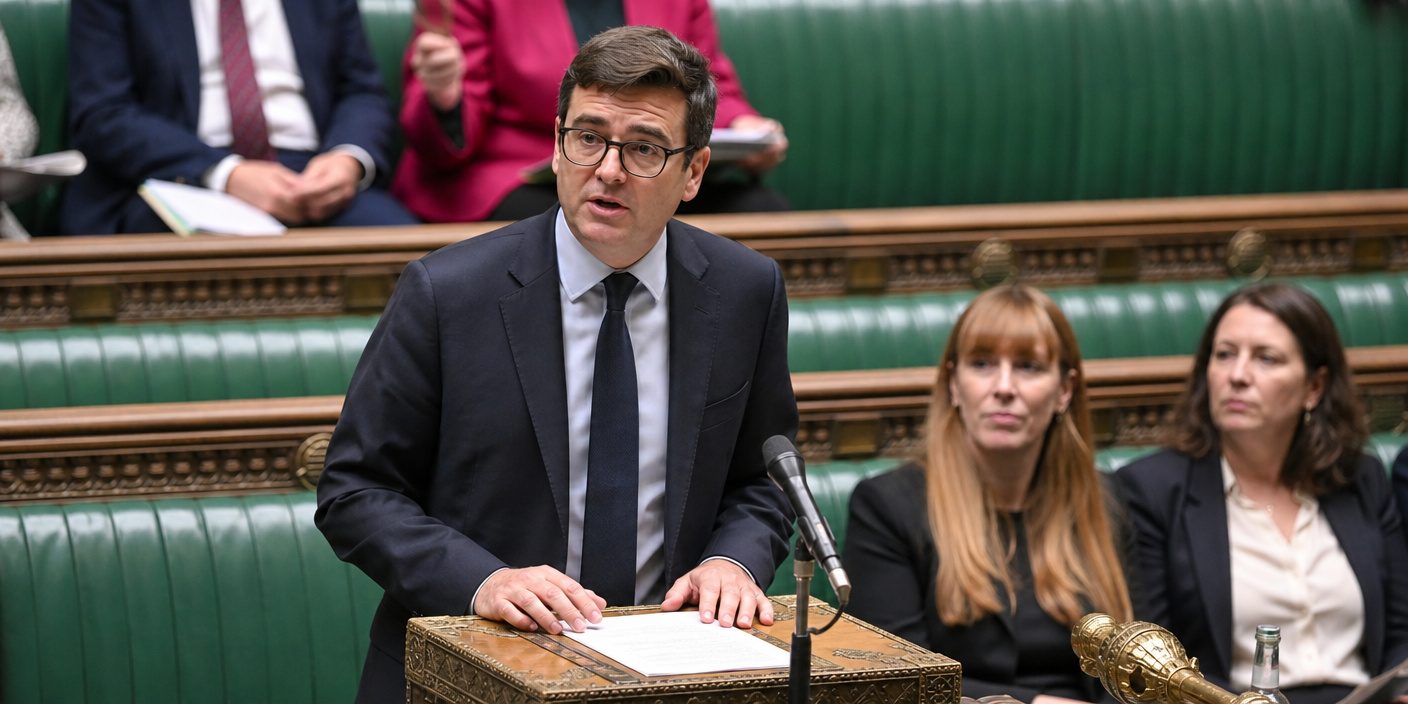
Prime Minister Andy Burnham is set to command the House of Commons on Tuesday, appearing before lawmakers for the first time since ascending to the UK’s highest office six weeks ago. The Prime Minister, who has largely remained within the bubble of Number 10 to consolidate his administration, now faces the scrutiny of the legislative chamber. This appearance marks a pivotal shift from policy formulation to parliamentary accountability, as Burnham must defend his nascent administration against an emboldened Opposition while navigating a complex intersection of international instability and domestic economic fragility.
Key Highlights
- Parliamentary Debut: This Tuesday marks Prime Minister Burnham’s first appearance in the House of Commons as leader, ending a six-week period of legislative distance.
- The Conflict Constraint: Burnham’s economic “kick-start” agenda is currently competing with the demands of funding defense and managing energy security amid ongoing wars in Europe and the Middle East.
- Legislative Priorities: The session is expected to focus on the interplay between inflationary pressures and the government’s promised growth strategy.
- Opposition Scrutiny: Lawmakers from both sides of the aisle are preparing to press the PM on the delivery timeline for his manifesto promises, specifically regarding the cost-of-living crisis.
The Weight of the Dispatch Box: Defining the Burnham Era
For any new Prime Minister, the transition from the executive planning phase to the reality of the House of Commons is a defining moment. For Andy Burnham, who has spent the last six weeks setting the administrative tone for his government, Tuesday’s appearance is not merely procedural—it is the first true stress test of his political capital. The House of Commons, with its adversarial architecture and history of intense debate, offers a stark contrast to the controlled environment of Downing Street.
As the Prime Minister approaches the Dispatch Box, he carries the weight of a campaign built on “kick-starting the economy.” However, the economic landscape he inherited has proven more volatile than anticipated. The intersection of global conflict and domestic stagnancy has created a policy corridor that leaves little room for error. The parliamentary session will likely center on whether the government’s initial six weeks of activity—often described by political analysts as a “quiet consolidation”—have successfully laid the groundwork for the structural changes promised during the election cycle.
The Geopolitical Storm and Domestic Inflation
The central tension of the upcoming session lies in the friction between foreign policy necessity and domestic economic requirements. The ongoing war in Ukraine has continued to strain European energy markets, while the escalating conflict in the Middle East has introduced new uncertainties into global supply chains. For a government focused on growth, these external shocks are significant headwinds.
Treasury officials have quietly signaled concerns that the cost of maintaining defense commitments and energy subsidies will limit the fiscal “headroom” needed for the tax reforms or infrastructure investment Burnham pledged on the campaign trail. During the session, MPs are expected to demand clarity on how the government plans to reconcile these rising costs without imposing further burdens on the average household. The Treasury’s ability to navigate this tightrope will be a primary focus, as the Bank of England watches for signs of fiscal discipline to guide interest rate policy.
Legislative Hurdles and the Opposition Strategy
The Opposition front bench is expected to move beyond the traditional “honeymoon period” courtesy usually afforded to new administrations. With six weeks of tenure under his belt, the grace period is effectively over. The strategy from the Opposition is likely to be twofold: first, to highlight the gap between the government’s pre-election rhetoric and the current economic data; and second, to paint the administration as detached from the daily realities of the electorate.
Key areas of contention are expected to include the government’s housing targets, the stability of public health funding, and the specific timeline for industrial strategy. Burnham will need to demonstrate that his administration is not only aware of these pain points but possesses a concrete, executable roadmap to address them. His performance at the Dispatch Box will set the narrative for the parliamentary autumn, potentially defining his approval ratings for the months to come.
Secondary Angles: The Path Forward
1. The ‘Honeymoon’ Paradox: Historical analysis of previous UK Prime Ministers suggests that the first six weeks are often the most crucial for setting the administrative tone. Burnham’s decision to limit public appearances during this period may prove to be a double-edged sword—offering him space to plan, but potentially allowing the Opposition to control the narrative vacuum.
2. Energy Security as a Growth Driver: There is an emerging school of thought within the administration that energy independence is the only true pathway to long-term economic stability. Expect the Prime Minister to frame energy infrastructure investment not as a cost, but as a strategic economic defense mechanism against future geopolitical shocks.
3. Institutional Trust: Beyond the policy specifics, this appearance serves as a symbolic restoration of the parliamentary process. In an era of political polarization, the Prime Minister’s demeanor and ability to engage with dissenters will be closely watched by the electorate as a barometer for his leadership style and respect for democratic institutions.
FAQ: People Also Ask
Q: Why has it taken six weeks for Prime Minister Burnham to face the House of Commons?
A: While it is standard for a new Prime Minister to prioritize the formation of their cabinet and the initial briefing process with civil servants, this six-week timeline is on the longer end of the spectrum for modern UK politics. This period has been used to stabilize the transition of power and align the administration’s policy priorities with current Treasury data.
Q: What is the main economic challenge facing the Burnham administration right now?
A: The primary challenge is balancing inflationary pressure with the need for growth. Global conflicts in Europe and the Middle East have disrupted energy and commodity markets, increasing the cost of living and potentially limiting the government’s ability to fund promised economic stimulus packages.
Q: What is expected to be the most contentious topic during the session?
A: Economic policy is expected to be the most contentious. Specifically, the Opposition is likely to press the government on the timeline for tax changes and how the administration intends to support working-class families amidst stagnant GDP growth and high interest rates.
Q: How does the House of Commons session affect the Prime Minister’s approval ratings?
A: The performance at the Dispatch Box is a critical indicator of leadership strength. A confident, policy-focused performance can solidify the PM’s support base and reassure financial markets, whereas a faltering performance can signal to the electorate and the media that the administration lacks a clear vision.