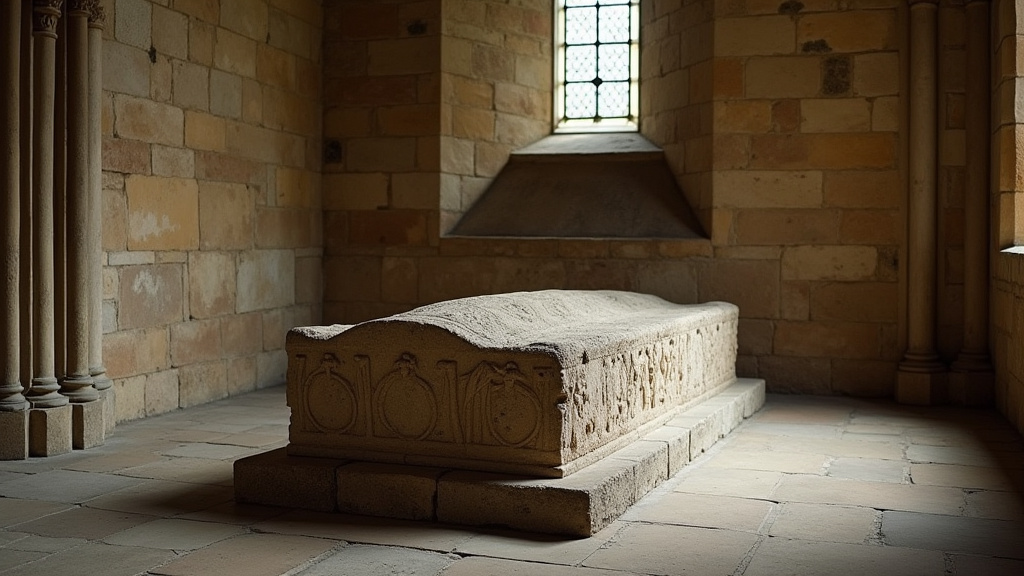
For over 150 years, the Roman sarcophagus discovered within the hallowed grounds of Westminster Abbey has stood as an enigmatic bridge between the ancient Roman world and the rise of Christian London. The heavy stone lid, clearly etched with the name ‘Valerius Amandinus’, led generations of historians to believe they were looking at the final resting place of a Roman official. However, recent, comprehensive forensic analysis and archaeological contextualization have finally unmasked the true occupant, revealing a narrative of power, prestige, and the recycling of history. The remains housed within the sarcophagus do not belong to a Roman military official, but rather to an influential 11th-century abbot, challenging our understanding of how early church leaders positioned themselves within the architectural footprint of one of Britain’s most significant religious sites.
The Discovery and the Roman Illusion
The sarcophagus was first unearthed in 1869 during excavations for the North Aisle of Westminster Abbey. At the time of its discovery, the object sparked intense academic interest due to its unmistakably Roman craftsmanship and the distinct inscription naming Valerius Amandinus. In the 19th-century context, the find was initially interpreted as potential evidence of a Roman temple or villa existing on the site where the Abbey was later constructed. For decades, this interpretation dominated, with the assumption that Amandinus had been buried there during the Roman occupation of Londinium.
However, archaeological methodology has evolved significantly since the Victorian era. Modern researchers began to question the stratigraphic relationship between the sarcophagus and the surrounding strata. When the physical location of the burial—nestled within the medieval foundations—was re-evaluated alongside the style of interment, the ‘Roman’ timeline began to falter. The burial did not display the characteristics of Roman-era interment rites, which often included grave goods specific to pagan or localized Roman practices; instead, it aligned with the austere, Christian burial traditions of the early medieval period.
Scientific Analysis and the 11th-Century Reality
The breakthrough came through a synthesis of radiocarbon dating and an assessment of the ecclesiastical context of the 11th century. When the skeletal remains were subjected to modern dating techniques, the results were unequivocal. The individual did not die in the Roman era, but rather during the late 11th century—a pivotal time for Westminster Abbey, as it was undergoing massive transformation and patronage under Edward the Confessor and his successors.
Who was the occupant? While the identity cannot be confirmed with absolute certainty due to the lack of contemporary funerary records matching the exact location, historical consensus points to an abbot of high standing. The placement of the sarcophagus—within the Abbey’s inner sanctum or associated primary structures—suggests an individual of significant wealth and authority. This was a man who commanded the respect of the church and the state, capable of securing a prestigious burial place that utilized a ‘prestige’ object, even if that object was centuries older than the occupant.
The Art of ‘Spolia’: Recycling Prestige
The phenomenon at play here is known as ‘spolia’—the repurposing of stone, architectural elements, or, in this case, sarcophagi from older cultures for new, prestigious uses. By the 11th century, a Roman sarcophagus would have been recognized as an item of extreme luxury and antiquity. For an Anglo-Saxon or Norman-era abbot, being interred in a Roman sarcophagus was not merely a matter of convenience; it was a powerful political and social statement. It connected the occupant to the grandeur of the Roman Empire, effectively ‘borrowing’ the authority of the past to legitimize the status of the Church in the present.
This act of re-use was common throughout the medieval world. Roman stone was highly prized for its durability and its aesthetic link to the ‘eternal’ nature of the Roman state. By placing an 11th-century abbot into a sarcophagus marked with a Roman name, the Church was demonstrating continuity, suggesting that the new religious order was the rightful successor to the civilizations that had come before. The ‘Valerius Amandinus’ inscription was effectively overwritten by the presence of the new occupant, rendering the Roman name a silent, secondary witness to the power of the medieval church.
Rewriting the Abbey’s Architectural History
This resolution provides critical insights into the construction history of Westminster Abbey. It suggests that the area where the sarcophagus was found was a site of high-status burial long before previously thought. It also complicates the theory that the Abbey was built in isolation from the city’s Roman past. Instead, it appears the builders were acutely aware of the Roman materials available to them and integrated them into the fabric of the Abbey as a method of cultural and religious signaling.
Historians now argue that we must view the sarcophagus not as a Roman relic in a vacuum, but as a medieval artifact—a ‘re-contextualized’ object that tells us more about the 11th-century Church’s aspirations than it does about the Roman official whose name it bears. This finding highlights the need for continued, non-invasive study of the Abbey’s subterranean archaeology, as many other artifacts and burials may hold similar ‘recycled’ secrets waiting to be uncovered.
FAQ: People Also Ask
Q: Was Valerius Amandinus a real person?
Yes, Valerius Amandinus was a historical Roman figure, likely a military official or civic administrator, as suggested by the style of the sarcophagus and the inscription. The sarcophagus itself is authentically Roman, likely dating to the 3rd or 4th century AD.
Q: Why did they reuse the sarcophagus for an abbot?
Reusing ancient stone, or ‘spolia’, was a status symbol in the medieval era. Placing an important religious figure in a Roman-era container linked the 11th-century Church to the prestige and legacy of the Roman Empire, effectively using the past to cement their own authority.
Q: Does this change what we know about Roman London?
It nuances our understanding. It shows that Roman stone was accessible to medieval builders, but it does not necessarily prove a continuous occupation of that specific spot. Rather, it highlights how medieval builders valued Roman materials as ‘prestige’ construction elements for their most important structures.
Q: Is the sarcophagus still at the Abbey?
Yes, the sarcophagus remains within the collection and care of Westminster Abbey, where it continues to serve as an object of study regarding the interplay between the site’s Roman and medieval history.