London’s cultural landscape undergoes a seismic shift this weekend as the new London Museum at West Smithfield opens its doors to the public. Representing the culmination of a massive £437 million refurbishment project, this institution is not merely a relocation of the former Museum of London—it is a total reimagining of how the capital city presents its own sprawling, chaotic, and magnificent history. Housed within the skeletal remains of the historic Victorian market buildings, the new museum promises to act as a bridge between the ancient Roman origins of Londinium and the gritty, subversive street art that defines modern London, represented by figures like Banksy.
The Architecture of History: Transforming the Victorian Market
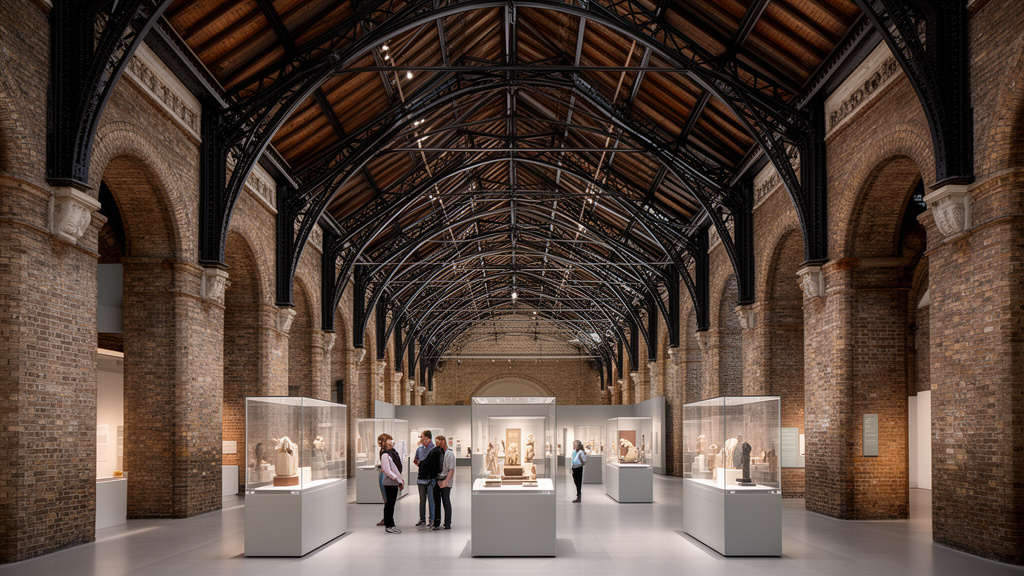
The choice of West Smithfield for the new London Museum is deeply symbolic. The site, long known for its meat markets, possesses a distinct Victorian character defined by grand ironwork, vaulted brick ceilings, and cavernous open spaces that have been painstakingly restored and repurposed. The £437 million budget has been deployed not just to house artifacts, but to curate an experience where the architecture itself acts as an exhibit. Visitors will walk through spaces that have seen centuries of commerce, disease, execution, and evolution, effectively placing them inside the very history they are there to study.
Architectural firms involved in the project have utilized the existing structural footprints to create a narrative arc. The subterranean levels, once holding market storage, have been converted into immersive galleries that house the darker, earlier histories of the city. As visitors ascend, the galleries brighten, mirroring the progression of time from the Roman era upward through the medieval period, the fire-ravaged seventeenth century, and into the industrial boom. By utilizing the existing market halls, the museum avoids the sterile feel of purpose-built modern galleries, instead opting for a texture and depth that feels inseparable from the city’s concrete reality.
A Continuum of Culture: From Roman Mosaics to Banksy
One of the most ambitious goals of the new London Museum is to bridge the gap between the ancient and the hyper-contemporary. The collection ranges from meticulously preserved Roman mosaics, which serve as a stark reminder of the city’s foundational governance and artistry, all the way to 21st-century cultural artifacts.
Perhaps the most discussed addition to the collection is the inclusion of modern street art, specifically works attributed to Banksy. This represents a bold curatorial decision: acknowledging that the spray-painted protest of a London alleyway is as historically significant as a royal decree from the Tudor era. This inclusion allows the museum to argue that London’s history is not a static sequence of dates and kings, but a living, breathing entity driven by the voices of its inhabitants, both in power and on the margins. By placing these modern artifacts in the same trajectory as items from the Roman occupation, the museum forces visitors to reckon with the continuity of urban identity.
The Future of Cultural Tourism in London
The move to West Smithfield also serves a logistical and economic imperative. The previous site at London Wall was often criticized for its relative isolation and somewhat dated presentation. The new location, integrated into the bustling Farringdon and Smithfield area, places the museum at a nexus of transport and activity. This is expected to drive a massive increase in both international tourism and local engagement.
Beyond simple footfall, the museum serves as an anchor for the continued regeneration of the Smithfield district. With this significant public investment, the surrounding area is likely to see an influx of hospitality, retail, and tech-driven cultural support services. For Londoners, the museum is being positioned not just as a tourist destination, but as a community “front room,” where the city’s story is told to those who live and work within it every day. The focus on accessibility, both physical and intellectual, suggests that the management intends to keep the London Museum at the center of the city’s civic life for the next century.
Strategic Curation and the Digital Transition
In addition to the physical layout, the museum has integrated advanced digital storytelling methods to guide visitors through its expansive timeline. Given the sheer scale of the history—spanning nearly 2,000 years—the museum employs interactive data visualization and augmented reality to prevent the visitor from feeling overwhelmed. These technological interventions allow for the “micro-histories” of individual Londoners to be spotlighted, ensuring that the grand sweep of the city’s narrative does not silence the personal stories that define it.
This balance between the physical artifact—the actual Roman coin, the Victorian tool, the Banksy stencil—and the digital layer is critical. It avoids the pitfall of becoming a “screen-only” museum, maintaining the reverence due to original items while providing the context necessary for a modern audience to appreciate them. The result is a seamless journey where the visitor never loses the thread of the city’s evolution, moving naturally from the ancient Roman foundations of Londinium to the complex, multi-cultural metropolis of today.