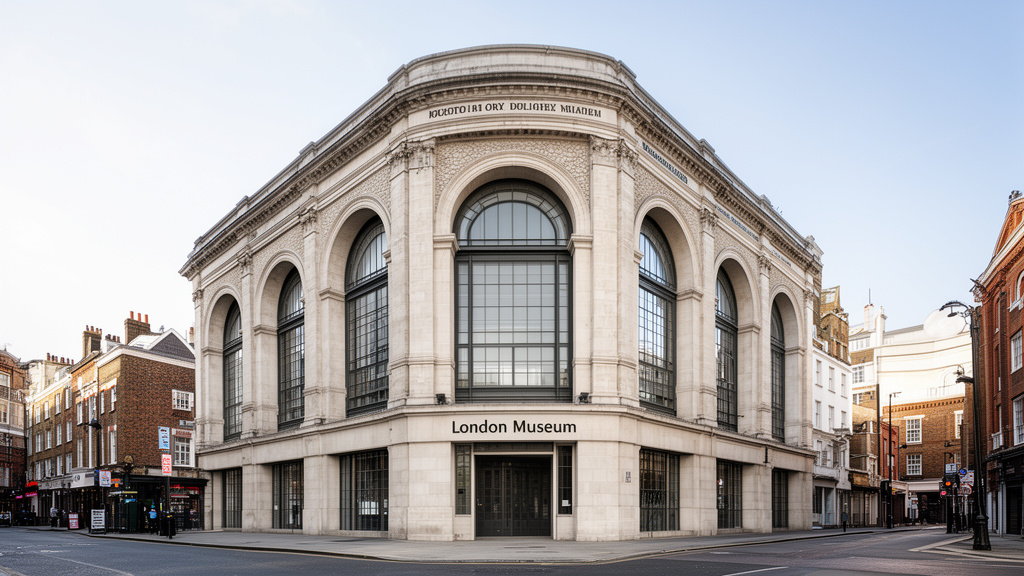
The capital’s cultural landscape is bracing for a tectonic shift as the new London Museum at Smithfield prepares to open its doors. Following a decade of meticulous planning and a staggering £437 million investment, the institution—formerly known as the Museum of London—is set to debut on November 28, 2026. This project is not merely an expansion; it is a profound reimagining of how the city’s history is preserved, presented, and experienced.
Key Highlights
- Opening Date: The museum will officially welcome the public on November 28, 2026.
- Investment Scale: A £437 million, 10-year restoration project has transformed the historic General Market site.
- Eclectic Curation: The collection spans from ancient Roman artifacts to modern street art, featuring standout items like a Banksy-decorated police box and a rare Colombian emerald watch.
- Adaptive Reuse: The project repurposes the Victorian-era General Market building, preserving historical architecture while integrating cutting-edge museum facilities.
Smithfield’s Renaissance: A Vault of London’s Soul
The story of London is one of perpetual reinvention, a narrative that the new museum seeks to capture within the cavernous, newly restored halls of the General Market. For decades, the site sat as a decaying industrial relic, a ghost of London’s Victorian mercantile ambition. Now, it stands as the centerpiece of a cultural revitalization. The £437 million restoration has been a feat of engineering, balancing the preservation of the market’s cavernous, arched architecture with the stringent climate and security requirements of a world-class museum.
From Victorian Market to Cultural Icon
The choice of Smithfield as the home for the new museum is deliberate. Located in the heart of the City of London, the area is steeped in layers of history—from medieval executions to the bustle of the wholesale meat trade. By situating the museum here, curators are not just placing artifacts in a building; they are embedding the institution into a neighborhood that has witnessed the very events the collections describe. This adaptive reuse project represents a triumph of urban planning, turning a neglected architectural asset into a flagship cultural destination that aims to rival the British Museum and the Victoria and Albert Museum.
Curating the Spectrum: Romans to Street Art
The curatorial team has faced the daunting task of summarizing thousands of years of human activity. The preview of the collection reveals a daring approach to history: the juxtaposition of the ancient and the transient. Visitors will be greeted by the solid, structural remnants of Roman Londinium, providing a foundation for the city’s deep past. Yet, the narrative arc extends aggressively into the 21st century. The inclusion of a Banksy-decorated police box serves as a poignant, contemporary counterpoint to traditional artifacts. This item—a symbol of order transformed by an icon of subversion—encapsulates the museum’s core philosophy: London is a city defined as much by its street-level defiance as by its institutional power. Alongside this, visitors will encounter artifacts of exquisite craft, such as the famous Colombian emerald watch, which highlights the city’s historic role as a global nexus of trade, wealth, and luxury.
The Economic and Cultural Ripple Effect
The economic implications of this launch cannot be overstated. With a project cost of £437 million, the expectation is that the museum will become a primary driver of tourism for the City of London. Beyond the direct ticket sales and gift shop revenue, the museum is designed to act as an anchor for local businesses, restaurants, and hospitality ventures in the Smithfield district. The 10-year timeline has allowed for extensive integration with city infrastructure, ensuring that the new museum is not just a destination for international tourists, but a community asset. Analysts predict that the opening will trigger a sustained increase in foot traffic, potentially shifting the center of gravity for London’s cultural tourism eastward.
The Future of Historical Preservation
This museum is effectively a stress test for the future of urban cultural institutions. As physical museums compete with digital archives and decentralized historical storytelling, the Museum of London has opted for scale and immersion. By utilizing the vast, open-plan spaces of the General Market, the curators are creating environments rather than just aisles of glass cabinets. This approach allows for large-scale installations that provide sensory engagement, ensuring the museum feels relevant to younger generations while maintaining the academic rigor expected of a national institution.
FAQ: People Also Ask
Q: When exactly will the new London Museum open to the public?
A: The museum is scheduled to open its doors on November 28, 2026.
Q: Why was the Smithfield location chosen?
A: The historic General Market site was selected to preserve a vital piece of Victorian architecture and to place the museum in a location that is historically significant to the story of London, moving away from its previous home at London Wall.
Q: What is the significance of the Banksy piece in the collection?
A: The Banksy-decorated police box represents the museum’s commitment to showcasing modern, authentic London history, blending the city’s complex social narrative with the work of its most famous living street artist.
Q: How was the £437 million budget spent?
A: The investment covered a 10-year project involving major structural restoration of the General Market building, asbestos removal, modern climate control installation, and extensive redesign of the interior gallery spaces.