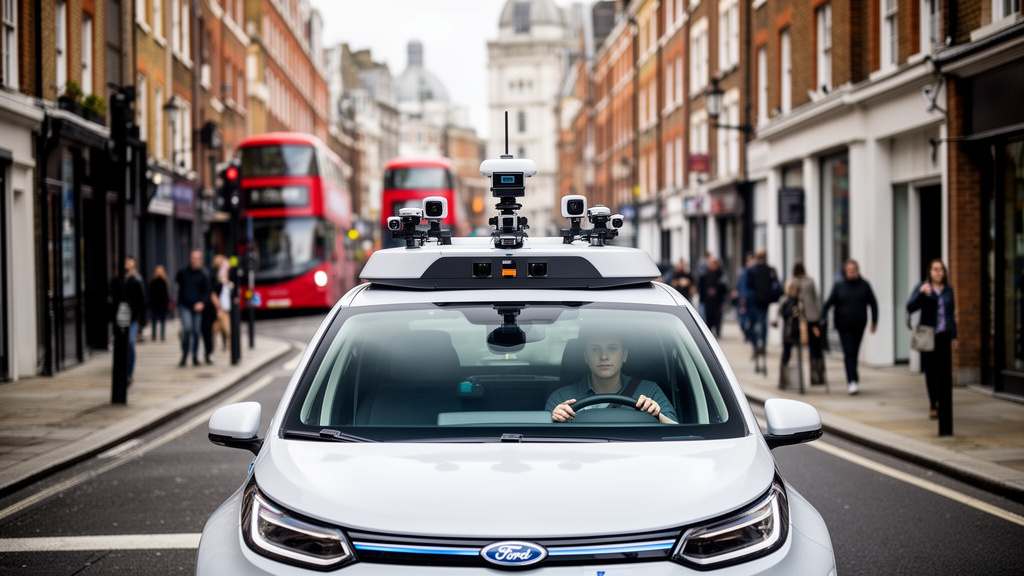
London’s urban transport landscape is set for a historic shift as Uber and Wayve, the London-based autonomous driving technology firm, have officially secured the necessary minicab licenses to commence self-driving vehicle operations in the capital. This milestone, scheduled for a public launch later this summer, marks a pivotal moment in the UK’s adoption of autonomous vehicle (AV) technology, transitioning from controlled testing environments to the complex, high-density traffic of central London.
The Strategic Partnership: Uber and Wayve
The collaboration between Uber, the world’s leading ride-hailing platform, and Wayve, a pioneer in end-to-end deep learning for autonomous driving, represents a synthesis of scale and cutting-edge research. Unlike traditional autonomous systems that rely heavily on high-definition mapping and pre-programmed rules—approaches that struggle with the unpredictable nature of London’s historic and often chaotic street layouts—Wayve utilizes “AV 2.0” technology. This approach leverages machine learning models that interpret sensor data to make real-time decisions, similar to how a human driver learns to navigate by observing and reacting to the environment.
By integrating this technology into the Uber ecosystem, the partnership aims to stress-test the feasibility of robotaxis in one of the world’s most challenging driving environments. For Uber, this serves as a strategic diversification, allowing the company to hedge against future labor shortages and operational costs while maintaining its dominance in the UK ride-hailing market. For Wayve, the deployment provides an unparalleled data-gathering opportunity, feeding millions of miles of real-world driving data back into their neural networks.
Navigating the Human Element
Despite the sophisticated artificial intelligence powering these vehicles, Transport for London (TfL) has imposed strict operational conditions to ensure public safety. Every autonomous vehicle operating under these new licenses will require a human safety driver present at the wheel at all times. This “human-in-the-loop” requirement serves dual purposes: it acts as a critical fail-safe for the nascent technology, and it satisfies the regulatory imperative to maintain accountability in the event of an unforeseen incident.
This requirement highlights the current plateau of autonomous technology; while AVs can handle standard traffic flow with remarkable precision, the “edge cases”—such as erratic cyclist behavior, sudden road closures, or complex junction navigation in London’s city center—still demand human intuition. The safety driver is tasked not just with intervention, but with monitoring the system’s performance, providing qualitative feedback that raw sensor data alone cannot capture. This phase of deployment is less about full autonomy and more about “supervised autonomy,” a critical bridge to building public trust and refining the system’s performance metrics.
The Complexity of London Infrastructure
Critics and urban planners often cite London’s irregular street patterns, which date back centuries, as a major hurdle for AV deployment. Unlike the grid-based layouts of cities like Phoenix or San Francisco, where many US-based AV trials have occurred, London’s roads are a mix of narrow lanes, varying road surfaces, and highly dynamic pedestrian traffic.
However, this complexity is precisely why the London trial is so valuable. The ability to navigate the capital’s intricate web of roundabouts and residential streets will prove that Wayve’s AV 2.0 approach is robust. As the fleet begins its rollout, engineers will be closely monitoring how the vehicles handle “contextual awareness”—the ability to understand that a child chasing a ball or a delivery rider darting through traffic requires a different reaction than a stationary bus.
Economic and Urban Implications
The introduction of self-driving taxis carries significant economic weight. If successful, the widespread adoption of such services could lead to a reduction in the total number of vehicles on the road, potentially alleviating congestion if integrated effectively into the broader public transport network. Economically, the move pressures the existing minicab and black cab industry to evolve. While traditional taxi unions have expressed concerns regarding job security, proponents argue that the technology will create new roles in vehicle maintenance, remote fleet management, and AI supervision.
Furthermore, the UK government is positioning itself as a leader in the global AV race. By fostering a regulatory environment that allows for rigorous testing alongside safety, London is effectively branding itself as an “open laboratory” for the next decade of transport technology. The success of this summer’s launch will likely influence future legislation, potentially paving the way for fully driverless vehicles in the coming years if safety records meet or exceed the benchmarks set by human-operated taxis.
The Path Toward Full Autonomy
The journey to a driverless summer is only the beginning. As the summer months progress, the data collected from these supervised rides will be analyzed to refine the underlying models. The industry is watching closely to see if the “human-in-the-loop” mandate will be relaxed in specific, low-risk areas before being expanded city-wide. Ultimately, the success of Uber and Wayve’s project will be measured not just by the technology’s ability to navigate London’s streets, but by its ability to integrate seamlessly into the daily lives of Londoners without compromising the safety that defines the city’s transit standards.
FAQ: People Also Ask
Will the taxis be completely driverless this summer?
No. While the vehicles are capable of autonomous driving, Transport for London requires a human safety driver to be in the driver’s seat at all times during this initial phase to ensure safety and compliance.
How does Wayve’s technology differ from other autonomous systems?
Wayve uses “AV 2.0,” which relies on end-to-end deep learning and artificial intelligence to interpret sensor data, rather than relying solely on high-definition maps and rigid rule-sets, making it better suited for complex, unpredictable urban environments.
Where can I book these self-driving taxis?
Uber and Wayve have not yet released the specific geographic zones or booking procedures for the initial launch, but updates are expected as the summer rollout date approaches.
What are the main regulatory hurdles for this launch?
Companies must secure minicab operator licenses from Transport for London (TfL) and satisfy strict safety protocols, including insurance, vehicle roadworthiness, and the mandatory presence of a trained safety monitor.