Planning proposals for a major new datacentre in North Ockendon, London, have ignited a fierce debate, with environmental impact assessments revealing a carbon footprint so significant that it is equivalent to 27,000 commercial flights between London and New York annually. This stark quantification has galvanized local community opposition and forced a re-examination of how major digital infrastructure projects align with the United Kingdom’s rigid, legally binding net-zero targets.
The Math of Digital Consumption
The calculation, which has become the centerpiece of the planning objection, frames the project’s environmental cost in terms that the public can easily grasp: aviation emissions. By converting the predicted MWh (megawatt-hour) consumption of the North Ockendon facility into projected carbon equivalent (CO2e), environmental consultants have drawn a direct line between the facility’s power demands and the aviation industry’s high-emission reality.
At the core of the controversy is not just the energy consumed by the thousands of high-density servers required to power modern AI and cloud-computing infrastructure, but the carbon intensity of the grid that feeds them. For a data center of this scale, the 24/7 nature of operations means there is no ‘off’ switch. Unlike heavy industry, which might scale down operations during off-peak hours, a datacentre requires a constant, high-voltage load to ensure data redundancy and uptime.
The Net-Zero Paradox
London, and specifically the borough of Havering, has committed to ambitious climate action plans. These strategies rely on reducing carbon emissions across public and private sectors. However, the approval of a hyper-scale datacentre complicates these statistics. If a single facility introduces a carbon burden equivalent to tens of thousands of transatlantic flights, it effectively cancels out the incremental carbon savings the local council has worked years to achieve through residential retrofitting, electric vehicle infrastructure, and waste management improvements.
This creates a ‘net-zero paradox.’ While the UK government identifies data centres as essential national infrastructure—critical for the digital economy, cyber security, and the development of AI—municipalities are simultaneously being penalized for failing to meet carbon budgets. The North Ockendon project highlights a disconnect between central government industrial strategy and local climate accountability.
Computational Demand vs. Environmental Limits
The rising demand for compute power, driven largely by the proliferation of Generative AI, means that the energy intensity of data centres is rising exponentially. Modern chips—such as those required for GPU-accelerated computing—run hotter and require far more power than the traditional server architectures of a decade ago.
This shift has changed the engineering requirements for new facilities. They now require liquid cooling systems, massive water cooling infrastructure, and higher electricity throughput. In North Ockendon, critics argue that the existing energy infrastructure is insufficient to support such a demand without relying on high-carbon energy sources during peak periods. Without a localized microgrid or an on-site renewable energy generation plant that is fully detached from the national grid, the facility becomes a massive drain on the local power supply, likely necessitating the reliance on fossil-fuel-backed peaking power plants to prevent grid brownouts.
The Secondary Angles of Digital Growth
1. The Cooling Dilemma: As we move away from air-cooled server rooms to liquid-cooled racks, the physical footprint of datacentres is changing. This project serves as a case study for future urban planning: How can councils zone for high-heat industrial sites without compromising the local urban heat island effect?
2. Grid Prioritization: There is a growing legislative question regarding grid prioritization. Should hospitals and residential districts receive energy priority over large-scale commercial datacentres? This debate is now moving from theoretical engineering to town hall planning committees.
3. The ‘Green’ Data Centre Myth: Many developers promise carbon neutrality through the purchase of RECs (Renewable Energy Certificates) rather than direct decarbonization. The opposition in North Ockendon is pushing for a higher standard—challenging the reliance on paper-based offsets and demanding operational carbon reductions at the source.
FAQ: People Also Ask
Q: Why does a datacentre consume so much power?
A: Datacentres require power not only for the servers processing data but also for the critical ‘chiller’ systems that prevent that hardware from overheating. High-performance computing, such as AI model training, increases this power density significantly.
Q: What is the significance of the 27,000 flights comparison?
A: It provides a tangible metric for the public to understand the scale of CO2 emissions. By comparing it to a common high-carbon activity like transatlantic flights, it contextualizes the ‘invisible’ emission of digital infrastructure.
Q: Can these datacentres be made truly green?
A: Technically, yes, through on-site solar, battery storage, and heat recovery systems that feed local homes. However, these retrofits significantly increase construction costs, which developers are often resistant to implement unless mandated by strict planning conditions.
Q: How does this impact local residents?
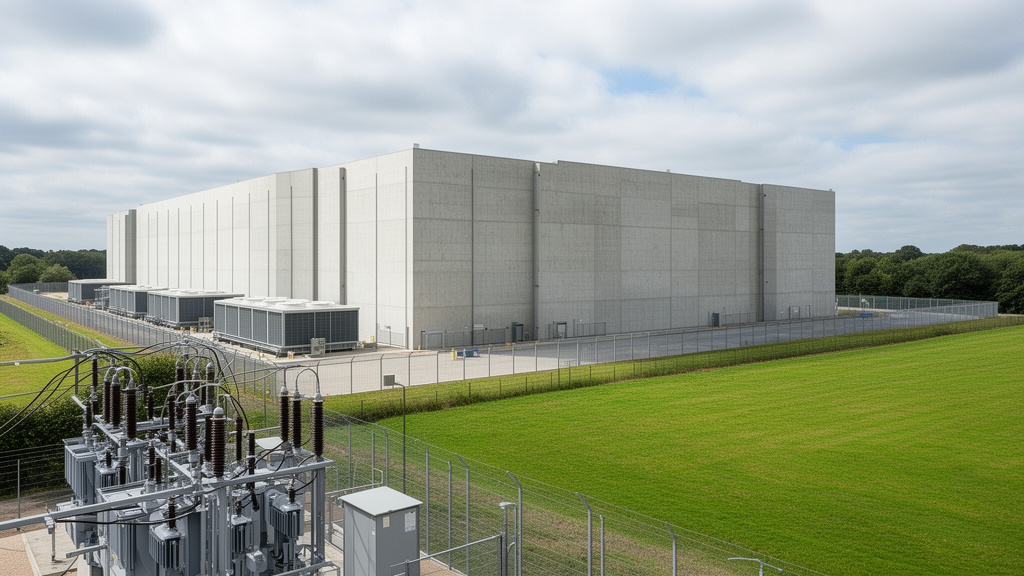
A: Beyond the climate impact, residents often voice concerns about noise pollution from constant cooling fans, light pollution, and the aesthetic impact of massive, windowless server ‘bunkers’ on the local landscape.