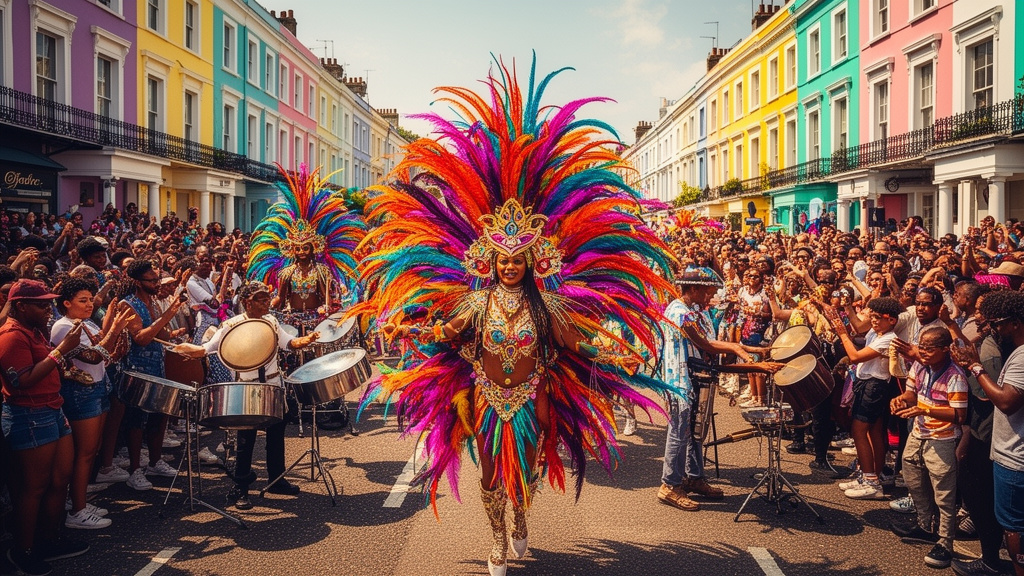
Notting Hill Carnival, Europe’s largest street festival, is preparing for a historic milestone in 2026 as it marks 60 years of vibrant celebration, cultural resilience, and community advocacy. What began as a local effort to foster unity during a time of racial tension has evolved into a global phenomenon, expected to draw over two million attendees. This year’s anniversary is particularly significant, as organizers unveil a dedicated community support fund and an ambitious, year-long programme of events designed to uplift the very community that birthed the movement.
Key Highlights:
- 60th Anniversary Celebration: The 2026 edition commemorates six decades of the Notting Hill Carnival street festival, a cornerstone of British-Caribbean history.
- Community Support Fund: Organizers are launching a new, comprehensive support fund to provide direct aid and resources to local creative groups and youth programs.
- Year-Long Programming: Moving beyond the traditional two-day event, the anniversary will feature a curated series of events spanning the entire year to honor Caribbean heritage.
- Cultural Legacy: The celebrations focus heavily on the contributions of the Windrush generation, whose arrival in the UK fundamentally reshaped British social and cultural life.
A Diamond Milestone: The Evolution of Notting Hill Carnival
The Origins: From Indoor Gatherings to Street Phenomenon
To understand the magnitude of the 60th anniversary, one must reflect on the roots of the event. The Notting Hill Carnival was not born in a vacuum; it emerged from the necessity for community building within the Caribbean diaspora. While early indoor events were organized by activist and journalist Claudia Jones in the late 1950s to foster unity following the Notting Hill race riots, the modern street parade as we recognize it began to take shape in 1966. Spearheaded by Rhaune Laslett, the event was envisioned as a local fayre. It quickly transformed into a high-octane celebration of Caribbean identity, incorporating traditional Soca music, elaborate masquerade costumes, and the distinct, percussive heart of steelpan orchestras. Over these sixty years, the carnival has survived political opposition, local hostility, and logistical challenges to become an indisputable pillar of British culture.
The 2026 Vision: Investing in the Future
As the festival approaches its 60th year, the planning committee—led by Notting Hill Carnival Ltd (NHCL)—has shifted its focus from purely celebratory spectacles to long-term sustainability. The introduction of the community support fund is a landmark policy shift. By decentralizing the festival’s impact, NHCL aims to address the socioeconomic challenges faced by the local community. This fund is not merely a one-time grant; it represents a commitment to supporting masquerade bands, sound system operators, and culinary vendors throughout the off-season. By institutionalizing support, the organization ensures that the cultural entities that make the carnival possible are not just surviving but thriving in an increasingly expensive urban landscape. The year-long programming will include workshops, historical exhibits, and forums that provide educational opportunities for the younger generation to connect with their ancestry.
The Pulse of the Streets: Cultural Significance
At the core of the carnival lies the Windrush generation. These individuals, who arrived in the UK between 1948 and 1971, brought with them not only their labour but their artistic traditions. The sound systems—massive, bass-heavy amplifiers curated by DJs—are a direct lineage to Jamaican sound system culture. Calypso and Soca music, characterized by their rhythmic complexity and social commentary, provide the soundtrack for the masquerade bands, or ‘Mas’ camps, which spend months designing and crafting elaborate costumes. These costumes are not just aesthetic choices; they are expressions of historical trauma, joy, and storytelling. In 2026, the anniversary will place a special emphasis on these traditions, with dedicated ‘Heritage Zones’ intended to showcase the artisanal skills involved in costume making and music production, ensuring these practices are passed down.
Economic Impact and Urban Renewal
Beyond the cultural significance, the Notting Hill Carnival serves as a massive economic engine for West London. With an expected attendance of two million people, the festival provides a significant injection of capital into local businesses, from restaurants and transport services to independent retail outlets. However, this influx of tourism brings with it complex challenges. Gentrification in the Notting Hill area has often placed the carnival at odds with new residents who may not appreciate the festival’s historical importance. The 2026 anniversary serves as a crucial moment for dialogue. By implementing more robust logistical planning and focusing on local community engagement, the festival aims to prove that it is not a disruption to the area, but an essential component of London’s identity that brings more value than it consumes. The organizers are currently working with local government bodies to ensure that the event remains safe, accessible, and respectful to the neighborhood.
Addressing Evolution and Challenges
No historical overview of the carnival would be complete without acknowledging the tension between the festival and state authorities, particularly the Metropolitan Police. Historically, the carnival has been a site of resistance against over-policing and systemic discrimination. As the festival enters its 60th year, the discourse has shifted towards ‘community-led policing’ and safety measures that prioritize the festival-goers’ experience over aggressive tactics. The 2026 initiative seeks to foster a safer environment through investment in community safety stewards who understand the dynamics of the crowd. This evolution in safety management is essential for the continued success of the event, as it seeks to maintain its status as a grassroots movement while managing the realities of a modern, large-scale public gathering.
Preserving the Spirit for Future Generations
As the milestone year approaches, the question remains: what does the future hold for the Notting Hill Carnival? The focus on the community support fund suggests a move towards a more sustainable model of festival management. By investing in the human capital—the artists, the organizers, and the local residents—the festival is building a resilient structure that can withstand the pressures of modern urban life. The 60th anniversary is not just a party; it is a declaration of presence. It serves as a reminder that the Caribbean diaspora in Britain is a permanent, evolving, and essential part of the nation’s fabric. Through the initiatives planned for 2026, the organizers are ensuring that when the 70th and 80th anniversaries come, the spirit of the carnival remains as vibrant and defiant as it was when it first took to the streets in 1966.
FAQ: People Also Ask
Q: When is the Notting Hill Carnival 60th Anniversary?
A: While the carnival takes place annually in August, the 60th anniversary specifically refers to the year 2026, marking the 60 years since the first street carnival in 1966.
Q: Why is the Windrush generation important to the carnival?
A: The Windrush generation laid the cultural foundation for the carnival, bringing Caribbean music, food, and social customs to the UK, which they used to build community and combat racial isolation.
Q: What is the new community support fund?
A: The fund is a financial initiative launched for the 2026 anniversary to provide ongoing support, resources, and grants to the local carnival arts, masquerade, and sound system community throughout the year, not just during the festival weekend.
Q: How many people attend the Notting Hill Carnival?
A: The event typically attracts approximately two million attendees over the course of the two-day festival weekend, making it one of the largest street festivals in the world.