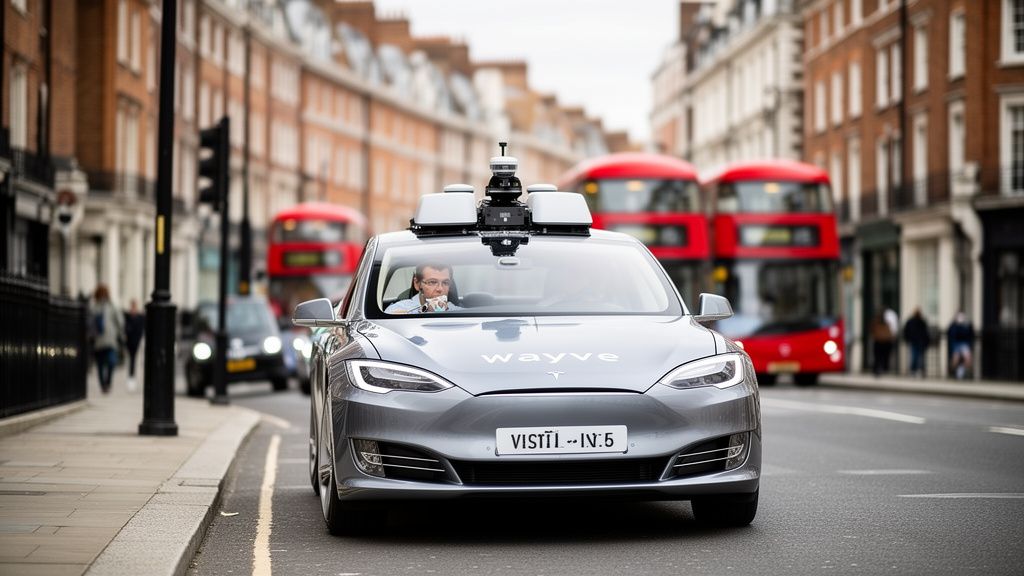
London has officially entered the era of autonomous ride-sharing with the launch of Wayve’s robotaxi fleet, marking a significant milestone in the evolution of urban transportation. By integrating directly into the Uber platform, this pilot program allows select users to book self-driving vehicles, signaling a shift in how one of the world’s most complex cities approaches mobility. While the technology is groundbreaking, the rollout is characterized by a cautious, highly regulated approach, featuring a 15-vehicle initial fleet that operates with a human safety driver behind the wheel at all times to ensure compliance and handle the nuances of London’s erratic traffic.
Key Highlights
- Strategic Integration: Wayve has partnered with Uber to allow users to summon autonomous vehicles through the familiar ride-sharing app interface.
- Initial Scale: The rollout is limited to a 15-vehicle licensed fleet, ensuring strict operational control during the testing phase.
- Safety-First Protocol: Despite the autonomous capabilities, a human safety driver remains on board at all times to monitor performance and intervene in complex scenarios.
- Pioneering Technology: Wayve utilizes ‘AV 2.0’ technology, an end-to-end deep learning approach that differs from traditional rule-based autonomous driving systems.
The Dawn of London’s Autonomous Ride-Sharing
The arrival of Wayve’s robotaxis on the streets of London is not merely a technological demonstration; it is a calculated business move that bridges the gap between high-level artificial intelligence and mass-market utility. By tapping into Uber’s existing user base, Wayve bypasses the massive hurdle of consumer adoption and trust. Users are not downloading a new, unproven app; they are simply interacting with a familiar interface that now occasionally offers a futuristic transport option. This integration is critical for gathering real-world data at scale, which is the lifeblood of Wayve’s proprietary AI.
The ‘AV 2.0’ Difference
Unlike competitors in the United States—most notably Waymo or the former Cruise—that have relied heavily on ‘AV 1.0’ architecture (which uses hand-coded rules to navigate environments), Wayve employs an approach known as AV 2.0. This utilizes end-to-end deep learning, where the AI is trained on vast datasets of human driving behavior rather than being programmed with static logic. The goal is a more natural, human-like driving style that can adapt to the unpredictable chaos of London’s roads—such as narrow lanes, aggressive cyclist maneuvers, and sudden road works—more effectively than rigid software. The current pilot serves as a crucible, forcing the system to learn from the city’s notoriously challenging infrastructure.
The Human Safety Mandate
Despite the sophistication of the machine learning models, the presence of a human safety driver remains non-negotiable. This is not just a technological limitation, but a regulatory requirement under current UK Department for Transport (DfT) guidelines. The driver acts as a failsafe, a necessary intermediary between the machine’s decision-making and the complex legal landscape of liability. For the passengers, this provides a psychological safety net, bridging the gap between current experience and the fully driverless future that both Wayve and the government envision.
Economic and Regulatory Context
The UK government has been vocal about its ambition to make the country a global leader in AI and autonomous vehicle development. The partnership between Wayve and Uber is widely viewed as a test case for the wider adoption of the Automated Vehicles Act. By hosting these trials, London is positioning itself as a sandbox for innovation, competing against tech hubs in San Francisco and Phoenix. The economic implications are vast; successfully implementing autonomous taxis could eventually reduce congestion, lower transport costs, and optimize the efficiency of the city’s transit network. However, the path to commercialization is steep. The 15-vehicle cap is a reflection of the regulator’s ‘wait-and-see’ philosophy—a necessary friction that prioritizes public safety over rapid deployment.
The Challenges of the London Streets
London presents an environment fundamentally different from the grid-based city layouts of many American counterparts. Roundabouts are frequent, lanes are often inconsistent, and the city’s historical architecture creates ‘urban canyons’ where GPS signals can struggle. Furthermore, the sheer volume of cyclists and pedestrians interacting with vehicular traffic adds an extra layer of difficulty for Wayve’s sensors and neural networks. This pilot program is designed specifically to encounter these ‘edge cases’—the rare but high-stakes scenarios that traditional AV systems struggle to resolve. Each mile driven with a safety driver is an opportunity to train the AI on specific local driving behaviors, from the ‘polite’ hesitance at a zebra crossing to navigating heavy rain in low-light conditions.
FAQ: People Also Ask
Are these Wayve taxis actually driverless?
No. While the vehicles are capable of autonomous operation, they are not ‘driverless’ in the full sense of the term. A trained human safety driver is required to sit in the driver’s seat at all times, ready to take control of the vehicle immediately if the AI encounters a situation it cannot handle safely or legally.
How do I hail a Wayve taxi in London?
Wayve has integrated its service directly into the Uber app. When you open Uber to book a ride, there is a possibility that a Wayve-equipped autonomous vehicle will be dispatched to your location if one is available in the vicinity. Users are notified within the app if their assigned ride is part of the autonomous pilot program.
Is this legal on London streets?
Yes. The operation is fully compliant with current UK government regulations regarding autonomous vehicle testing. The Department for Transport permits these trials as long as they meet rigorous safety standards, which include the presence of a safety driver, comprehensive insurance, and compliance with the Highway Code.