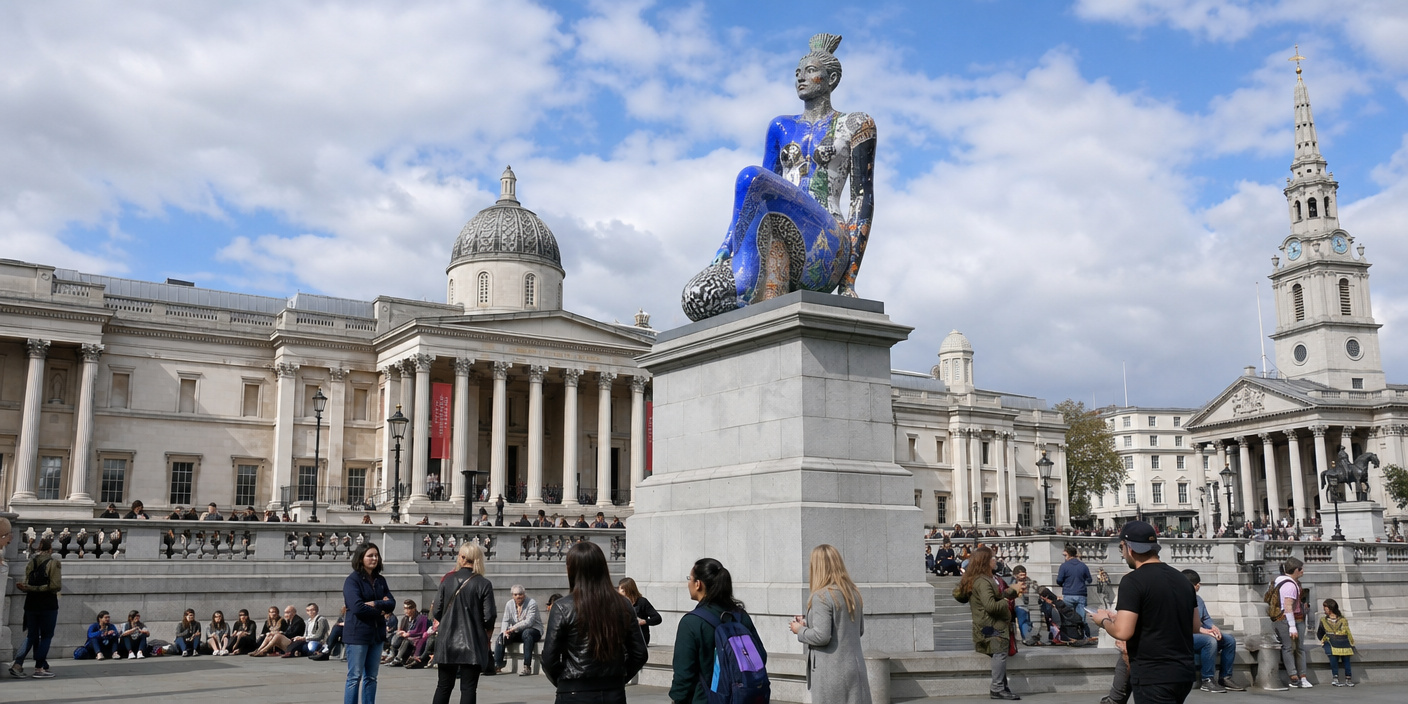
The cultural calendar for autumn 2026 has been solidified by a singular, looming event: the unveiling of Tschabalala Self’s latest commission, ‘Lady in Blue’, arriving in Trafalgar Square on September 10th. This Fourth Plinth installation marks a definitive pivot in the city’s artistic narrative, moving away from traditional, austere commemoration toward a vibrant, textured engagement with the contemporary urban experience. For collectors, critics, and the general public, the arrival of Self’s work serves as the anchor for a season that is increasingly preoccupied with the interplay between historic prestige and the aesthetics of nostalgia.
Key Highlights
- Fourth Plinth Landmark: Tschabalala Self’s ‘Lady in Blue’ officially debuts in Trafalgar Square on September 10, 2026.
- A Nostalgic Shift: The season is defined by a resurgence of 90s cultural motifs and an exploration of identity within public spaces.
- Riviera Influence: Curatorial trends for autumn 2026 are heavily leaning into the legacy of Impressionism, specifically focusing on Monet’s Riviera period.
- Architectural Dialogue: New cultural programming emphasizes adaptive reuse, blending modern sculpture with classical stone architecture.
The Anatomy of the 2026 Cultural Season
The artistic landscape of autumn 2026 is characterized by a deliberate tension: a dialogue between the past and the immediate, hyper-saturated present. At the center of this dialogue is the Fourth Plinth in Trafalgar Square. By commissioning Tschabalala Self, the Mayor’s Fourth Plinth Commissioning Group has opted for an artist whose practice is deeply rooted in the construction of identity through fabric, collage, and paint. ‘Lady in Blue’ is expected to challenge the traditional silhouette of the plinth, replacing the expected rigidity of stone with the fluid, kinetic energy that Self’s work is known for.
The Fourth Plinth: A Catalyst for Conversation
For nearly three decades, the Fourth Plinth has served as the UK’s most scrutinized open-air gallery. In 2026, the commission takes on a heightened significance. The choice of Self is not merely aesthetic; it is a structural statement on the evolution of British public art. While previous installments have often utilized irony or historical critique, ‘Lady in Blue’ promises a more visceral exploration of the ‘everyday’ figure. The sheer scale of the project, required to hold its own against the imposing architecture of the National Gallery and the surrounding historic monuments, places significant pressure on the technical execution of the sculpture. Observers are already noting that this installation will likely dictate the architectural discourse for the remainder of the year, influencing how public squares are reimagined as sites of social, rather than strictly historical, gathering.
Monet, The Riviera, and 90s Nostalgia
Beyond the Fourth Plinth, the autumn season is being shaped by two seemingly disparate, yet deeply linked, aesthetic trends: the rediscovery of Monet’s Riviera-era landscapes and the relentless cycle of 90s nostalgia. Exhibitions are increasingly focusing on the light-drenched, chromatic explorations of Claude Monet’s time in the Mediterranean, providing a stark, soothing contrast to the gritty, analog-inspired textures of 90s-focused galleries. This duality offers a fascinating psychological profile of the current art market: a desire for escapism via Impressionist beauty, coupled with a compulsive need to re-examine the recent past of the 1990s. This synthesis of historical fine art and cultural pop-nostalgia is driving record-breaking foot traffic in London’s major cultural hubs.
Secondary Angles: Exploring the Impact
1. Technological Fabrication in Monumentality: The engineering behind ‘Lady in Blue’ represents a leap in 3D scanning and structural collage. We are seeing a shift where artists no longer sculpt from a block but construct from data-rich blueprints, allowing for a level of detail that mirrors the tactile quality of a painting.
2. The Economic Ripple Effect of Public Art: Trafalgar Square acts as a primary economic artery for London. The presence of a high-profile commission like Self’s is projected to increase localized spending in the West End by an estimated 12-15% during the September-October window, underscoring the vital role of temporary culture in post-recession recovery.
3. Curatorial Evolution in 2026: Institutions are moving away from chronological retrospectives. The current trend is ‘associative curating’—grouping works based on color, emotional resonance, or texture (such as the Monet/90s pairings) rather than linear historical dates. This allows audiences to engage with art on an intuitive level, which is proving to be a highly effective engagement strategy for the ‘social media generation’ of museum-goers.
FAQ: People Also Ask
Q: When is the official unveiling of ‘Lady in Blue’ at Trafalgar Square?
A: The official unveiling date for Tschabalala Self’s ‘Lady in Blue’ on the Fourth Plinth is September 10, 2026. Visitors should expect significant crowding in the square during this time.
Q: What is the significance of the Fourth Plinth in London?
A: The Fourth Plinth is the best-known public art commission in the UK. Designed originally for an equestrian statue that was never completed, it has served as a dedicated space for temporary contemporary art commissions since 1999, curated by the Mayor of London’s Fourth Plinth Commissioning Group.
Q: Is Tschabalala Self’s work usually sculpture?
A: Tschabalala Self is primarily known for her mixed-media paintings and collage-based works that explore the iconographic significance of the Black female body. The transition to large-scale, 3D public sculpture for the Fourth Plinth is a significant expansion of her practice, translating her signature ‘layered’ painting style into a structural, material form.
Q: How does the 2026 autumn season reflect ’90s nostalgia’?
A: The nostalgia is manifesting in exhibition design, fashion-forward art galleries focusing on the ‘low-fi’ aesthetics of the late 20th century, and a resurgence of interest in post-Cold War identity politics, which are being re-contextualized through the lens of modern digital surveillance and privacy.