A significant security incident at RAF Fairford, a strategically vital US Air Force base in Gloucestershire, has culminated in the arrest of a 27-year-old dual UK-Iranian national. The individual was taken into custody in London on suspicion of terrorism offenses, marking a rare and highly sensitive development in the United Kingdom’s ongoing efforts to protect critical national infrastructure. Counter-Terrorism Policing Southeast (CTPSE) is currently leading the investigation, with officials confirming that the scope of their inquiry includes the potential for foreign state involvement, adding a complex geopolitical layer to what is already a high-stakes security breach.
The Incident at RAF Fairford
The arrest stems from a security incident reported at the perimeter of RAF Fairford, a base that serves as a cornerstone of NATO’s bomber operations in Europe. The facility is famously used by the United States Air Force for the deployment of nuclear-capable B-52 Stratofortresses and B-1B Lancers, making it an asset of immense strategic importance. According to authorities, the 27-year-old suspect was apprehended in London following intelligence gathered after the incident at the Gloucestershire site. The speed and coordinated nature of the arrest—conducted by counter-terrorism units—suggest that the breach was not viewed as a simple trespassing event, but rather as an act that necessitated the full force of national security protocols.
While the Ministry of Defence has remained tight-lipped regarding specific details of the breach, the involvement of CTPSE indicates that the suspect’s actions may have been premeditated, or linked to broader networks. Investigators are meticulously combing through electronic devices and digital footprints associated with the suspect to determine the nature of the breach and whether the suspect was acting alone or under direction.
Understanding the Strategic Importance of RAF Fairford
To understand the gravity of this incident, one must look at the function of RAF Fairford itself. It is one of the few airfields in Europe capable of supporting large-scale US strategic bomber deployments. Its location in the Cotswolds is deliberate, providing rapid access to theaters of operation in Europe, the Middle East, and beyond. In recent years, as tensions between NATO and Russia have escalated, Fairford has seen increased activity, with sustained deployments of B-52s participating in long-range training exercises. Any compromise to the perimeter or intelligence gathering at such a site is treated with the utmost severity by both the UK and US governments.
The site is classified under the critical national infrastructure (CNI) framework, which triggers higher levels of security oversight and automated threat-detection systems. The fact that the suspect was able to reach the perimeter—or at least warrant a security investigation—raises serious questions about the current vulnerability of such installations. The investigation is reportedly examining whether the breach was a ‘dry run’ for future operations, or an attempt to collect technical data on base security measures.
Counter-Terrorism Policing and State-Sponsored Risk
The mention of ‘foreign state involvement’ by law enforcement is a significant escalation from typical criminal trespassing cases. In the context of modern counter-terrorism, this phrasing often points toward intelligence agencies working in tandem with the suspect, or at least the influence of a foreign power in orchestrating the disruption. The relationship between the UK and Iran has been fraught with tension, and the accusation of state involvement adds a layer of diplomatic friction.
UK authorities are using the Terrorism Act to manage the investigation, which grants police significant powers regarding detention and questioning. The suspect, whose name has not yet been released pending formal charges, is being held while the police follow a ‘golden hour’ strategy—capturing time-sensitive evidence before it can be destroyed or hidden. The intelligence services, including MI5, are undoubtedly providing support, looking for ‘signal’ amidst the ‘noise’ to see if there are other individuals connected to this specific incident or if it is part of a larger, coordinated campaign against Western military sites.
The Future of Military Base Security
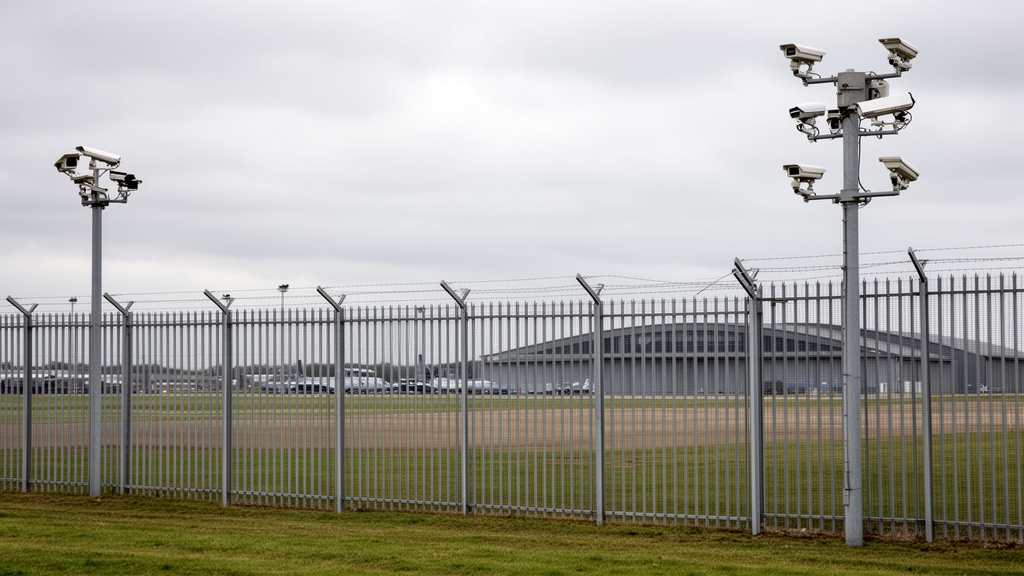
This incident will likely trigger a comprehensive review of security protocols at all US-run military facilities in the UK. We can expect to see an increase in physical barrier reinforcements, enhanced drone-detection capabilities, and a revision of patrolling frequencies for the private security contractors and military police tasked with protecting these sites. The challenge for the UK government is to balance the openness of the countryside where many of these bases are located with the absolute necessity of preventing high-level security breaches. As the nature of warfare becomes increasingly hybrid—blending cyber-espionage with physical surveillance and sabotage—the perimeter of the airfield is no longer just a fence; it is the front line of an invisible conflict.
FAQ: People Also Ask
Why is RAF Fairford so important?
RAF Fairford is the only base in Europe that maintains the infrastructure necessary to support the long-term deployment of US Air Force strategic bombers, including the B-52 Stratofortress. It is a critical asset for NATO’s rapid response capabilities.
What does ‘foreign state involvement’ imply in this case?
In security terms, this phrase implies that the suspect may not have been acting as a ‘lone wolf,’ but rather may have been directed, funded, or supported by the intelligence apparatus of a foreign nation, raising the stakes from a criminal issue to a matter of national security.
What are the likely consequences for the suspect?
The suspect is currently being investigated under UK terrorism legislation. If charges are brought and proved, they could face significant prison sentences. The investigation is still in its early stages, and the full extent of the charges will depend on the evidence gathered by the Counter-Terrorism Policing Southeast (CTPSE) unit.
How common are security breaches at such bases?
While minor perimeter incidents occur occasionally, breaches that warrant counter-terrorism investigation and involve accusations of state-sponsored activity are rare. Most intrusions are quickly neutralized by base security before reaching sensitive areas.