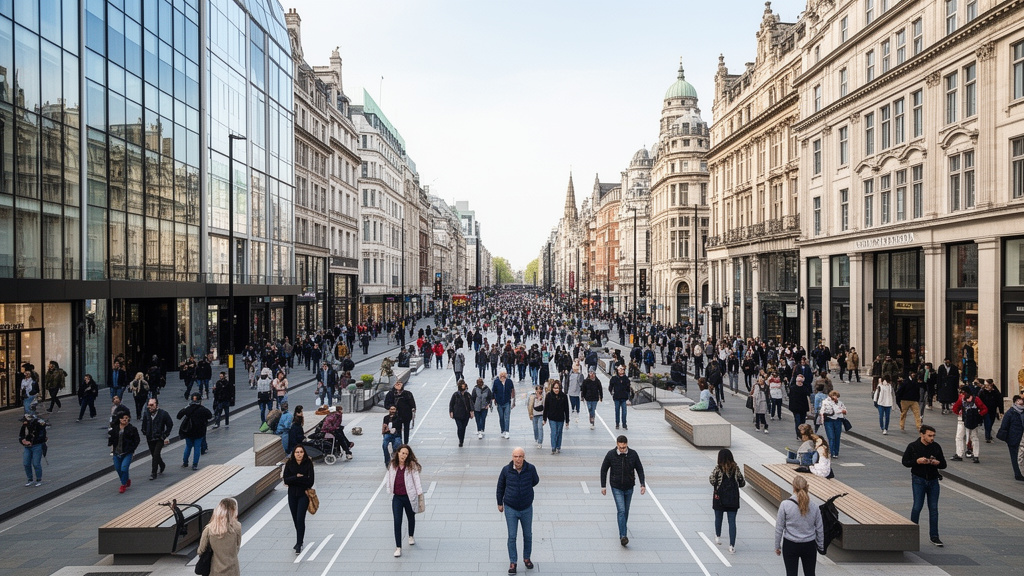
The long-anticipated transformation of London’s primary shopping artery has finally reached a definitive milestone. Transport for London (TfL) and municipal authorities have confirmed that the total traffic-free pedestrianization of the central stretch of Oxford Street—specifically the section running between Orchard Street and Great Portland Street—will commence on October 26, 2026. This directive represents one of the most significant changes to the capital’s infrastructure in the 21st century, ending decades of stop-start political negotiations and marking a permanent shift in how the West End operates.
The Logistics of the ‘Car-Free’ Corridor
The decision to implement the ban effective October 26, 2026, is not merely a symbolic gesture but a full-scale operational overhaul. The prohibition will cover all private motor vehicles, public buses, and cyclists within the designated zone. This creates a contiguous ‘car-free’ environment intended to prioritize the pedestrian experience, improve air quality, and enhance safety in one of Europe’s busiest retail districts.
Logistically, the transition involves rerouting numerous high-frequency bus routes that currently utilize Oxford Street as their main corridor. TfL has emphasized that the plan includes a comprehensive restructuring of the surrounding road network to accommodate this displacement. However, the timeline remains tight, as the authority must finalize traffic signal modifications, signage installation, and road surface alterations in the coming months to ensure the transition is seamless.
The Displacement Debate: Congestion and Community Concerns
While the environmental and retail benefits are lauded by proponents, the ‘displacement’ of traffic remains the primary point of contention. Local residential groups and commercial stakeholders in areas immediately adjacent to the exclusion zone—such as Marylebone and Mayfair—have voiced significant concerns. The ‘displacement theory’ suggests that by removing traffic from a major thoroughfare, vehicles will not vanish but will instead divert into smaller, residential side streets. This risks increasing congestion in quieter neighborhoods, potentially impacting air quality and noise pollution levels in areas not equipped to handle higher volumes of transit traffic.
Critics of the plan argue that without a robust, long-term solution for ‘last-mile’ connectivity and effective traffic management on secondary roads, the scheme risks creating localized gridlock. The Westminster City Council, which has often been at odds with the Mayor of London’s office on this matter, remains under pressure to ensure that the surrounding infrastructure can withstand the increased pressure. The coming weeks will likely see renewed negotiations between local stakeholders and TfL regarding traffic mitigation strategies, such as smart signaling and increased enforcement of residential speed limits.
Economic Revitalization vs. Logistical Hurdles
The economic argument for the pedestrianization is stark: proponents believe that a vehicle-free environment will catalyze a retail renaissance. The New West End Company, representing retailers in the area, has consistently argued that Oxford Street must evolve to compete with modern, experiential shopping destinations. By creating an open-air plaza style environment, the district hopes to draw foot traffic back to the West End, which has faced a challenging retail climate in recent years.
However, the economic impact is a double-edged sword. Retailers rely on frequent, reliable bus service to bring customers to their doorstep. The removal of these routes effectively shifts the burden of access to the London Underground and the Elizabeth Line. If accessibility decreases for those relying on surface transport, some businesses fear a potential drop in sales among demographics who prefer bus travel over tube transit.
Secondary Angles for Future Exploration
1. The Evolution of Public Transit Accessibility: How will the rerouting of major bus lines affect elderly and mobility-impaired visitors who rely on ‘door-to-door’ bus service? The success of the October 26 launch may hinge on the efficacy of shuttle services or enhanced pedestrian accessibility initiatives.
2. The Architectural Transformation: Beyond the traffic ban, what is the planned physical aesthetic of the new plaza? The project serves as a case study for ‘tactical urbanism’—the process of using temporary or semi-permanent changes to redesign urban spaces. This could set a precedent for other European capitals looking to pedestrianize major city centers.
3. Environmental Data Tracking: Post-launch, the monitoring of nitrogen dioxide (NO2) levels and particulate matter in the immediate area will be critical. This provides a measurable metric to determine if the scheme effectively reduces pollution or simply relocates it to surrounding streets.
As October 26, 2026, approaches, all eyes will be on TfL’s traffic management command center. The success of this initiative will likely serve as the blueprint for future urban regeneration projects across London, making this, perhaps, the most watched infrastructure project in the city’s modern history.