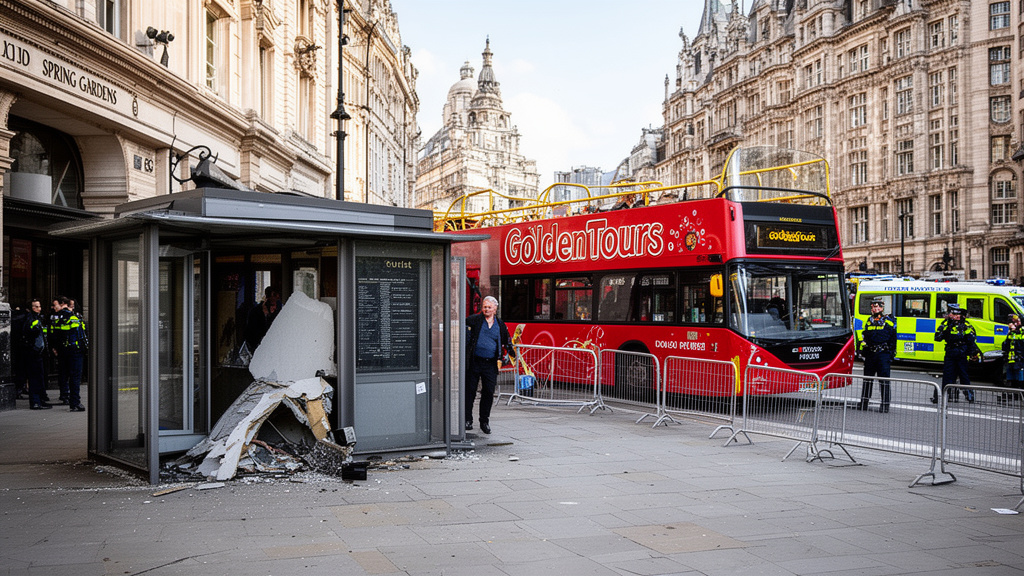
A collision involving a Golden Tours sightseeing bus and a tourist stand at Spring Gardens, located in the immediate vicinity of Trafalgar Square, has resulted in significant traffic disruption and a major multi-agency emergency response in Central London. The incident, which occurred during a busy period in one of the capital’s most heavily trafficked tourist hubs, prompted authorities to cordon off the area for five hours to ensure public safety and facilitate a detailed on-site investigation.
Key Highlights
- Incident Location: The collision occurred on Spring Gardens, a critical connector point near the bustling Trafalgar Square, causing localized gridlock.
- Vehicle Involved: A Golden Tours sightseeing bus, a prominent fixture of London’s tourism infrastructure, was confirmed to be the vehicle involved in the crash.
- Emergency Response: Metropolitan Police, the London Ambulance Service, and the London Fire Brigade were deployed to the scene to secure the perimeter and assist with the investigation.
- Operational Impact: The site remained closed to vehicular traffic for approximately five hours, forcing diversions through the heart of the city and causing ripple-effect delays across the West End.
Anatomy of a Central London Traffic Incident
The incident in the Spring Gardens area serves as a stark reminder of the complexities involved in navigating Central London’s labyrinthine road network. Trafalgar Square is not merely a tourist destination; it is a vital artery for transit, encompassing major bus routes, pedestrian pathways, and commercial thoroughfares that must accommodate a constant flux of heavy goods vehicles, public transit, and emergency responders simultaneously. When a collision occurs within this tight radius, the consequences are immediate and far-reaching.
According to preliminary reports and observations from the scene, the collision involved a Golden Tours bus—part of the company’s extensive fleet of open-top sightseeing vehicles—which struck a tourist kiosk positioned near the roadside. While the structural damage to the kiosk was apparent, the primary concern for first responders was the management of the surrounding pedestrian environment, which is frequently crowded with tourists and commuters. The quick deployment of the Metropolitan Police and the London Fire Brigade ensured that the site was rapidly contained, preventing further escalation of the situation.
The Logistics of Emergency Intervention
The five-hour road closure highlights the rigor with which the Metropolitan Police approach traffic incidents in high-density areas. Because the crash occurred near a major transit junction, authorities had to balance the need for a thorough investigation—collecting witness statements, analyzing road conditions, and potentially downloading data from the vehicle’s telemetry systems—with the urgency of clearing the blockage to prevent total gridlock in the West End.
For the London Ambulance Service, any incident involving a large commercial vehicle requires a triage-first approach. Even in the absence of severe injuries, the sheer size and weight of a double-decker bus necessitate a precautionary evaluation of all involved parties, including those on the bus and any individuals who may have been near the kiosk. This operational thoroughness is why such incidents, even those that seem straightforward, often result in multi-hour cordons.
Challenges of Sightseeing Bus Operations
Golden Tours, a major operator in the London sightseeing circuit, faces the unique challenge of operating high-capacity, large-profile vehicles through streets that were designed centuries before the advent of motor transport. The topography of Trafalgar Square and its feeder streets like Spring Gardens includes narrow passages, high pedestrian density, and unpredictable traffic patterns.
Industry analysts often point to the balancing act these operators perform: providing a high-visibility service for tourists while adhering to the stringent safety requirements of the Transport for London (TfL) network. Following this incident, discussions regarding the positioning of roadside kiosks and the navigation parameters for heavy tourist vehicles are likely to be revisited. Traffic engineers and local council authorities continuously evaluate the safety profile of these areas, particularly how fixed structures, such as kiosks, interact with the turning radii and stopping distances of large buses.
Economic and Infrastructure Implications
Beyond the immediate physical impact, the closure of a major thoroughfare like Spring Gardens creates significant economic friction. London’s central district relies on a ‘just-in-time’ efficiency for its transit systems. When a road is closed for five hours, the ripple effects extend to local retail, hospitality venues, and the efficiency of public bus services that are rerouted. The cost of such incidents is measured not just in repairs, but in the lost productivity and the massive operational resources required to manage traffic flow around the blockage.
As London continues to integrate smart traffic management systems, the incident serves as a data point for future urban planning. Authorities utilize these occurrences to model traffic stress, ensuring that the infrastructure can absorb such disruptions without leading to complete systemic failure. The cooperation between the various agencies—Police, Fire, and local transit planners—demonstrates the resilience of the city’s response mechanisms, yet underscores the inherent vulnerability of a historic city center operating with modern, high-volume tourist traffic.
FAQ: People Also Ask
Was anyone injured in the Golden Tours bus collision?
While details are often subject to ongoing investigation, emergency services conducted full assessments on the scene. The primary response was focused on securing the site and clearing the thoroughfare.
Why was the road closed for five hours?
The Metropolitan Police maintain strict protocols for traffic collisions involving large commercial vehicles. The five-hour closure was necessary to complete a thorough investigation of the scene, manage the wreckage, and ensure the safety of the public and infrastructure integrity before reopening.
Are Golden Tours buses safe for London streets?
Golden Tours operates under strict Transport for London (TfL) regulations. Incidents involving sightseeing buses are treated with high scrutiny, leading to rigorous safety reviews and internal investigations to prevent recurrence.
What should tourists do if they see an accident in London?
Public safety advice from the Metropolitan Police is to stay clear of the cordon, follow instructions from officers on the scene, and avoid congregating, which can impede emergency access.