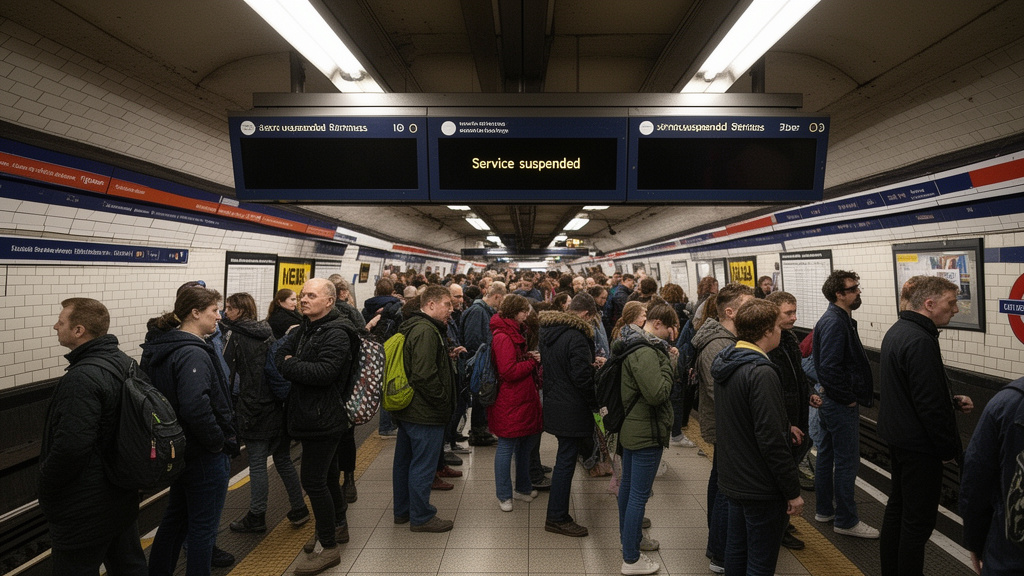
Commuters across the capital are bracing for significant travel disruption today, November 26, 2026, as members of the RMT union embark on a 24-hour strike across the London Underground network. While the industrial action has brought large swaths of the Tube to a standstill, passengers are increasingly looking to the Elizabeth Line as a vital corridor of mobility, though the infrastructure faces mounting pressure as the morning progresses. With severe delays and total service suspensions in key areas, navigating London requires precise planning today.
Key Highlights
- 24-Hour Action: A full 24-hour RMT union strike commenced on November 26, 2026, affecting the London Underground.
- Service Suspensions: Total cessation of services is confirmed on the Piccadilly and Circle lines.
- Network Impact: Severe disruption across the wider Underground network intensified significantly from 10:00 AM.
- Elizabeth Line Status: The Elizabeth Line remains fully operational as it is managed by MTR Elizabeth Line, independent of the RMT Underground bargaining unit.
Navigating the Disruption: A Comprehensive Analysis of the November 26 Strike
The industrial action hitting the London Underground today, November 26, 2026, represents a significant escalation in the ongoing labor dispute between the RMT union and Transport for London (TfL). As the clock struck 10:00 AM, the impact of the strike became palpably severe, shifting from limited capacity issues to a near-total breakdown of core transit arteries. For the millions of Londoners who rely on the Tube, today is defined by the stark absence of service on critical lines, specifically the Piccadilly and Circle lines, which are reporting a complete lack of operational capacity.
The RMT Dispute and TfL’s Operational Challenges
At the heart of today’s industrial action lies a complex standoff involving staffing levels, pension structures, and the broader modernization efforts of the London Underground. The RMT (National Union of Rail, Maritime and Transport Workers) has cited failure in negotiations regarding working conditions and job security as the primary driver for this 24-hour walkout.
From the perspective of Transport for London, this strike comes at a precarious time as the agency attempts to balance post-pandemic ridership recovery with shrinking operational budgets. The timing of the strike—a 24-hour window starting November 26—is calculated to maximize pressure on the transit authority during a mid-week period, which typically sees high commuter volumes. The 10:00 AM threshold mentioned in reports likely marks the point where morning shift rotations were meant to commence, essentially paralyzing the network as staffing fell below minimum safety requirements for full operation.
The Elizabeth Line: A Technical and Operational Haven
Perhaps the most pressing question for commuters today is the status of the Elizabeth Line. Unlike the traditional London Underground network, the Elizabeth Line is operated by MTR Corporation (Crossrail) and falls under a different set of industrial bargaining agreements. Consequently, it remains the only high-capacity, heavy-rail solution functioning near-normally during this period of industrial unrest.
However, its ‘operational’ status does not equate to a seamless experience. As Piccadilly and Circle line commuters flock to the Elizabeth Line, the infrastructure is experiencing unprecedented ‘crush loads.’ Stations like Paddington, Farringdon, and Liverpool Street are seeing significant congestion at platform levels. While the trains are moving, the passenger experience is drastically compromised. The Elizabeth Line acts as a relief valve, but it is one currently pushed to its absolute limits, illustrating the fragility of London’s transit ecosystem when one segment of the workforce withdraws labor.
Economic and Social Ripples
The ripple effects of a 24-hour total stoppage on the Piccadilly and Circle lines extend far beyond the station platforms. For London’s hospitality and retail sectors, a strike day is synonymous with lost revenue. Hospitality staff who rely on the Underground for shift work are finding themselves unable to reach their places of employment, leading to temporary closures or reduced hours in Central London.
Furthermore, this strike highlights a recurring tension in the modern British economy: the friction between legacy public transport infrastructure and the evolving demands of a digital-first, 24/7 service economy. The economic impact is not merely a one-day loss; it serves as a compounding factor, eroding public confidence in the reliability of rail transit and encouraging, in the long term, a shift toward private hire or remote working arrangements, which in turn challenges TfL’s future revenue projections.
Historical Context and Future Projections
This is not the first time the RMT has utilized 24-hour strikes to highlight systemic grievances, but the landscape of 2026 is markedly different from the strikes of the early 2020s. With the Elizabeth Line now fully integrated into the daily habits of Londoners, the union’s leverage on the legacy network is paradoxically both stronger and weaker. It is stronger because the legacy network remains essential for local connectivity (Piccadilly/Circle), but weaker because the presence of the Elizabeth Line provides a ‘Plan B’ that didn’t exist a few years ago. Future negotiations between TfL and the RMT will likely center on whether the Elizabeth Line’s success can be replicated or if it remains a unique island of stability within a volatile labor environment.
FAQ: People Also Ask
Q: Is the Elizabeth Line affected by the Tube strikes today?
A: No. The Elizabeth Line is operated independently of the London Underground (TfL) network and is not subject to the RMT strike action. It remains the most reliable transit option today, though expect extreme overcrowding at major interchanges.
Q: Why did the disruption get worse at 10:00 AM?
A: The strike officially commenced for 24 hours, but operational capacity on the Underground often deteriorates after the initial morning rush as staff rotas expire and the skeleton crew configurations fail to sustain service levels across the network.
Q: Are there any alternatives if I cannot use the Tube or Elizabeth Line?
A: London Buses are currently running, but they are experiencing extremely high demand. If possible, consider cycling, walking, or using river bus services, as road congestion is expected to be significantly higher than a standard Tuesday or Wednesday.
Q: How long will the RMT strike last?
A: The current industrial action is scheduled for a 24-hour duration. Commuters should prepare for residual delays and potential knock-on service adjustments well into the early hours of the following day, November 27.