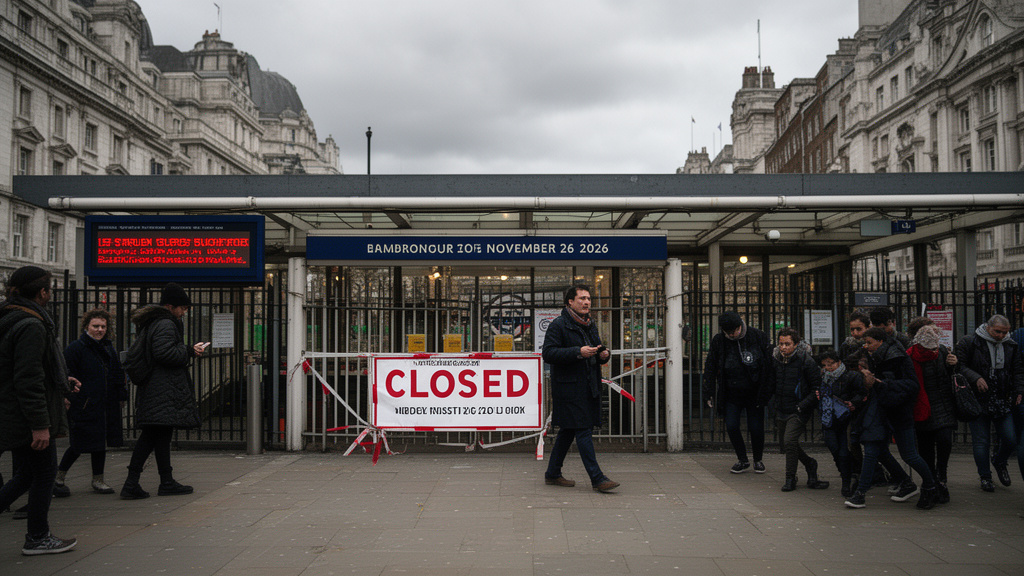
London’s transport network faces significant disruption today, November 26, 2026, as London Underground drivers commenced a 24-hour strike at 12:00 PM GMT. This walkout follows a total breakdown in negotiations between driver unions and Transport for London (TfL) regarding contentious new working arrangements. The industrial action, which is expected to cripple services across the network, represents a major escalation in the current labor dispute, serving as the first of eight planned strikes scheduled to unfold through February 2027.
Key Highlights
- Strike Commencement: The 24-hour walkout began at midday today, November 26, 2026, causing widespread suspension of Underground services.
- Cause of Action: The dispute stems from a failure to agree on new working arrangements between drivers and Transport for London (TfL) management.
- Scale of Disruption: This is the first of a series of eight planned strikes occurring between now and February 2027.
- Commuter Advice: Passengers are strongly urged to check live travel maps, as Overground services remain distinct, though they are expected to experience severe overcrowding.
The Anatomy of the Walkout: Understanding the TfL Dispute
The decision to strike today did not happen in a vacuum. For months, the relationship between TfL and the various driver unions representing London’s workforce has been strained, characterized by a fundamental disagreement over what management describes as ‘modernization’ and what unions characterize as ‘unacceptable degradation’ of working conditions. At the core of the conflict are new working arrangements, which include proposed shifts in roster patterns, on-call expectations, and a restructuring of how rest days are allocated.
The Breakdown in Negotiations
Management at Transport for London has consistently maintained that these changes are vital for the long-term sustainability of the network. They argue that efficiency gains are necessary to manage the post-2026 budget requirements and ensure the reliability of the system as usage patterns evolve in the hybrid-work era. However, the unions contend that these shifts ignore the human element of the role, leading to increased fatigue and a lack of work-life balance for drivers who have already endured years of salary stagnation. As of this morning, no new talks have been scheduled, leaving the parties at a stalemate that has pushed the network into today’s shutdown.
Impact on Connectivity: Are the Overground Lines Safe?
A common question for Londoners during any Tube strike is the status of the London Overground. It is critical to distinguish between the two systems. London Overground, while branded under the TfL umbrella, operates under a different concession model, meaning the staff directly involved in today’s Underground strike action are not the same personnel operating the Overground trains.
However, ‘not on strike’ does not equate to ‘running normally.’ While the Overground is technically exempt from this specific industrial action, the system is bracing for significant indirect consequences. As the primary artery of the capital—the London Underground—goes dark, the Overground network is expected to absorb a surge of displaced passengers, leading to extreme crowding, station entry restrictions, and potential safety delays. Travelers are advised that while their line may not be picket-lined, the platform experience will be drastically different.
Economic Ripples: The Cost of Stagnation
The economic fallout of such a large-scale transport shutdown is difficult to overstate. London’s economy relies on the fluid movement of its labor force. Retail sectors in Central London, restaurants, and hospitality businesses often report double-digit percentage drops in footfall during major strike days. Furthermore, the 24-hour nature of this strike—beginning at midday—is particularly disruptive to the ‘mid-day rush’ and the evening transition, effectively cutting off the workforce from the city center during peak revenue hours. Analysts tracking the city’s quarterly GDP contributions are already lowering forecasts for late Q4, noting that these strikes introduce a ‘stop-start’ volatility that businesses struggle to manage.
The Road Ahead: 8 Strikes Through February 2027
The most alarming aspect of today’s event for the average commuter is the knowledge that this is not an isolated incident. The current plan includes seven additional strike days scheduled intermittently between now and February 2027. This long-term strategy of ‘guerrilla industrial action’ is designed to keep pressure on TfL management, but it also creates a sense of fatigue among the public. If a resolution is not found within the next few weeks, Londoners face a winter of uncertainty, where transport reliability becomes a roll of the dice rather than a standard expectation. The challenge for the Mayor of London and TfL leadership will be to bring the unions back to the table before the next strike date in December, preventing a recurring cycle that threatens to destabilize the capital’s daily rhythm for the next three months.
FAQ: People Also Ask
1. Are all London Underground lines affected by the strike today?
Yes, the industrial action is network-wide. Because the dispute centers on TfL working arrangements for drivers, the entire Underground system is effectively shut down for the 24-hour duration of the walkout.
2. Is the London Overground or DLR also on strike today?
No. The current strike action is limited to London Underground drivers. However, you should expect severe delays and overcrowding on the Overground and DLR as thousands of commuters are forced to seek alternative routes.
3. How long will the strike last?
Today’s strike is a 24-hour action that began at 12:00 PM GMT on November 26, 2026. Services are expected to remain severely impacted for the duration of this window, with potentially lingering delays into the following morning as the network resets.
4. Will there be more strikes after this?
Yes. This is the first of eight planned strikes through February 2027. Unless a new agreement is reached between TfL and the unions, the subsequent dates will proceed as planned.