The rigid, charcoal-grey uniformity that once defined London’s financial and legal districts is rapidly dissolving, replaced by a nuanced, hybrid-ready aesthetic now widely referred to as ‘upsmart.’ As hybrid working models stabilize across the capital, Londoners are fundamentally recalibrating their daily wardrobes to suit a split reality: the solitude of the home-office and the high-stakes collaboration of the central London workplace. This isn’t merely a relaxation of rules; it is a profound socio-economic shift in how we project professional identity.
Key Highlights
- The ‘Upsmart’ Emergence: A fusion of high-quality tailoring with relaxed silhouettes, prioritizing versatility for both Zoom calls and boardroom meetings.
- The Retail Pivot: Traditional Savile Row tailors and high-street giants alike are reporting a surge in demand for ‘deconstructed’ blazers and premium knitwear over structured wool suits.
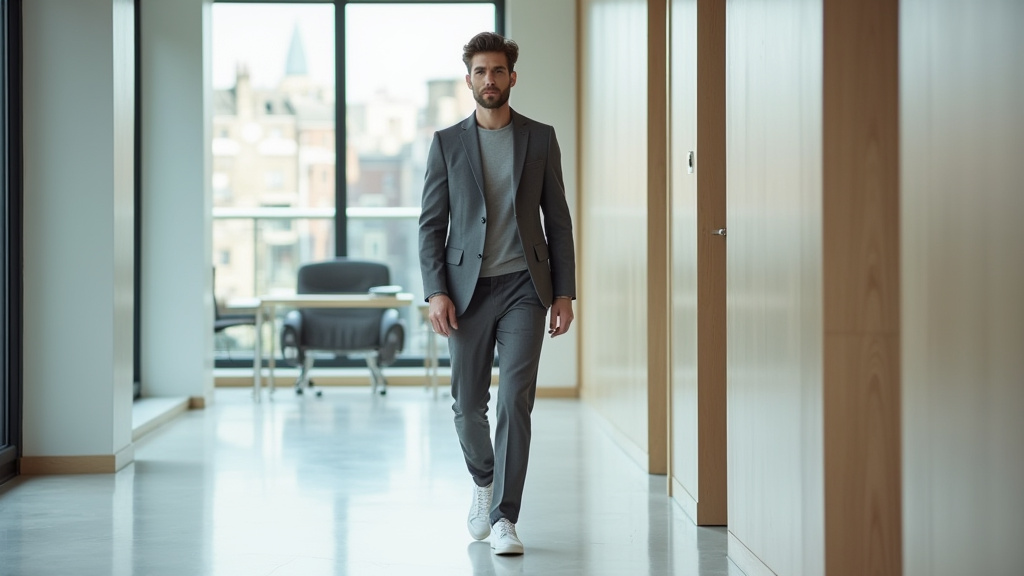
- Geographic Variations: The transition is most visible in The City and Canary Wharf, where the ‘City Suit’ is being replaced by chinos, premium sweaters, and clean, white leather sneakers.
- Economic Driver: The shift is driven by the hybrid workweek, with employees demanding clothing that offers maximum comfort for commuting without sacrificing executive presence.
The Anatomy of the ‘Upsmart’ Evolution
The traditional London professional uniform—the crisp, navy suit, the stiff collar, and the leather-soled oxford—was built for a specific rhythm of life that no longer exists in its absolute form. Today, the hybrid worker in London faces a unique wardrobe challenge: clothes must work just as well for a focused day at a kitchen table in Zone 3 as they do for an afternoon of client meetings in The City. This has given rise to the ‘upsmart’ aesthetic, a strategic curation of separates that balances corporate polish with genuine physical comfort.
The Deconstruction of Tailoring
London’s legendary Savile Row has not been immune to this seismic shift. Historically the bastion of rigid, structured tailoring, many heritage houses are now pivoting toward what industry insiders call ‘soft tailoring.’ This involves removing shoulder pads, utilizing lighter, unstructured canvas linings, and employing high-performance fabrics that resist wrinkling during commutes on the Tube. It is a nod to the fact that the modern professional values freedom of movement as much as they value the prestige of a bespoke cut. Brands are now betting on the ‘deconstructed suit’—a blazer that pairs seamlessly with trousers in the office but can just as easily be paired with dark denim or quality chinos for a casual Friday or a commute.
The Canary Wharf Phenomenon
Perhaps nowhere is this change more visible than in Canary Wharf. Previously the fortress of the ‘power suit,’ the area has experienced a visual softening. Financial analysts and corporate lawyers are increasingly opting for Merino wool turtlenecks, high-grade knitwear, and minimalist, unbranded luxury items. This trend, often categorized under ‘quiet luxury,’ allows professionals to maintain a high standard of presentation while signaling an awareness of the contemporary working environment. The focus has moved from ‘formal’ to ‘appropriate’—a subtle distinction that prioritizes the context of the day over the static requirement of a dress code.
Economic Impacts on Retail
The shift has created a tangible economic divide in the retail sector. Conventional formalwear retailers that failed to pivot have struggled, while brands that leaned into the hybrid aesthetic have thrived. This has led to a reimagining of the ‘commuter uniform.’ Retailers are seeing a decline in the sales of rigid dress shirts, replaced by a surge in high-end polos, stretch-fabric shirts, and technical apparel that looks professional but behaves like activewear. This isn’t just about fashion; it is about functionality. The Londoner now views their daily outfit as a piece of ‘work tech’—clothing that must perform under the pressure of a two-hour commute, the temperature fluctuations of the Underground, and the varied settings of a modern hybrid office.
Psychological Implications: The ‘Hybrid’ Identity
Beyond the fabric and the cut, there is a psychological component to this style shift. Clothing serves as a ‘work transition’ tool. In a remote-first world, the act of putting on ‘upsmart’ clothes signals to the brain that the transition from home mode to work mode has occurred. However, because that transition now occurs in public spaces, the clothing must satisfy two conflicting needs: the desire for the comfort of home and the necessity of being perceived as professional. ‘Upsmart’ bridges this gap, effectively democratizing professional attire and allowing for a more individualistic expression that was previously stifled by the ubiquity of the standard uniform.
FAQ: People Also Ask
1. What exactly constitutes ‘Upsmart’ style in a London context?
‘Upsmart’ is a blend of formal and casual. Think high-quality, deconstructed blazers, dark tailored chinos or trousers, premium knitwear (merino or cashmere), and clean, minimalist leather sneakers. It avoids the rigidity of a suit while maintaining a sharp, clean silhouette suitable for client-facing environments.
2. Is the traditional suit officially ‘dead’ in London offices?
Hardly. The suit is not dead, but it has been repurposed. It is now reserved for high-stakes meetings, formal presentations, or events where traditional decorum is expected. The shift is away from the ‘daily’ suit, not the suit itself.
3. How has the hybrid work schedule changed retail spending in the UK?
Retail data indicates that spending has shifted toward versatile, multi-purpose items. Consumers are buying fewer pieces but investing in higher-quality items that can be layered or mixed and matched, moving away from mass-market ‘workwear’ toward a more durable, capsule-wardrobe philosophy.
4. Will this trend revert back to formal dress codes in the future?
Most analysts suggest the shift is permanent. As hybrid working becomes the structural norm for major London firms, the overhead of enforcing rigid dress codes is seen as counterproductive to employee retention and talent attraction, particularly among younger generations who prioritize comfort and self-expression.