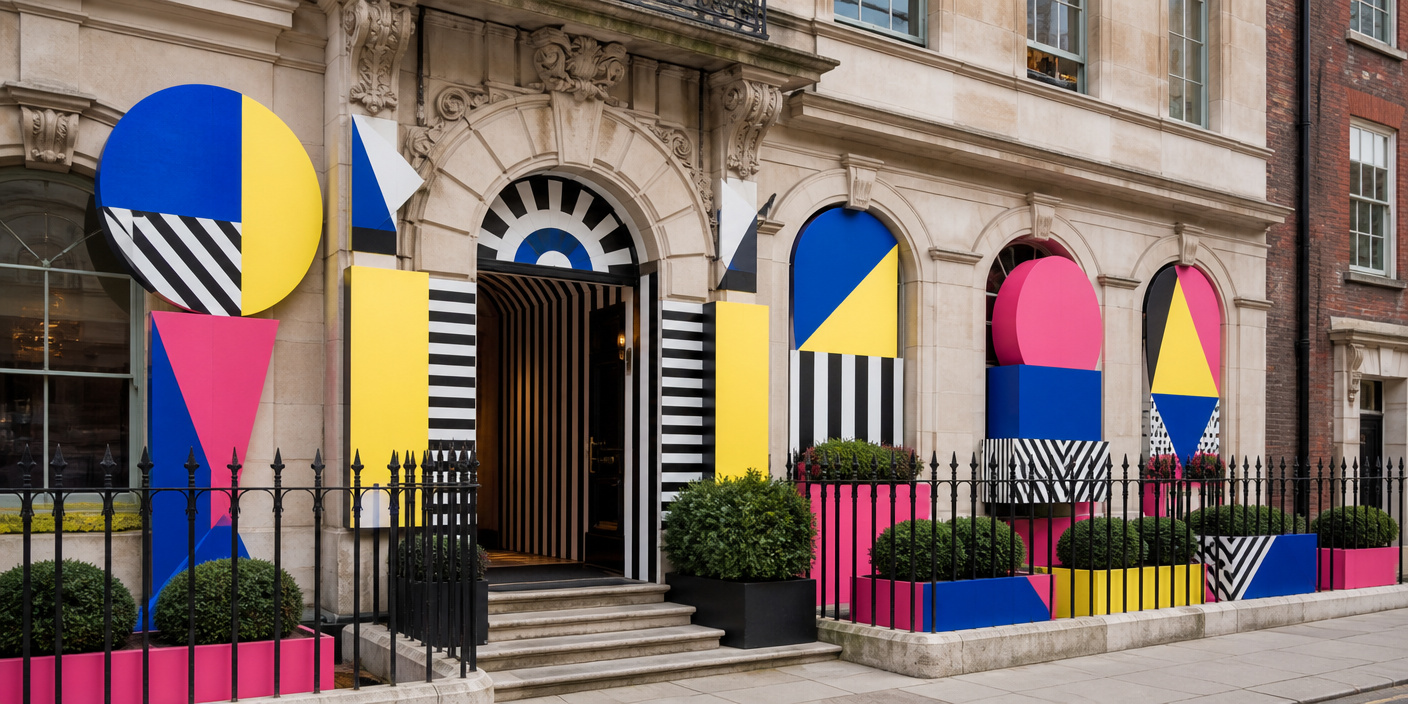
The iconic Sketch restaurant in Mayfair, London, has officially unveiled a dramatic new entrance design, transforming the threshold of its historic 9 Conduit Street location into a high-octane visual experience. Spearheaded by renowned French-born, London-based artist Camille Walala, the installation is a defining feature of this year’s London Design Festival, signaling a shift in how luxury hospitality venues integrate immersive art to redefine the guest experience. By fusing Walala’s signature geometric abstraction with the venue’s distinctive architectural character, Sketch has successfully repositioned its entryway not just as a point of transit, but as a destination in its own right.
Key Highlights
- Artistic Collaboration: The redesign is helmed by Camille Walala, an artist world-renowned for her ‘Walala-fication’ of public spaces through vibrant, geometric, and chromatic patterns.
- London Design Festival Integration: The installation serves as a key cultural anchor for the London Design Festival, emphasizing the intersection of interior architecture and high-end gastronomy.
- Strategic Partnership: The project includes a major collaborative menu launch with premium spirit brand Grey Goose, centering on specialized, art-inspired cocktail experiences.
- Location Specificity: The redesign occupies the entrance of 9 Conduit Street, Mayfair, a Grade II listed building originally designed by James Wyatt.
The Architecture of Impression: Reimagining the Arrival
For nearly two decades, Sketch has curated an identity that transcends the traditional boundaries of dining. By appointing Camille Walala to reimagine the facade and entrance corridor, the restaurant has doubled down on its commitment to ‘experiential luxury.’ The redesign does not merely decorate the space; it fundamentally alters the psychological threshold of the guest. As patrons move from the grey, traditional backdrop of Mayfair into the kaleidoscopic, pattern-saturated world of Walala, the transition serves as a sensory reset.
Walala’s design philosophy relies on what critics often call ’emotional geometry.’ By utilizing bold, primary color palettes—specifically her trademark deep blues, vibrant yellows, and searing pinks—she creates a sense of optimism and playfulness that contrasts sharply with the reserved, often sterile nature of high-end Mayfair establishments. This installation is a masterclass in ‘placemaking,’ where a static architectural element is transformed into a dynamic canvas. The geometry is mathematically precise yet visually kinetic, guiding the eye and the body toward the restaurant’s interior with a deliberate rhythm.
The Grey Goose Synergy: A Sip of Art
No major redesign at Sketch would be complete without a beverage component that mirrors the aesthetic intensity of the space. The collaboration with Grey Goose is not an afterthought but an extension of the design narrative. The partnership has birthed a bespoke menu, where the cocktails are as visually curated as the entrance walls themselves. This synergy between luxury spirit production and high-concept interior design represents a growing trend in the hospitality sector: the total-concept environment.
This is not simply a bar collaboration; it is a branding integration. By aligning with a high-end spirit brand that values the ‘art of the mix,’ Sketch is reinforcing its identity as a luxury platform. The cocktails are designed to be consumed in a setting that matches their own craft, creating a cohesive narrative that flows from the entrance door to the glass in the patron’s hand.
Contextualizing the London Design Festival
Being a featured installation during the London Design Festival (LDF) adds an extra layer of critical weight to the project. The festival, which transforms London into a laboratory for global design innovation, requires its partners to do more than just exist; they must engage. Sketch’s entrance is an exercise in cultural visibility. It captures the spirit of the LDF by proving that architecture and art are not exclusive to galleries and museums. Instead, by integrating these elements into a commercial hospitality space, Sketch is democratizing access to high-end design, allowing every visitor—whether there for a meal or merely passing by—to participate in the design discourse.
The Historical Tension: Tradition vs. Transformation
What makes the Sketch x Walala collaboration particularly successful is the tension between the building’s history and the artist’s intervention. 9 Conduit Street is a building steeped in heritage, possessing the kind of structural gravitas that Mayfair is famous for. Injecting such a radical, modern, and high-energy design into a historic frame is a risky maneuver, yet it works because of the mutual respect for craft. Walala’s work does not erase the building’s history; it highlights it by offering a contemporary contrast. It is a dialogue between the eighteenth-century architecture and the twenty-first-century artistic zeitgeist.
ROI of the Instagrammable Architecture
In the era of the ‘Experience Economy,’ the physical environment of a restaurant has become as important as the culinary output. Modern diners are increasingly choosing venues that offer a ‘shareable’ moment. While some traditionalists might dismiss the focus on ‘Instagrammable’ design, the strategic reality is that this entrance acts as a massive, organic marketing tool. Every guest who walks through the new geometric archway is essentially participating in the promotion of the brand.
However, the sophistication of this redesign ensures it is more than just a selfie-bait location. The depth of the pattern, the material quality of the installation, and the integration of the Grey Goose brand demonstrate that Sketch is playing a long game in brand loyalty. They are creating a space that feels like a ‘Third Place’—a social environment separate from the home and the workplace, where the architecture itself becomes a participant in the social interaction.
As the installation continues to draw crowds through the remainder of the London Design Festival, it serves as a case study for other high-end venues. The successful fusion of artist-led design and commercial partnership suggests that the future of hospitality lies in moving away from the ‘neutral white box’ towards spaces that are unapologetically, colorfully, and architecturally loud.
FAQ: People Also Ask
1. Why did Sketch choose Camille Walala for this project?
Sketch is known for its ongoing commitment to art-led dining. Camille Walala was selected due to her international reputation for transforming urban spaces through color and pattern, which aligns with Sketch’s mission to provide an immersive, artistic environment for its patrons.
2. Is this entrance design permanent?
While the installation is timed to coincide with the London Design Festival, its high-profile nature and the effort involved in the architectural modification suggest it will remain a significant feature of the restaurant for the duration of the current seasonal campaign and potentially longer, depending on the venue’s rotation schedule.
3. How does the Grey Goose partnership function within the entrance redesign?
The partnership is holistic. Beyond the physical entrance design, Grey Goose has curated a limited-edition cocktail menu available within the restaurant, ensuring the artistic theme of the entrance is carried through the entire guest experience.
4. Can the public visit the entrance if they are not dining at the restaurant?
Sketch is located on Conduit Street, and while the entrance itself is visible to the public from the street, access to the full restaurant interior and the bar areas requires a reservation, especially during high-traffic periods like the London Design Festival.