As the sun set over Westminster, a profound silence descended upon Richmond Terrace, where members of the British Jewish community and allies gathered to mark the first anniversary of the 7 October 2023 Hamas attacks in Israel. The vigil, a solemn act of remembrance and resilience, served as a stark reminder of the profound trauma that has rippled across the globe since the events of that day.
Key Highlights
- Formal Commemoration: The vigil at Richmond Terrace, a stone’s throw from the heart of the British government, brought together thousands of attendees to honor the victims of the Hamas-led massacre.
- Organizing Entities: The event was spearheaded by major British Jewish organizations, including the Board of Deputies of British Jews and the Jewish Leadership Council, demonstrating a unified front in the face of ongoing grief.
- Political and Social Weight: The location was chosen specifically for its proximity to Downing Street, emphasizing the community’s call for continued support and government action regarding hostages and rising antisemitism.
- Security and Unity: Amidst increased security concerns in London, the event remained a focused, peaceful, and somber reflection, emphasizing unity over political polarization.
A Nation Remembering: The Weight of October 7
The gathering in London was part of a coordinated international effort to remember the lives lost and the hostages still held captive one year after the brutal Hamas-led incursion into Israel. For the British Jewish community, the date of 7 October represents more than a historical marker; it is an open wound that has fundamentally altered the community’s sense of security and identity in the United Kingdom.
The Significance of Richmond Terrace
The choice of Richmond Terrace for the vigil was deeply symbolic. Situated directly adjacent to the corridors of power in Whitehall, the location served as a physical intersection between the personal, raw grief of the Jewish community and the political seat of the British government. By assembling here, organizers ensured their presence was felt not just as a community mourning its own, but as a constituency demanding accountability and awareness from the state. The proximity to Downing Street was a deliberate choice to amplify their message: that the safety of Jewish citizens and the return of hostages remain urgent priorities that cannot be sidelined by competing geopolitical narratives.
Psychological and Societal Impacts
The primary focus of the evening was the act of remembrance—reciting the names of the victims and saying Kaddish, the Jewish prayer for the dead. However, the atmosphere was thick with the weight of the last 365 days. Speakers at the vigil did not shy away from addressing the “new normal” that the community has faced since October 2023. Reports from the Community Security Trust (CST) have documented an unprecedented surge in antisemitic incidents across the UK throughout the year. This rise in hate speech, intimidation, and violence has forced British Jews into a defensive posture, fundamentally shifting the tenor of communal life.
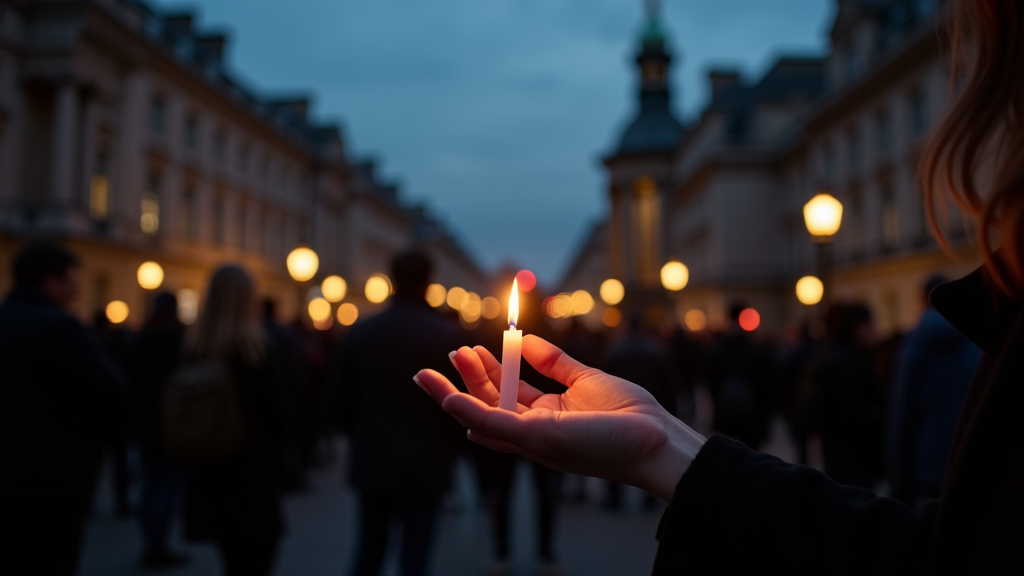
The vigil was not merely a reaction to the past, but a navigation of the present. As individuals lit candles against the backdrop of the darkened London streets, there was a palpable sense of fatigue. The community has spent a year balancing their own mourning with the need to constantly explain and defend their existence in the face of hostile rhetoric. The vigil allowed for a moment of suspension, where the internal processing of grief could finally take precedence over the external pressures of political debate.
The Dual Nature of the Vigil: Grief and Resolve
There is a duality to these gatherings that is often misunderstood by outside observers. While the immediate purpose was to honor the dead and call for the return of hostages, the vigil also acted as a statement of endurance. For many attendees, simply showing up was an act of defiance against the fear that has pervaded Jewish life in London since the start of the conflict. The sea of blue and white flags was not necessarily an assertion of state policy, but a cultural symbol of solidarity.
The Role of Leadership Organizations
The involvement of the Board of Deputies and the Jewish Leadership Council underscored the institutional weight behind the event. These bodies act as the primary interface between the British Jewish community and the UK government. By facilitating such a high-profile public display, they effectively signaled that the Jewish community is not backing down from public life. It was a clear message to policymakers that the community expects the British government to maintain a firm stance on security and the protection of its citizens, regardless of shifting electoral winds or changing international public opinion.
Looking Toward the Future
As the vigil concluded, the conversation among attendees inevitably turned toward the future. Uncertainty remains the defining feature of the current landscape. How will the UK manage domestic tensions? What is the long-term prognosis for Jewish-Muslim relations in the capital? These are questions that will outlive the immediate anniversary. The vigil provided a sanctuary—a temporary space of communal healing—but it also highlighted the long road ahead for reconciliation and peace within the UK’s diverse societal framework. The event effectively galvanized the community, proving that even in the face of deep-seated grief and anxiety, the collective spirit of the British Jewish population remains intact, focused, and determined to be heard.
FAQ: People Also Ask
1. Why was the vigil held at Richmond Terrace?
The location, near Downing Street, was chosen for its symbolic significance. It places the concerns of the Jewish community—specifically the return of hostages and the fight against rising antisemitism—directly in the sightline of the British government in Whitehall.
2. Who organized the London vigil?
The vigil was organized by the leading representative bodies of the British Jewish community, including the Board of Deputies of British Jews and the Jewish Leadership Council, among others.
3. Is there a distinction between this vigil and political protests?
Yes. Organizers emphasized that this event was a somber, religious, and communal act of remembrance for the victims of the October 7 attacks, rather than a geopolitical demonstration. Its focus was on honoring the dead and supporting the families of hostages.
4. How has the first year impacted the British Jewish community?
The past year has been described as a period of profound difficulty, marked by a record-breaking surge in antisemitic incidents and a noticeable increase in safety concerns for Jewish citizens, impacting community engagement and daily life.