The United Kingdom’s aviation sector faced a significant operational crisis on September 8th, when a technical failure within the National Air Traffic Services (NATS) system triggered a wave of cancellations and delays across the country. Approximately 1,100 flights were grounded as a direct consequence of the disruption, impacting tens of thousands of passengers and creating a cascading logistical backlog that rippled through major international hubs, most notably London Heathrow and Gatwick airports. The incident, which paralyzed flight schedules throughout the day, has since prompted critical questions regarding the resilience and technological dependency of the UK’s airspace management infrastructure.
The Technical Catalyst: Understanding the NATS Failure
The root of the chaos originated within the flight planning systems managed by NATS. Air traffic control relies on a seamless flow of digital data to ensure safe separation between aircraft and to manage flow rates into busy terminal spaces. When the failure occurred on September 8th, the automated systems—essential for processing flight plans and ensuring that controllers had accurate data—suffered a critical error. This effectively left controllers blind to the specific flight plans required to manage safe traffic flow.
To ensure passenger safety, NATS was forced to implement emergency flow restrictions. By curbing the number of aircraft allowed into the airspace, the agency could manage the system manually, but the trade-off was a massive reduction in operational capacity. This artificial bottleneck led to the immediate cancellation of hundreds of scheduled flights, as airlines could not secure the necessary slots to operate their fleets effectively. The complexity of modern air traffic management means that even a minor data handshake error can manifest as a total system halt, underscoring the fragility of the digital architecture supporting global travel.
Economic Fallout and Passenger Rights
The economic implications of the September 8th failure are substantial. Airlines operating within the UK, including major carriers like British Airways, EasyJet, and Ryanair, were forced to grapple with immediate logistical costs, including passenger rebooking, hotel accommodations for stranded travelers, and the operational strain of re-positioning aircraft and flight crews.
Under UK aviation regulations, airlines generally face rigorous requirements to provide care for passengers during extended delays, which includes food, drink, and overnight accommodation. While airlines may attempt to classify such technical glitches as “extraordinary circumstances” to avoid statutory delay compensation, the scale of the disruption has placed significant pressure on the carriers’ bottom lines. Furthermore, the loss of revenue from 1,100 cancelled flights represents a multimillion-pound hit to the aviation industry, a sector still actively working to solidify its post-pandemic profitability.
Airlines’ Response and Logistical Strain
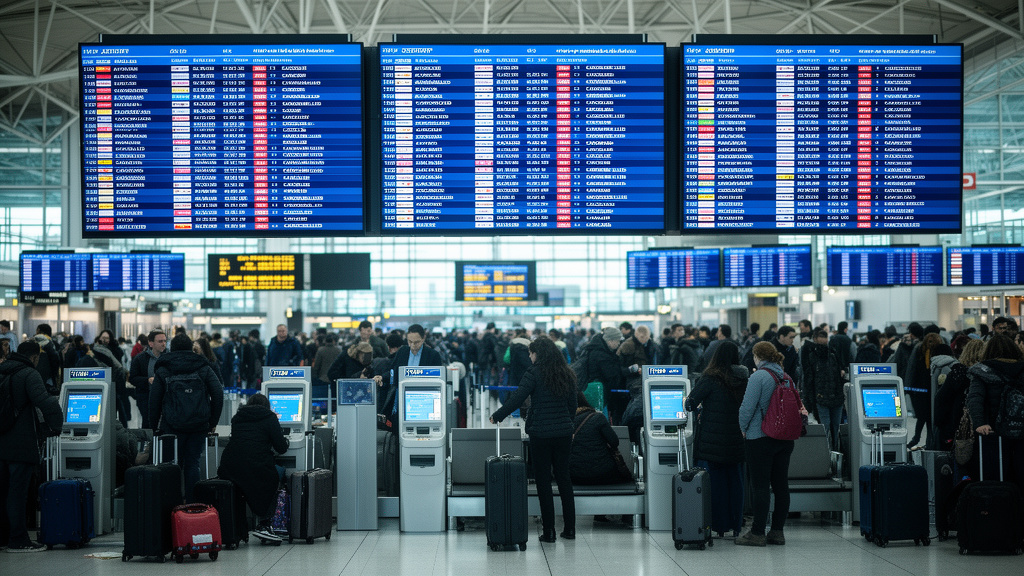
For major hubs like Heathrow and Gatwick, the aftermath of the September 8th incident created a scene of profound congestion. As terminals filled with stranded passengers, airlines struggled to communicate updates in real-time, often exacerbating traveler frustration. The logistical challenge was not merely limited to the day of the glitch; the ripple effect meant that planes were in the wrong locations, crews were exceeding their legal flying hours, and the scheduling matrix for the following 48 hours was effectively ruined.
Carriers had to employ rapid contingency planning, prioritizing long-haul flights while cancelling domestic and short-haul connections to minimize disruption. However, the sheer volume of cancellations—totaling over 1,000 flights—meant that for many travelers, the resolution process stretched into several days. Airline staff were placed under immense pressure to mitigate the chaos, often facing the brunt of passenger ire at check-in desks and gates, highlighting the human toll of large-scale technical failures.
Infrastructure Vulnerability: A Wake-Up Call
The September 8th incident serves as a stark reminder of the vulnerability of centralized infrastructure. In an era where air travel efficiency is predicated on highly automated, integrated systems, the NATS failure exposes the potential for singular points of failure to impact national security and economic stability. Experts within the aviation industry are now calling for a comprehensive audit of air traffic control redundancies.
There is a growing consensus that the UK must invest in more robust fail-safes. This involves not only upgrading software but also developing decentralized backup protocols that allow for graceful degradation rather than total system lockouts. As the aviation industry continues to rely on increasingly complex digital ecosystems, the September 8th glitch stands as a case study in the necessity of technological resilience. Ensuring that such a disruption does not repeat is now the primary objective for regulators, who are under intense pressure to justify the reliability of the current airspace management strategies to both the public and airline stakeholders.
FAQ: People Also Ask
1. What caused the September 8th flight cancellations in the UK?
The cancellations were caused by a technical failure in the National Air Traffic Services (NATS) flight planning system. This error forced a move to manual air traffic control, drastically reducing the number of flights that could be safely managed.
2. How many flights were affected by the NATS disruption?
Approximately 1,100 flights were cancelled across various UK airports on September 8th. The disruption caused secondary delays for thousands of other passengers throughout the following days as airlines worked to normalize their schedules.
3. Are passengers entitled to compensation for these cancellations?
While airlines are required to provide duty of care (food, water, accommodation) during the disruption, they may argue that a technical failure of air traffic control constitutes an ‘extraordinary circumstance,’ which could limit their liability for additional monetary compensation. Passengers should check individual airline policies and regulatory guidance for their specific rights.