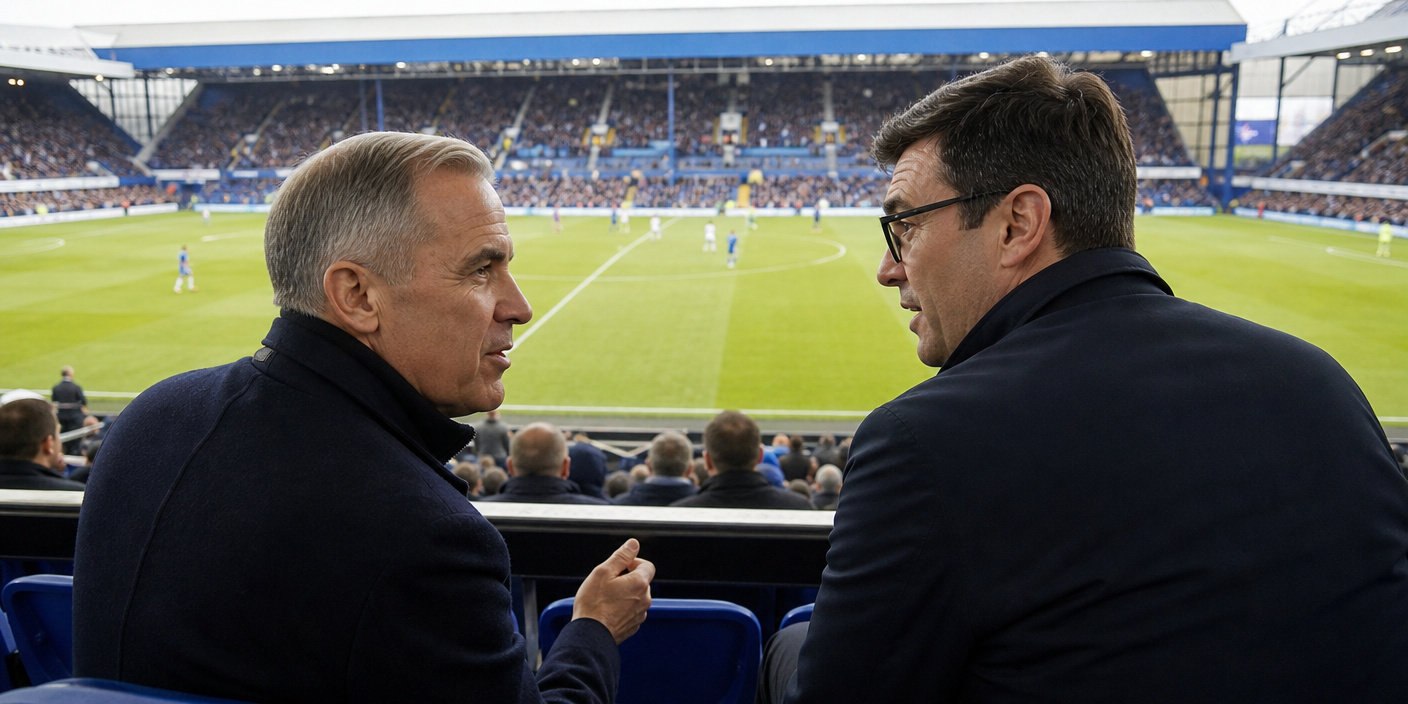
Canadian Prime Minister Mark Carney and British Prime Minister Andy Burnham held their first formal meeting while attending an Everton League Cup football match in Liverpool, marking a departure from traditional diplomatic summits. The meeting, which took place within the historic confines of Goodison Park, serves as a high-visibility signal of the priorities the new administrations intend to pursue, focusing on direct communication and community-centric policy making. By choosing a sporting venue rather than a government office, both leaders aimed to frame their collaborative era as one defined by accessibility and a break from the rigid protocols of the past.
Key Highlights
- Unconventional Diplomacy: The meeting took place at an Everton League Cup match, signaling a focus on informal, high-trust diplomacy over traditional ministerial summits.
- Strategic Alliance: Discussions centered on the burgeoning relationship between the Carney and Burnham administrations, prioritizing trade and industrial infrastructure.
- Symbolic Venue: The choice of Liverpool highlights a commitment to northern industrial hubs and community engagement in both nations.
- Future Cooperation: The leaders have committed to a series of policy reviews focused on trans-Atlantic economic stability and shared security interests.
Diplomacy in the Stands: A New Era of Trans-Atlantic Relations
The decision by Prime Minister Mark Carney and Prime Minister Andy Burnham to conduct their first formal meeting at an Everton football match in Liverpool is far more than a PR stunt; it is a calculated opening gambit in a new chapter of Canada-UK relations. Historically, initial meetings between heads of government are held behind closed doors, often in the sterile, high-security environments of government palaces or international summits. The choice of Goodison Park—a stadium deeply rooted in the industrial history of Merseyside—suggests a pivot toward “real-world” diplomacy.
Breaking the Protocol
For Prime Minister Carney and Prime Minister Burnham, the optics of the meeting at the Everton match serve a dual purpose. First, it humanizes the administration, presenting both leaders as accessible figures willing to engage with the populace. Second, it serves as a deliberate signal to the political establishment in both Ottawa and London that the “business as usual” approach to international relations is being retired.
By stepping outside the traditional office, the leaders are attempting to align their policy agendas with the tangible, daily concerns of their constituents. The Everton atmosphere, known for its intense passion and historical significance, provides a backdrop that emphasizes endurance and resilience—traits both leaders seemingly want to associate with their respective mandates. This “stadium diplomacy” is designed to foster a direct line of communication, cutting through the red tape of standard diplomatic channels to establish personal rapport early in their terms.
The Agenda Behind the Noise
While the setting was raucous, the substance of the meeting was notably serious. Behind the scenes of the League Cup spectacle, the discussions touched upon critical economic and infrastructural policy. The Carney and Burnham administrations are reportedly looking to capitalize on shared industrial challenges. Canada, with its vast natural resources and technological sectors, and Britain, with its focus on post-industrial renewal and renewable energy, find themselves at a crossroads where cooperation could yield significant bilateral benefits.
Sources suggest that the agenda included initial talks on a new framework for trade, specifically looking at supply chain resilience and green-tech investment. The two leaders explored the potential for a “Trans-Atlantic Corridor” of innovation, linking British research centers with Canadian manufacturing hubs. This meeting at the football match allowed them to establish the skeleton of these agreements before bringing in the wider diplomatic corps to finalize the details.
The Significance of Liverpool
Choosing Liverpool for this inaugural meeting is historically resonant. As a city that has undergone significant economic transformation, it serves as a perfect case study for the policies both Prime Minister Carney and Prime Minister Burnham are advocating. The city’s history of trade, its relationship with the Atlantic, and its recent focus on regeneration mirror the goals set forth by both leaders.
Furthermore, the sporting venue underscores the commitment to community. Both administrations have campaigned on platforms that prioritize grassroots economic growth. By attending a local football match rather than a corporate function, the leaders are signaling that their economic strategies will be built from the ground up, focusing on regional development rather than centralized, top-down approaches.
Analyzing the Political Strategy
The strategy of high-profile, low-formality engagement is risky but potentially rewarding. Critics might argue that such meetings lack the gravity of formal state visits, potentially undermining the seriousness of the political discourse. However, supporters of the Carney-Burnham approach argue that modern electorates are fatigued by traditional political theater. By opting for a more authentic, albeit unconventional, meeting space, the leaders are banking on the public’s desire for transparency and connection.
If the subsequent policies prove successful—particularly in areas like trade facilitation and infrastructure investment—this meeting at Goodison Park will likely be remembered not as an oddity, but as the moment a new, more dynamic style of diplomacy was born. The pressure is now on for the follow-up meetings to deliver the concrete results that the optics of this event have promised.
FAQ: People Also Ask
Q: Why did Prime Minister Carney and Prime Minister Burnham choose an Everton match for their meeting?
A: The choice of venue was symbolic, aiming to project a message of accessibility, community connection, and a break from traditional, rigid diplomatic protocols. It emphasizes a focus on real-world concerns rather than bureaucratic processes.
Q: What specific policies were discussed during the match?
A: While the full details are under wraps, discussions primarily focused on trans-Atlantic trade frameworks, supply chain resilience, and potential collaborations in green technology and industrial infrastructure.
Q: Does this meeting signal a long-term shift in Canada-UK diplomatic relations?
A: Yes, it marks the intent of both the Carney and Burnham administrations to prioritize direct, high-trust communication and a shift toward more grassroots-oriented economic policy, signaling a divergence from the standard diplomatic playbook.
Q: Will future meetings follow this pattern?
A: It is expected that both leaders will continue to utilize unconventional, high-visibility venues for their key engagements, though formal summits will remain a component of their overall diplomatic strategy.