
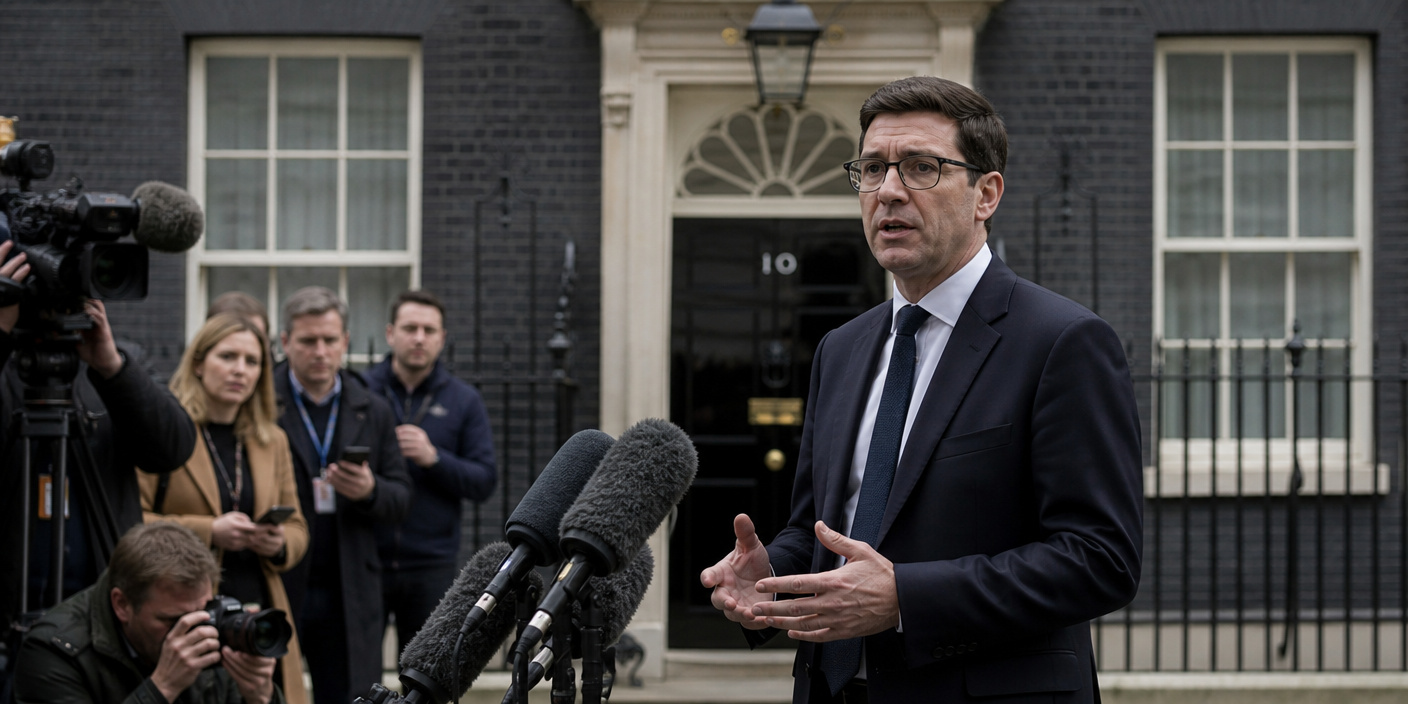
Prime Minister Andy Burnham has confirmed that the United Kingdom will immediately rework its sovereignty agreement regarding the Chagos Islands. This major diplomatic pivot comes in the wake of direct, public criticism from US President Donald Trump during their high-stakes encounter at the United Nations General Assembly. The Prime Minister’s decision signals a renewed prioritization of strategic security concerns regarding the Diego Garcia military base, which has long served as a cornerstone of Western power projection in the Indian Ocean.
Key Highlights
- Strategic Reversal: PM Andy Burnham has officially ordered the reopening of negotiations on the Chagos sovereignty transfer deal.
- US Pressure: President Donald Trump’s public criticism at the UN General Assembly cited security risks to the Diego Garcia military installation.
- Security Over Sovereignty: The reworked deal aims to provide ironclad guarantees for the United States’ continued, unimpeded access to the base.
- Diplomatic Tightrope: The UK now faces the complex challenge of balancing decolonization commitments to Mauritius with vital alliance obligations to the United States.
The Indian Ocean Sovereignty Crisis: A Strategic Pivot
The announcement from 10 Downing Street marks one of the most significant foreign policy shifts for the Burnham administration. The Chagos Islands, a remote archipelago in the Indian Ocean, have been the subject of decades of legal and diplomatic friction. The original agreement, intended to transfer sovereignty of the islands to Mauritius while maintaining a lease for the US-UK joint military facility on Diego Garcia, was widely viewed as a breakthrough solution to a colonial-era dispute. However, President Trump’s intervention at the UN General Assembly has effectively stalled the momentum of that transition, injecting a new level of volatility into the negotiations.
The Diego Garcia Factor
At the heart of the crisis is the military facility on Diego Garcia. This installation is not merely a regional outpost; it is a critical asset for the United States. Functioning as an airbase, a naval support facility, and a hub for satellite and intelligence gathering, the base allows the US to project power across the Indo-Pacific region, the Middle East, and East Africa.
President Trump’s critique, delivered with characteristic bluntness during the UN summit, focused on the potential legal and administrative complications that could arise under Mauritian sovereignty. From the US perspective, the risk of bureaucratic hurdles or shifts in local foreign policy stances—potentially influenced by other global powers with interests in the region—poses an unacceptable threat to the seamless operation of the base. For the UK, the pressure from Washington is clear: the “Special Relationship” requires that the security of this facility remains non-negotiable.
Diplomatic Ramifications and the ‘Rework’
For Prime Minister Burnham, the order to rework the deal is a delicate political maneuver. The UK is currently committed to an international process aimed at rectifying the historical injustice of the 1960s expulsion of the Chagos Islanders. To backtrack on this commitment would invite significant domestic and international criticism, particularly from the UN and the African Union, which have both consistently championed Mauritian sovereignty.
However, the Burnham administration appears to be betting that a reworked deal—one that perhaps offers more rigorous legal protections for the US lease, or establishes a more robust, long-term treaty structure—will satisfy Washington without completely abandoning the sovereignty transfer process. The diplomatic team is now tasked with drafting a “sovereignty-plus” model, which aims to reconcile the legal reality of Mauritian ownership with the ironclad security assurances demanded by the United States.
Historical Context: The Long Road to Dispute
The Chagos Islands have been a point of contention since the 1960s, when the UK severed the archipelago from Mauritius (then a British colony) to create the British Indian Ocean Territory (BIOT). The forced removal of the Chagossian population remains a stain on British foreign policy, and subsequent decades of legal challenges in international courts have consistently favored the argument for decolonization.
By engaging in this rework, the UK is attempting to bridge a gap between 21st-century values—which prioritize the right to self-determination and the correction of colonial wrongs—and 20th-century strategic realities, which prioritize military hegemony. This tension is not unique to the UK, but the Chagos Islands serve as the most acute example of the difficulty in reconciling the two.
Looking Ahead: Can a Consensus be Found?
The coming weeks will be crucial. Diplomatic channels between London, Washington, and Port Louis are expected to move into overdrive. The United States holds the leverage of the lease, while Mauritius holds the weight of international law and moral authority. The UK, caught in the middle, must now craft a solution that is palatable to all parties.
Analysts suggest that the reworked deal may include specific amendments to the treaty text that explicitly codify US base access for a minimum of 99 years, regardless of future sovereignty shifts, and possibly include a tripartite commission to oversee the administration of the base. Whether this will be sufficient to appease the concerns raised by President Trump remains to be seen, but the administration is clearly indicating that the security of the Indian Ocean, as viewed through the lens of the current US administration, is now the primary driver of the UK’s approach to the islands.
FAQ: People Also Ask
1. Why is the US so concerned about the Chagos Islands sovereignty?
The US concern stems from the military facility on Diego Garcia. The base is essential for power projection in the Indo-Pacific. Washington fears that transferring sovereignty to Mauritius could introduce legal or political uncertainty that might jeopardize their operational freedom at the base.
2. What does ‘reworking the deal’ actually mean in practice?
It implies the UK will introduce amendments or addendums to the existing sovereignty transfer framework. These changes will likely focus on strengthening the long-term, binding status of the US base lease, providing the US with additional guarantees that their presence cannot be disrupted by future changes in local government or international law.
3. Will the UK still proceed with the sovereignty transfer?
The Prime Minister has stated the government remains committed to the principle of the transfer, but the timeline and the final terms are now subject to the outcome of this “rework.” The core challenge is integrating US security requirements into a transfer agreement that is acceptable to the UN and international legal standards.