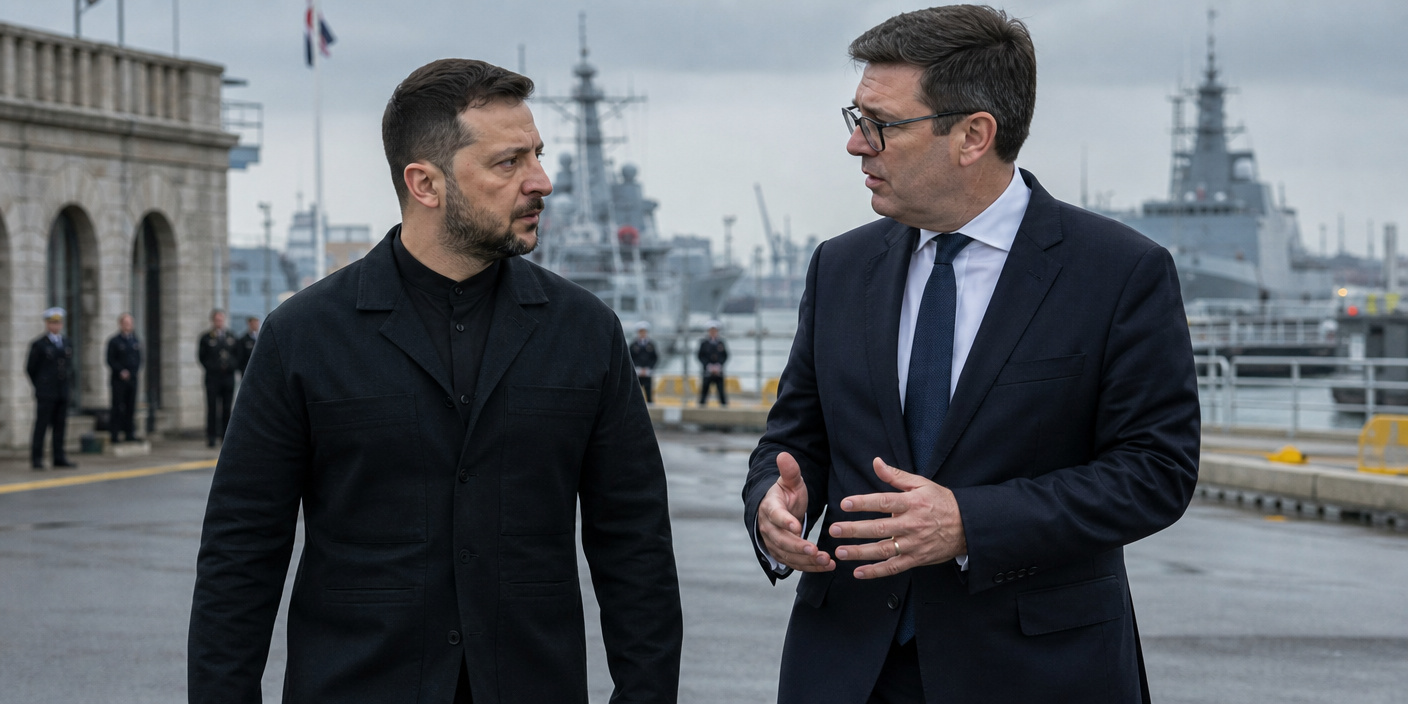
The Portsmouth Summit: A Strategic Alignment for Kyiv
The choice of Portsmouth Naval Base as the venue for this inaugural international summit was far from coincidental. As the historic home of the Royal Navy, Portsmouth represents the depth of British maritime heritage and military innovation. For Ukrainian President Volodymyr Zelenskyy and the new British Prime Minister, Andy Burnham, the location served as a symbolic staging ground for a revitalized defense strategy. The meeting signals an immediate pivot toward a more localized, industrialized approach to supporting Ukraine’s ongoing defensive war, focusing heavily on technological sovereignty and the urgent requirement for ballistic missile interception.
The Strategic Importance of Portsmouth
Portsmouth Naval Base is more than just a historical site; it is a center of modern naval excellence, housing state-of-the-art training facilities and logistics capabilities. By hosting Zelenskyy at this specific location, Prime Minister Burnham highlighted the UK’s continued commitment to training Ukrainian personnel in naval and aerial defense operations. The proximity to the English Channel and the base’s current infrastructure provide a stark reminder of the global nature of supply chains and the importance of secure maritime corridors. Analysts have pointed out that utilizing Portsmouth for high-level summits underscores the British government’s desire to keep the war effort grounded in tangible, actionable defense logistics rather than purely symbolic political posturing.
Scaling Drone Production: The New Anglo-Ukrainian Initiative
A centerpiece of the discussions was the proposed joint drone project. As the conflict in Ukraine has fundamentally shifted the nature of modern warfare toward an attrition-based, high-tech engagement, the demand for affordable, effective Unmanned Aerial Vehicles (UAVs) has skyrocketed. The proposed partnership aims to move beyond simple equipment donations, transitioning toward a collaborative manufacturing model. By leveraging British engineering expertise alongside Ukrainian frontline feedback, the alliance seeks to produce specialized reconnaissance and strike drones that are resilient against Russian electronic warfare (EW) countermeasures.
The partnership envisions a dual-track approach: establishing regional assembly centers that utilize modular drone components, and creating a joint R&D cell focused on AI-integrated targeting. This collaboration is designed to reduce the supply chain strain that often occurs when waiting for third-party deliveries, allowing Kyiv to scale its fleet significantly faster than current projections. The focus remains on speed, cost-efficiency, and the rapid deployment of combat-proven hardware.
Urgent Requirements: The Ballistic Missile Defense Crisis
While drone technology offers tactical flexibility, the immediate existential threat to Ukrainian infrastructure remains the barrage of ballistic missiles. During the Portsmouth summit, President Zelenskyy presented updated intelligence and logistics assessments regarding the urgent need for advanced ballistic missile interceptors. The discussion centered on integrating British-supplied guidance and radar technology with existing ground-based defense systems to create a layered protection “umbrella” over Kyiv and other critical urban centers.
Defense experts have emphasized that the current defense deficit is not merely a lack of interceptors, but a lack of technical integration. The Burnham-Zelenskyy meeting appears to have broken new ground in operationalizing the transfer of specialized radar components that improve the success rate of existing Soviet-era batteries, bridging the gap between legacy systems and modern interceptor missiles. This initiative is viewed as a bridge toward achieving long-term air superiority, or at the very least, denying the airspace to adversaries.
Diplomatic Signaling and Long-term Security
This meeting is equally significant for what it signals to the international community regarding British foreign policy under Prime Minister Burnham. By prioritizing Ukraine as the first international meeting on his agenda, Burnham has reinforced the bipartisan consensus within British politics that supporting Kyiv is a non-negotiable pillar of national security. The summit suggests a move toward “hard-power diplomacy,” where the focus shifts from vague promises of support to concrete manufacturing, delivery timelines, and technical capacity building.
Furthermore, the collaboration on missile defense technologies creates a deeper interoperability between NATO-standard systems and Ukrainian defense networks. This long-term integration is widely seen as a necessary precursor for any eventual postwar security guarantees. By deepening these institutional and technical ties, the UK and Ukraine are crafting a model for defense cooperation that could serve as a template for other European nations looking to modernize their own defensive architectures in the face of regional instability.
The logistical execution of these initiatives will be monitored closely. With the Portsmouth summit concluded, the establishment of a joint ministerial working group is expected to follow within weeks, tasked with the oversight of drone supply chains and the rapid procurement of interceptor radar modules. For the Burnham administration, the success of these initiatives will likely define the early months of his tenure as he attempts to balance domestic policy with the intense requirements of a high-stakes, international theater.