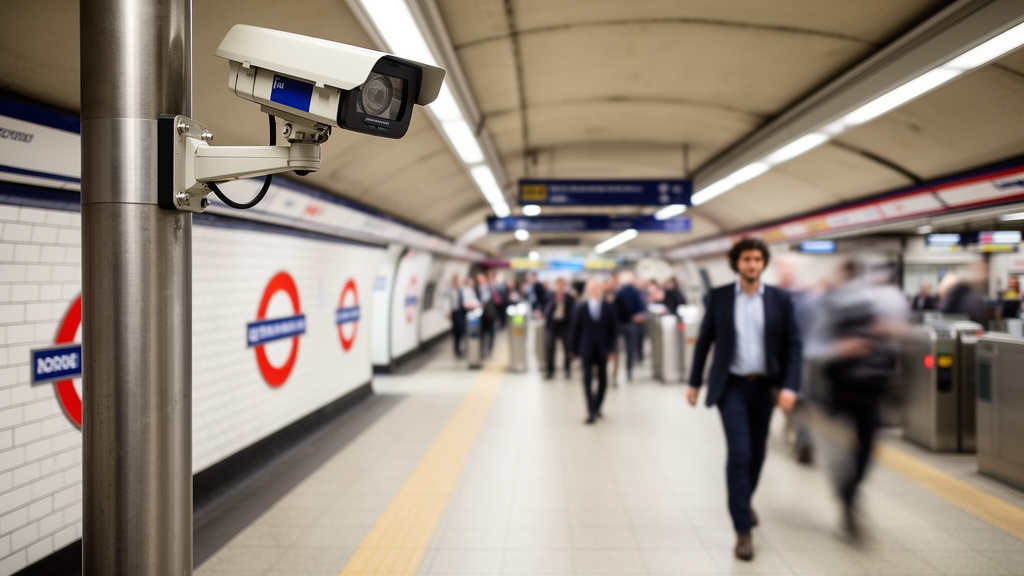
Transport for London (TfL), working in close coordination with the Metropolitan Police Service, has commenced the deployment of live facial recognition (LFR) cameras at strategic London Underground stations. This initiative marks a significant escalation in urban transit security, designed specifically to identify and intercept individuals currently sought by law enforcement on active watchlists. By integrating real-time biometric analysis into existing surveillance infrastructure, authorities aim to address the persistent challenges of serious crime within the subterranean network, with a particular focus on perpetrators of sexual offenses and knife-related violence.
The Operational Scope of TfL’s Surveillance
The implementation of LFR technology on the London Underground represents a technological evolution of the transit network’s existing CCTV capabilities. TfL maintains one of the most comprehensive video surveillance systems in the world, with thousands of cameras monitoring platforms, ticket halls, and corridors. However, traditional CCTV remains reactive, requiring manual monitoring or retrospective investigation. The introduction of LFR transitions this infrastructure into a proactive security asset.
Under the current operational guidelines, the LFR system processes live video feeds and compares facial biometric templates against specific ‘watchlists’ curated by the Metropolitan Police. These lists are not exhaustive databases of the general public; rather, they are targeted lists of individuals identified as high-risk or wanted for severe criminal acts. The system is calibrated to trigger an alert only when a positive match occurs between a passenger’s biometric data and a person of interest on the police database.
Targeting High-Harm Offenders
The primary driver for this technological intervention is the prioritisation of public safety concerning ‘high-harm’ offenders. Police data consistently highlights that sexual offenses and knife crime are areas of significant operational pressure for the Metropolitan Police. By placing detection tools at transit hubs—which serve as the primary arteries of city movement—authorities intend to interrupt the mobility of offenders who might otherwise evade detection.
Law enforcement officials have emphasized that the watchlists are restricted to individuals for whom there is an active warrant or an urgent intelligence requirement. This focused approach is intended to mitigate civil liberty concerns, ensuring that the technology acts as a scalpel rather than a dragnet. The efficacy of this deployment relies on the accuracy of the algorithm and the speed at which police officers can be deployed to intercept a matched individual, effectively shortening the gap between detection and apprehension.
Data Integrity and Privacy Protocols
Perhaps the most contentious aspect of the deployment concerns data privacy and the handling of biometric information. In response to concerns raised by privacy advocates and the Information Commissioner’s Office (ICO), TfL and the Metropolitan Police have instituted strict ‘data-purge’ protocols.
Central to this policy is the immediate deletion of non-matching data. When a member of the public passes an LFR camera, their biometric ‘template’ is generated, compared against the watchlist, and—provided there is no match—instantly discarded from the system. This ‘delete-on-failure’ mechanism is designed to comply with the Data Protection Act 2018 and the UK GDPR, ensuring that the system does not create a permanent database of commuter movements. For the system to be legally and ethically sustainable, the authorities must demonstrate that this process is automated, audited, and strictly confined to the defined security objectives.
The Balancing Act: Security vs. Civil Liberties
The deployment has not been without its detractors. Organizations such as Big Brother Watch have long argued that live facial recognition represents a significant intrusion into the right to anonymity in public spaces. The core of the debate centers on the concept of ‘chilling effect’—the idea that the knowledge of being constantly scanned and analyzed may alter public behavior, even among law-abiding citizens.
However, supporters of the technology, including senior figures within the Metropolitan Police, argue that the societal harm caused by the targeted offenses outweighs the theoretical intrusion of the tech. They point to the high density of the London Underground as a unique environment where anonymity has historically allowed serious offenders to move through the city with relative impunity. By utilizing LFR, the police argue they are regaining a necessary advantage in an increasingly complex urban security environment.
Future Implications and Technological Maturity
As this deployment scales, its success will likely be measured by more than just arrest statistics. The long-term viability of LFR on the Tube will depend on public trust, accuracy rates, and the transparency of the oversight mechanisms in place. If the system proves effective at reducing high-harm crimes without significant technical errors or privacy breaches, it could pave the way for wider integration across other UK transit networks.
Conversely, any high-profile false positives—where innocent individuals are incorrectly identified and subsequently detained—could trigger a legal and public relations crisis. The technology’s evolution is being closely monitored by legal scholars and the ICO, who are tasked with ensuring that this powerful surveillance tool remains within the boundaries of the law. As London continues to integrate smart technology into its infrastructure, the Tube remains the testing ground for the future of urban policing.
FAQ: People Also Ask
1. Does the facial recognition system store my face data if I am not a criminal?
No. According to the operational protocols established by TfL and the Metropolitan Police, biometric templates of individuals who do not match the police watchlist are deleted immediately. The system is designed to discard non-matching data in real-time.
2. Which crimes are being prioritized by the LFR deployment?
The deployment specifically targets ‘high-harm’ offenders. This includes individuals wanted for serious sexual offenses and those involved in knife crime. The watchlists are generated based on active police intelligence and warrants.
3. Is this a permanent, system-wide rollout?
It is being deployed at specific, strategic London Underground stations. While this is an active, ongoing deployment, it is not currently blanket-covering every square inch of the entire network simultaneously. The strategy involves focusing on key transit hubs to maximize the potential for identifying persons of interest.
4. Who regulates the use of this technology?
The deployment is subject to UK data protection laws, including the Data Protection Act 2018. It is also under the purview of the Information Commissioner’s Office (ICO), which oversees privacy compliance, and adheres to guidelines set by the Biometrics and Surveillance Camera Commissioner.