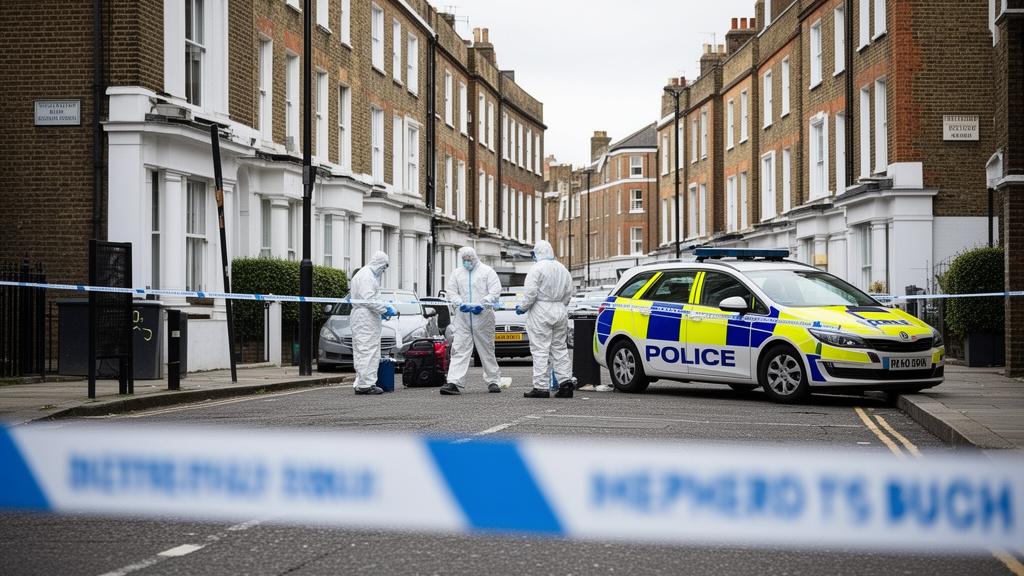
The Metropolitan Police have initiated a formal murder investigation following a tragic incident in Shepherd’s Bush that resulted in the death of a woman by stabbing. Authorities confirmed that a male suspect has been detained and is currently being held in police custody on suspicion of murder. The incident has sent shockwaves through the local West London community, prompting a heavy police presence and a wide-reaching forensic sweep of the surrounding area.
Key Highlights
- Formal Murder Probe: The Metropolitan Police have officially launched a murder investigation into the fatal stabbing of a woman in Shepherd’s Bush.
- Suspect in Custody: A male suspect has been apprehended by officers and remains in police custody on suspicion of murder.
- Ongoing Investigation: Crime scene cordons have been established as forensic teams continue to gather evidence.
- Public Appeal: Police are actively seeking information from potential witnesses who may have been in the vicinity during the time of the incident.
Unfolding the Investigation: Protocols and Procedural Rigor
When a major crime of this nature occurs, the Metropolitan Police operate under a strictly defined set of operational protocols designed to ensure the integrity of the evidence and the swift administration of justice. The immediate declaration of a murder investigation signals that senior detectives from the Homicide and Major Crime Command have taken carriage of the inquiry, tasked with building a robust case that will eventually be presented to the Crown Prosecution Service (CPS).
Forensic Preservation and Scene Management
The most critical phase in the early hours of this investigation involves the total preservation of the crime scene. In Shepherd’s Bush, this has necessitated the installation of extensive police cordons, restricting access to the public. These physical barriers are not merely to control crowds but to protect the integrity of forensic evidence—a process known as “scene preservation.” Forensic officers, often seen in protective suits, meticulously scan the perimeter for trace evidence, including DNA samples, fingerprints, and electronic evidence. Every square meter of the location is cataloged. In urban environments like Shepherd’s Bush, this also extends to the retrieval of CCTV footage from local businesses and residential doorbell cameras, which have become vital tools for modern investigators. The goal is to construct a continuous timeline of events leading up to and immediately following the incident.
The Legal Framework of Custody
With a male suspect already in custody, the legal clock is ticking. Under the Police and Criminal Evidence Act 1984 (PACE) in the United Kingdom, the police are afforded a specific window of time to hold a suspect before they must either charge, release on bail, or release under investigation. During this time, the suspect will undergo rigorous interviews conducted by specialist detectives. These interviews are recorded, and the suspect is provided with legal representation. The focus of these interrogations is to cross-reference the suspect’s statement with the burgeoning timeline gathered from forensic evidence and witness testimony. If the evidence mounts, the police will liaise with the Crown Prosecution Service to determine if there is a realistic prospect of conviction, which is the legal threshold required to charge an individual with murder.
Community Impact and Public Safety
Beyond the procedural mechanics, a stabbing in a residential and commercial hub like Shepherd’s Bush deeply affects community morale. The visible presence of police vehicles and tape serves as a stark reminder of the realities of violent crime in London. Local community engagement teams are typically deployed alongside investigative units to provide reassurance and, crucially, to gather “soft intelligence” from residents who may have seen or heard something significant but have not yet come forward. In cases like this, the “primary witness” concept is paramount; even small, seemingly insignificant details—a person running, a vehicle speeding away, or an unusual disturbance—can prove to be the linchpin in a murder trial. The police are currently appealing to anyone with dashcam footage or CCTV to come forward, emphasizing that even non-traditional video evidence can be pivotal in reconstructing the fatal sequence of events.
Secondary Angles: Examining the Context
1. The Role of Forensic Science in Homicide: The sophistication of DNA recovery and blood-spatter analysis has revolutionized how the Met approaches stabbing cases. Unlike historical investigations, the modern era relies on a “digital footprint” that follows the forensic trace, making it exponentially harder for suspects to obscure their presence at a crime scene.
2. Hammersmith and Fulham Crime Trends: Statistically, investigating how this event fits into the broader crime patterns of the borough provides essential context. Analyzing whether the incident was isolated or part of a wider trend helps policymakers and law enforcement allocate resources, such as increased patrols or targeted community intervention programs.
3. The Psychological Toll of Violent Crime: Beyond the tragedy of the victim, there is the secondary impact on the first responders and the local neighborhood. Understanding the long-term community recovery process is vital for mental health advocacy groups operating within the Shepherd’s Bush area.
FAQ: People Also Ask
Q: What is the current status of the suspect?
A: The suspect is currently in police custody, where they are being questioned by detectives. The police are not seeking any other suspects at this time, though the investigation remains ongoing.
Q: How can members of the public assist in this investigation?
A: The Metropolitan Police are urging anyone with information, CCTV, doorbell footage, or dashcam recordings from the vicinity of the incident to contact the investigation team immediately via the non-emergency number or the Crimestoppers anonymous reporting line.
Q: How long will the police cordon remain in place?
A: The cordon will remain in place as long as forensic examination teams require access to the scene to secure evidence. This is a standard procedure and the site will be released once detectives are satisfied that all relevant material has been recovered.
Q: Will the police release the name of the victim or the suspect?
A: Police procedure dictates that identities are typically only released once next-of-kin have been fully informed and, in the case of the suspect, once a formal charge has been brought by the Crown Prosecution Service.