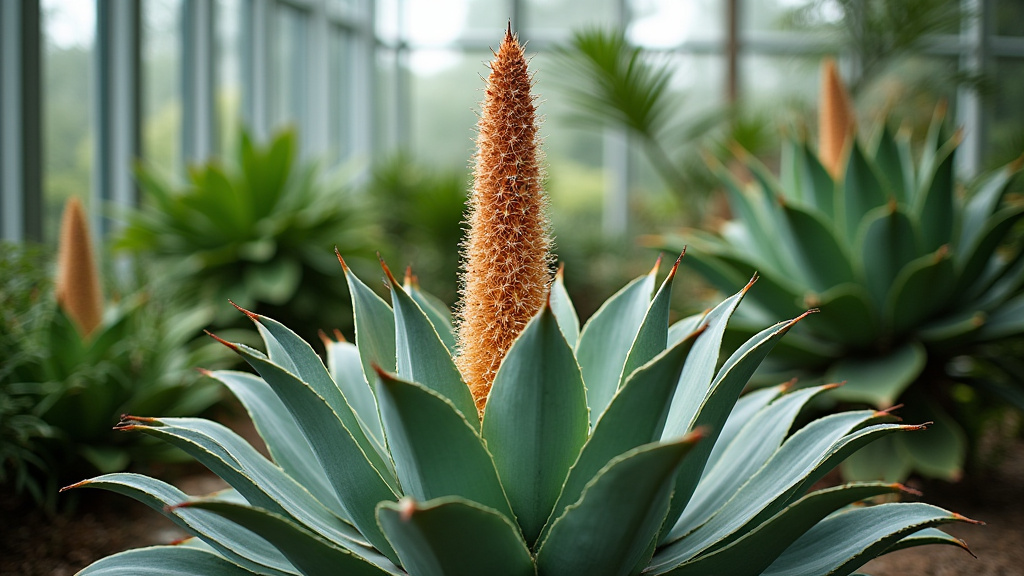
At the Royal Botanic Gardens, Kew, a natural phenomenon is commanding the attention of botanists and casual observers alike. A 20-year-old Agave montana, colloquially known as the ‘Mountain Agave,’ has entered its final, dramatic stage of life, initiating a ‘death bloom’ that will see the plant push a monumental flowering spike into the air before it inevitably expires. Growing at a startling rate of up to 10cm per day, this fleeting cultural moment offers Londoners a rare opportunity to witness one of nature’s most poignant expressions of semelparity.
Key Highlights
- Terminal Flowering: The Agave montana is undergoing a ‘death bloom,’ a biological process where the plant uses all its stored energy to produce a massive flower spike, leading to its death.
- Rapid Growth: Observation teams have clocked the central stalk increasing in height by 10cm every 24 hours, making daily visits a different experience for guests.
- Two Decades in the Making: This specific specimen has been nurtured within the Kew collection for 20 years, marking the climax of a two-decade-long maturation process.
- Public Spectacle: The event has transformed the Princess of Wales Conservatory into a site of pilgrimage for those eager to document the fleeting beauty of this terminal event.
The Biology of the Terminal Bloom
The phenomenon occurring at Kew is scientifically categorized as semelparity. Unlike perennial plants that may flower annually or intermittently throughout their lifespans, the Agave montana functions on a ‘big bang’ reproductive strategy. After years of accumulating resources, sugars, and energy within its thick, waxy, rosette-forming leaves, the plant directs the entirety of its physiological reserves into the production of a towering inflorescence.
This is not merely a flower; it is a structural marvel. The spike, which can reach impressive heights, serves as the singular vehicle for the plant’s genetic legacy. By investing every ounce of life force into this bloom, the plant seeks to attract pollinators across a wider range, ensuring the survival of the next generation. For the observers at Kew, the bloom serves as a humbling reminder of nature’s efficiency—the plant does not ‘die’ in the traditional sense of failure, but rather completes its biological purpose.
The Princess of Wales Conservatory Stage
The setting for this event is as critical as the plant itself. Housed within the Princess of Wales Conservatory, the Agave is shielded from the unpredictable London climate, yet it exists in a space designed to mimic its native high-altitude environment. The glass structure, with its sophisticated environmental controls, allows visitors to get closer to the bloom than would be possible in the wild.
This creates a unique intersection of 19th-century botanical architecture and 21st-century conservation science. The conservatory, which spans ten distinct climate zones, acts as a living laboratory. Curator teams at Kew have been monitoring the specific hormone shifts in the Agave, anticipating the bloom for months, but the visible ‘spike’ phase—the rapid 10cm-per-day growth spurt—remains an awe-inspiring visual for the public.
The Cultural Psychology of Impermanence
Why does the ‘death bloom’ capture the public imagination so effectively? It taps into a rare, shared cultural experience of witnessing a definitive ending. In a world of digital persistence and ‘always-on’ media, the ephemeral nature of the Agave montana provides a stark, physical contrast.
This event is being framed not just as a botanical exhibit, but as a cultural spectacle. The rarity of the event—occurring only once in a lifetime for this specific specimen—creates a ‘fear of missing out’ (FOMO) that drives attendance. It turns a static botanical garden into a dynamic, time-sensitive venue, much like a concert or a theatre performance, where the show is truly over once the curtain falls.
Secondary Angles: Conservation, Climate, and Taxonomy
Beyond the spectacle, the Kew bloom provides an invaluable dataset for researchers studying Agave genetics. As climate patterns shift globally, understanding how these high-altitude plants react to varied conservatory conditions offers insights into potential resilience strategies for the species in the wild. Furthermore, the ‘death bloom’ event serves as a platform for public education regarding botanical taxonomy. Visitors are learning that not all plants adhere to the same growth cycles, fostering a deeper appreciation for the diversity of plant life found within the temperate and arid regions of the planet.
There is also the historical perspective: Kew has been collecting and studying these specimens for generations. This 20-year-old individual is part of a broader lineage of research that informs how we protect rare flora from the pressures of habitat loss. The attention it garners is, ultimately, a win for botanical science, proving that public engagement with nature is the first step toward environmental advocacy.
FAQ: People Also Ask
Why does the plant die after blooming?
Semelparity is an evolutionary trade-off. The plant effectively ‘cashes out’ its entire life savings of nutrients and energy to produce a massive flower spike. Once it has achieved pollination, it has no biological ‘budget’ left to continue life, and it withers to provide nutrients to the soil for its offspring.
How tall will the spike get?
While 10cm a day is the growth rate, the final height of an Agave montana inflorescence can vary depending on the plant’s health and environmental variables. Historically, these can reach several meters, often dwarfing the plant itself and necessitating specific conservatory modifications to accommodate the height.
Is this the only Agave blooming?
While Kew holds a significant collection of arid plants, the ‘death bloom’ of an older, established specimen like this one is an irregular, stochastic event. It is a singular, isolated occurrence for this specific individual plant, which makes it a ‘once-in-a-lifetime’ viewing opportunity for the public.